Preparing for Next FATF Evaluation – UAE Roadmap
Introduction
The Financial Action Task Force (FATF) plays a central role in setting global standards for combating money laundering (ML), terrorist financing (TF), and proliferation financing (PF). For the UAE, which has made significant progress in strengthening its Anti-Money Laundering and Counter-Terrorist Financing (AML/CFT) framework in recent years, preparing for the next FATF mutual evaluation is a critical priority.
Businesses operating in the UAE—especially financial institutions and Designated Non-Financial Businesses and Professions (DNFBPs)—must understand their role in this process. A strong national evaluation outcome not only boosts international credibility but also ensures smoother business and investment flows.
________________________________________
Understanding FATF Evaluations
FATF mutual evaluations assess two key aspects:
1. Technical Compliance – Alignment of laws, regulations, and frameworks with FATF recommendations.
2. Effectiveness – How well those laws and regulations are implemented in practice across both government and private sectors.
A poor evaluation may result in increased monitoring or grey-listing, which impacts global confidence. Conversely, a positive evaluation strengthens the UAE’s position as a global financial hub.
________________________________________
The UAE’s Progress So Far
The UAE has already taken major steps to enhance AML/CFT compliance, including:
• Strengthened AML Legislation – Federal Decree-Law No. 20 of 2018 and Cabinet Decisions No. 10/2019 and 109/2023.
• Regulatory Oversight – Enhanced supervision by the Central Bank, Ministry of Economy, and free-zone regulators (DIFC, ADGM, DMCC, etc.).
• Adoption of goAML Portal – For STR/STR filings.
• Increased Awareness & Training – Ongoing AML education for DNFBPs and professionals.
• Enforcement – Penalties and fines for non-compliance to drive accountability.
________________________________________
Roadmap for the Next FATF Evaluation
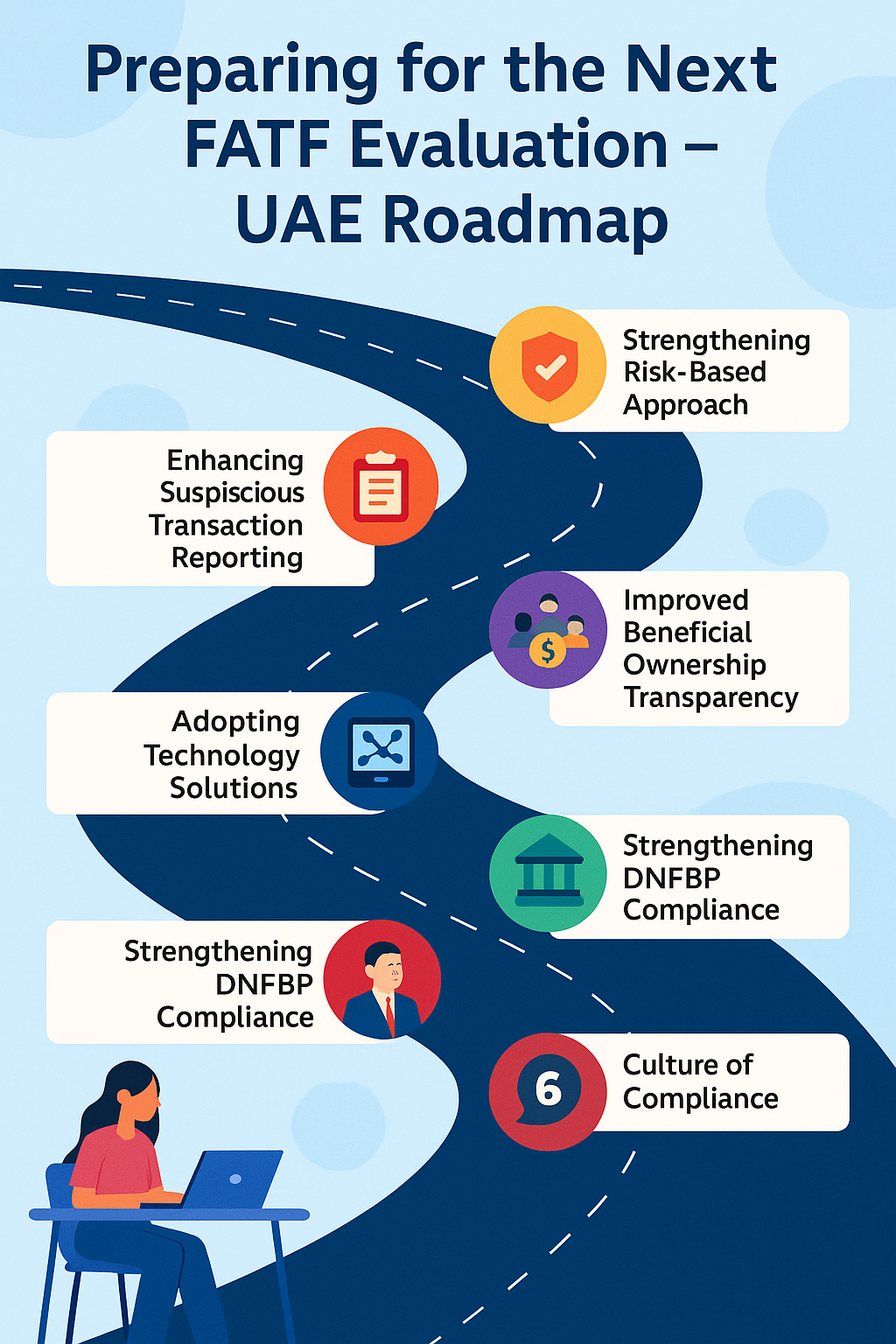
1. Strengthening Risk-Based Approach (RBA)
Businesses must adopt robust risk assessments tailored to their sector, size, and geography. Regulators will evaluate how institutions identify and mitigate risks, rather than simply applying generic policies.
2. Enhancing Suspicious Transaction Reporting (STRs)
The FATF emphasizes effective reporting. Entities should:
• Ensure staff are trained to recognize red flags.
• Submit timely and well-documented STRs via goAML.
• Maintain clear internal escalation procedures.
3. Improved Beneficial Ownership Transparency
The UAE has tightened rules on Ultimate Beneficial Owners (UBOs). Businesses must ensure UBO registers are up to date and accessible to regulators.
4. Adopting Technology Solutions
FATF evaluators increasingly expect technology-enabled compliance. Businesses should leverage:
• Transaction monitoring software.
• Sanctions screening tools.
• Digital identity verification systems.
5. Strengthening DNFBP Compliance
The FATF will closely examine sectors like gold trading, real estate, legal, and corporate services. DNFBPs must demonstrate strong AML frameworks, including:
• Customer due diligence (CDD).
• Record-keeping.
• Independent audits and MLRO appointments.
6. Cross-Border Cooperation
The UAE’s position as a trade hub means cross-border transactions are critical. Businesses must ensure compliance with both local regulations and international AML obligations.
7. Culture of Compliance
Beyond policies and systems, FATF evaluators look at tone from the top. Boards and senior management must actively oversee AML compliance and allocate resources accordingly.
________________________________________
What Businesses Should Do Now
• Conduct internal AML audits ahead of the evaluation.
• Review and update policies and procedures to align with the latest laws.
• Train staff at all levels—frontline employees, compliance officers, and executives.
• Test reporting workflows to ensure efficiency in filing STRs.
• Maintain documentation and evidence to demonstrate compliance efforts.
________________________________________
Conclusion
The next FATF evaluation is not just a test for regulators—it is a national effort involving both the public and private sectors. By adopting risk-based approaches, leveraging technology, and fostering a culture of compliance, UAE businesses can help secure a strong evaluation outcome. This, in turn, will reinforce the UAE’s reputation as a trusted and globally connected financial hub.
________________________________________
About Us
At Sheikh Anwar Accounting and Auditing LLC, we guide businesses in preparing for FATF evaluations through AML audits, compliance training, risk assessments, and regulatory advisory services. Our expertise ensures that your business not only meets regulatory expectations but also contributes to the UAE’s vision of being a global leader in AML/CFT compliance.
📩 Email: info@sa-auditors.com
🌐 Website: www.sa-auditors.com