Predictive Analytics for AML Risk Detection
Introduction
The global financial ecosystem is facing a new generation of money laundering threats — faster, smarter, and more complex than ever before. Traditional rule-based Anti-Money Laundering (AML) systems, while effective in identifying known red flags, often fail to detect emerging typologies or hidden behavioural patterns.
To close this gap, compliance teams are increasingly adopting Predictive Analytics, a branch of Artificial Intelligence (AI) that anticipates suspicious activity before it occurs. By analysing historical transaction data, customer behaviour, and typology patterns, predictive models empower organizations to detect and prevent financial crime with unmatched precision.
________________________________________
1. What Is Predictive Analytics in AML?
Predictive analytics applies advanced statistical models and machine learning algorithms to forecast potential money laundering risks based on historical and real-time data.
Unlike traditional monitoring, which reacts to transactions after they happen, predictive analytics enables proactive risk detection — identifying high-risk customers, transactions, or entities before suspicious activity takes place.
Key Technologies Used:
• Machine Learning (ML) — Supervised and unsupervised models for anomaly detection.
• Artificial Neural Networks (ANNs) — To identify non-linear relationships across multiple variables.
• Natural Language Processing (NLP) — For adverse media and narrative analysis in STRs.
• Graph Analytics — To reveal hidden networks of related entities or accounts.
________________________________________
2. Limitations of Traditional AML Systems
Traditional AML systems depend on static, rule-based thresholds (e.g., transactions above AED 100,000 or multiple cash deposits in 24 hours). While these detect basic patterns, they:
• Generate high volumes of false positives (often 90%+ of alerts).
• Fail to detect novel typologies or “smurfing” structures.
• Lack contextual understanding (why a transaction occurred).
• Require constant manual rule tuning by compliance analysts.
Predictive analytics overcomes these constraints by learning from past cases and continuously adapting to new risk signals.
________________________________________
3. How Predictive Analytics Strengthens AML Risk Detection
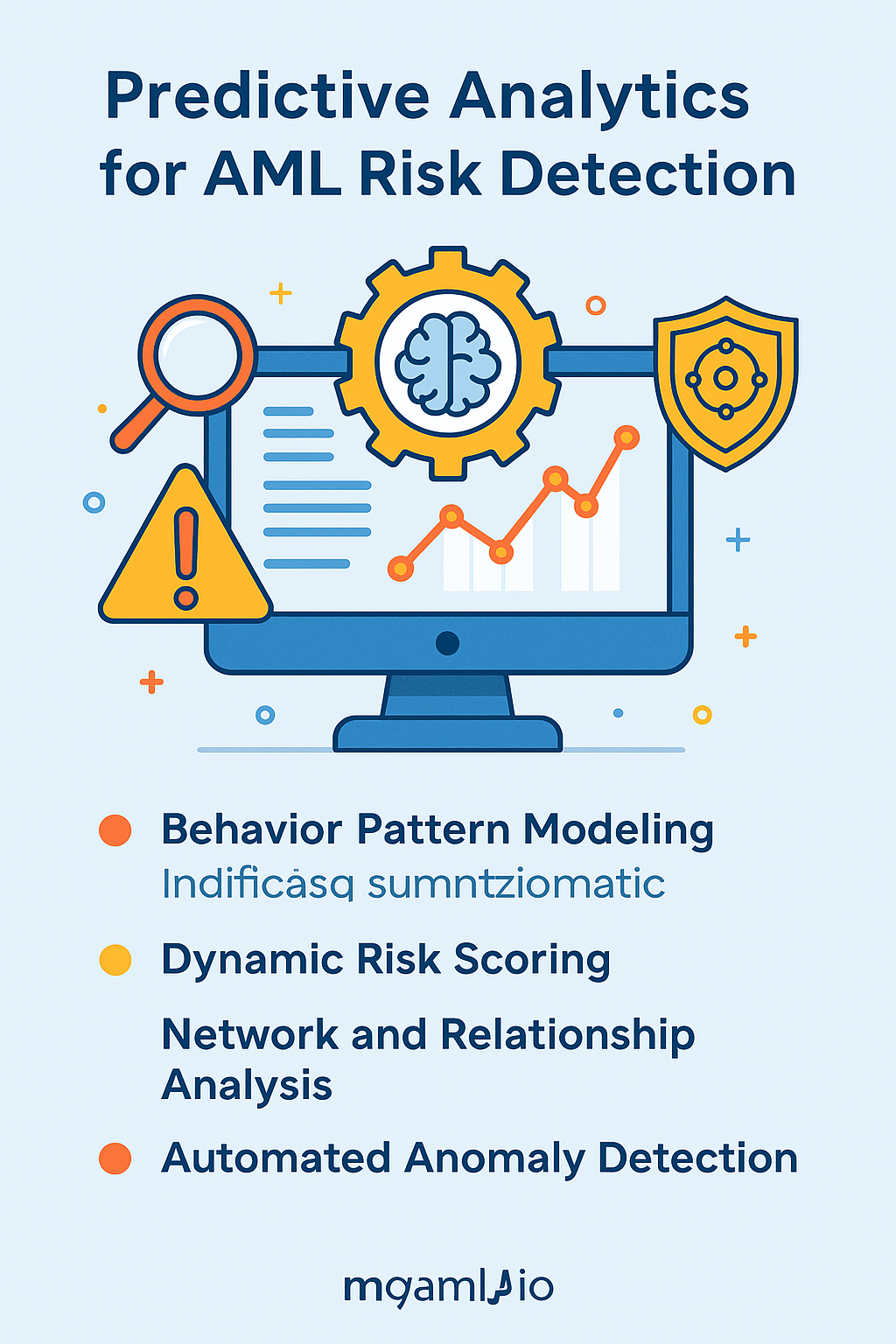
A. Behavior Pattern Modeling
AI models learn normal customer behavior over time — transaction frequency, destinations, counterparties, and channels — to identify deviations that suggest laundering or layering.
Example: A customer typically sending AED 5,000 weekly suddenly begins sending AED 50,000 to high-risk jurisdictions. Predictive models instantly flag the anomaly with confidence scoring.
________________________________________
B. Dynamic Risk Scoring
Instead of static “Low/Medium/High” labels, predictive models assign probabilistic risk scores that evolve with each new data point.
This allows for real-time recalibration of customer risk profiles as behaviors change.
________________________________________
C. Network and Relationship Analysis
Money launderers rarely act alone. Predictive systems use graph analytics to detect networks of linked accounts, companies, or individuals — revealing hidden connections behind complex transactions.
Example: A network of small businesses transacting with the same offshore entity under different names is flagged as a coordinated laundering ring.
________________________________________
D. Suspicious Typology Prediction
Predictive systems can be trained on historical STR/SAR data to anticipate typologies such as:
• Circular trading
• Rapid layering through crypto-to-fiat channels
• Real-estate overvaluation
• Trade-based money laundering (TBML)
As typologies evolve, models retrain using feedback from compliance outcomes.
________________________________________
E. Automated Anomaly Detection
AI continuously scans millions of data points to identify outliers without manual thresholds — such as unusual transaction velocity, fund flow paths, or inconsistent KYC data — minimizing human bias.
________________________________________
4. Core Components of an AML Predictive Analytics Framework
Component Purpose
Data Lake Unified repository combining KYC, transaction, and behavioral data.
Feature Engineering Converts raw data into predictive variables (transaction frequency, country risk, etc.).
Machine Learning Models Logistic regression, decision trees, random forests, and neural networks.
Model Validation Independent testing, precision-recall measurement, and backtesting.
Alert Prioritization Engine Ranks alerts based on probability and materiality.
Feedback Loop Incorporates analyst outcomes to retrain models and reduce false positives.
________________________________________
5. Benefits of Predictive Analytics in AML
• Reduced False Positives: Intelligent alert prioritization lowers review workload.
• Early Risk Identification: Detects potential laundering before large exposure occurs.
• Adaptive Intelligence: Models learn from new patterns automatically.
• Regulatory Compliance: Enhances effectiveness per FATF’s “Risk-Based Approach.”
• Operational Efficiency: Frees compliance officers from repetitive manual reviews.
________________________________________
6. Integration with AML Frameworks
Predictive analytics seamlessly integrates with existing AML tools and workflows:
• KYC/CDD Modules: Real-time risk scoring updates upon data refresh.
• Transaction Monitoring Systems: Predictive triggers complement rule-based alerts.
• goAML Reporting: Automated STR generation enriched with predictive indicators.
• Case Management Systems: Risk heatmaps and investigation workflows improve prioritization.
________________________________________
7. Real-World Use Cases
Banking Sector
Predictive models identify synthetic identity fraud and micro-structuring across digital banking channels.
Virtual Asset Service Providers (VASPs)
Machine learning detects crypto mixer activity, cross-chain transfers, and suspicious token swaps before regulatory reporting thresholds are breached.
Jewellery & Precious Metals Dealers (DNFBPs)
Predictive analytics correlates purchase patterns, payment methods, and client profiles to flag potential laundering through high-value transactions.
________________________________________
8. Regulatory Expectations and UAE Perspective
The UAE’s AML framework encourages the adoption of advanced analytics under:
• Federal Decree-Law No. 20 of 2018 (AML/CFT Law)
• Cabinet Decision No. 10 of 2019 (Risk-Based AML Implementation)
• Cabinet Decision No. 109 of 2023 (Virtual Assets Regulation)
Regulators such as the Ministry of Economy, CBUAE, FSRA (ADGM), DFSA (DIFC), and VARA promote data-driven compliance models for DNFBPs and financial institutions.
Predictive analytics tools align perfectly with the UAE’s shift toward AI-enabled RegTech ecosystems for enhanced financial integrity.
________________________________________
9. Challenges and Best Practices
Challenges:
• Data Quality Issues: Inconsistent or incomplete data reduces model accuracy.
• Model Explainability: Regulators require interpretable results for decision accountability.
• Integration Complexity: Requires alignment between IT, compliance, and risk teams.
• Privacy & Data Protection: Must comply with UAE Federal Data Protection Law (No. 45 of 2021).
Best Practices:
• Maintain transparent model governance and version control.
• Perform periodic backtesting and independent validation.
• Use explainable AI (XAI) techniques for regulator confidence.
• Ensure human-in-the-loop oversight for all automated alerts.
________________________________________
10. Future Outlook
By 2026, predictive AML analytics will become the global compliance standard, integrated with:
• Federated learning models for data privacy across institutions.
• Generative AI assistants that explain model outputs in natural language.
• Unified risk intelligence platforms combining sanctions, UBO, and transaction data.
Early adopters will not only reduce financial crime exposure but also demonstrate regulatory maturity and technological leadership.
________________________________________
11. Conclusion
Predictive analytics is redefining AML risk detection from a reactive to a proactive, intelligence-driven process.
For UAE-based entities — especially DNFBPs, financial institutions, and VASPs — the integration of predictive analytics represents both a compliance advantage and a strategic investment in long-term resilience.
By leveraging AI, data, and human expertise, organizations can safeguard their operations, protect their reputations, and lead the future of financial compliance.
________________________________________
About Sheikh Anwar Accounting & Auditing LLC
Sheikh Anwar Accounting & Auditing LLC (SA Auditors) is a registered UAE auditing firm (MOE Entry No. 5817) providing AML compliance, outsourced MLRO services, audits, and corporate tax advisory.
Through our compliance technology platform MyAML.io, we deliver AI-driven AML analytics, predictive monitoring, and regulatory reporting solutions for financial institutions and DNFBPs.
📍 Office Address: M-35, Dubai Creek Tower, Dubai, U.A.E.
📞 Phone: +971 4 250 1084
✉️ Email: info@sa-auditors.com
🌐 Websites: www.sa-auditors.com | www.myaml.io