Overview of Federal Decree-Law No. 20 of 2018 (AML Law)
Introduction
In an increasingly globalized financial environment, combating money laundering (ML) and terrorism financing (TF) is a top priority for regulators. To align with international standards set by the Financial Action Task Force (FATF), the United Arab Emirates (UAE) introduced Federal Decree-Law No. 20 of 2018 on Anti-Money Laundering (AML) and Combating the Financing of Terrorism (CFT).
This landmark legislation significantly strengthened the UAE’s legal framework, ensuring greater transparency, robust compliance requirements, and stronger penalties for violators.
________________________________________
Purpose of the Law
Federal Decree-Law No. 20 of 2018 aims to:
• Establish a comprehensive framework to detect and deter ML and TF.
• Align UAE regulations with FATF’s 40 Recommendations.
• Protect the integrity of the UAE’s financial and trade systems.
• Enhance the country’s global reputation as a safe and transparent hub for investment and commerce.
________________________________________
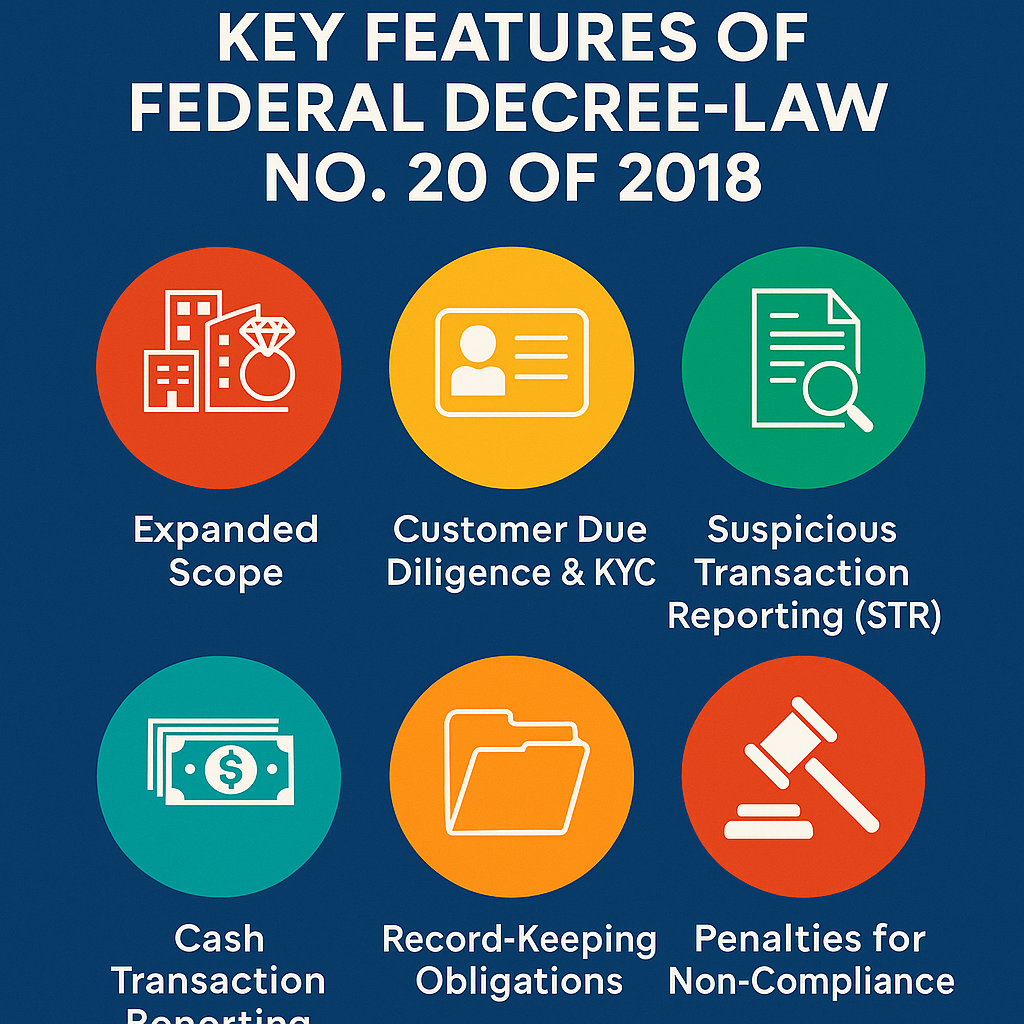
Key Features of Federal Decree-Law No. 20 of 2018
1. Expanded Scope of Application
The law applies not only to financial institutions (FIs) but also to Designated Non-Financial Businesses and Professions (DNFBPs) such as:
• Real estate brokers and developers.
• Dealers in precious metals and stones (DPMS).
• Auditors and accountants.
• Corporate service providers.
• Lawyers and notaries when engaging in financial transactions.
2. Customer Due Diligence (CDD) & KYC
Businesses must:
• Verify customer identity and Ultimate Beneficial Owners (UBOs).
• Apply Enhanced Due Diligence (EDD) for high-risk customers, including politically exposed persons (PEPs).
• Maintain accurate and updated client records.
3. Suspicious Transaction Reporting (STRs)
Entities must file Suspicious Transaction Reports with the UAE Financial Intelligence Unit (FIU) via the goAML platform whenever unusual or suspicious activity is detected.
4. Cash Transaction Reporting (CTRs)
Mandatory reporting of cash transactions above AED 55,000, particularly in high-risk sectors like real estate and gold trading.
5. Record-Keeping Obligations
Businesses must retain client and transaction records for at least five years, ensuring proper documentation for regulatory reviews.
6. Supervisory Authorities
The law empowers multiple regulators to oversee compliance, including:
• Central Bank of the UAE (CBUAE)
• Ministry of Economy (MoE)
• Securities and Commodities Authority (SCA)
• Dubai Financial Services Authority (DFSA) and FSRA (ADGM) for free zones
7. Penalties for Non-Compliance
Non-compliance can result in:
• Fines from AED 50,000 to AED 5,000,000.
• License suspension or revocation.
• Criminal liability, including imprisonment for willful violations.
________________________________________
Impact on UAE Businesses
• Greater Accountability: Businesses must establish internal AML frameworks, appoint compliance officers, and adopt a risk-based approach.
• International Credibility: Aligning with FATF standards improved the UAE’s reputation and helped secure its removal from the FATF Grey List in 2024.
• Operational Challenges: SMEs and startups face higher compliance costs, but failure to comply poses even greater financial and reputational risks.
________________________________________
The Way Forward
Federal Decree-Law No. 20 of 2018 is not static—it has been supported by further Cabinet Decisions (e.g., No. 10 of 2019 and No. 111 of 2022) and continuous regulatory updates. As financial crime methods evolve, the UAE is expected to strengthen its AML/CTF frameworks with AI-driven monitoring, cryptocurrency regulation, and enhanced DNFBP oversight.
________________________________________
Conclusion
Federal Decree-Law No. 20 of 2018 laid the foundation for a robust and internationally aligned AML regime in the UAE. By applying strict due diligence, reporting obligations, and penalties, the law ensures businesses operate transparently while safeguarding the UAE’s financial integrity.
For companies in both financial and non-financial sectors, compliance with this law is not only a legal requirement but also a business necessity for building trust, avoiding penalties, and contributing to the UAE’s global reputation.
________________________________________
About Sheikh Anwar Accounting and Auditing LLC
At Sheikh Anwar Accounting and Auditing LLC, we specialize in helping businesses comply with Federal Decree-Law No. 20 of 2018 and related AML regulations. Our services include:
• AML risk assessments and policy drafting.
• STR/CTR filing support via goAML.
• UBO compliance assistance.
• Outsourced MLRO and compliance officer services.
• Training and awareness programs for staff.
• 📍 Head Office: Dubai, UAE
• 🌐 Website: www.sa-auditors.com
• 📧 Email: info@sa-auditors.com