Outsourcing AML Functions – Pros and Cons
Introduction
With the growing complexity of Anti-Money Laundering (AML) compliance requirements in the UAE, many businesses—especially Designated Non-Financial Businesses and Professions (DNFBPs) such as jewellers, real estate brokers, lawyers, and accountants—are considering outsourcing AML functions to specialized service providers.
Under Federal Decree-Law No. 20 of 2018, Cabinet Decision No. 10 of 2019, and the supervisory requirements of the Ministry of Economy and free zone regulators, businesses must establish effective AML frameworks. However, building and maintaining these in-house can be resource-intensive. Outsourcing provides an alternative, but it comes with both advantages and challenges.
________________________________________
1. What Does Outsourcing AML Mean?
Outsourcing AML involves delegating certain compliance functions to external experts or firms that specialize in AML advisory and monitoring. This can include:
• Customer Due Diligence (CDD) and Enhanced Due Diligence (EDD).
• Sanctions and PEP screening.
• Transaction monitoring and reporting through goAML.
• Risk assessments and compliance program reviews.
• Staff training and awareness programs.
• Appointment of external MLROs (Money Laundering Reporting Officers) in some cases.
While ultimate responsibility remains with the business, outsourcing can significantly reduce the operational burden.
________________________________________
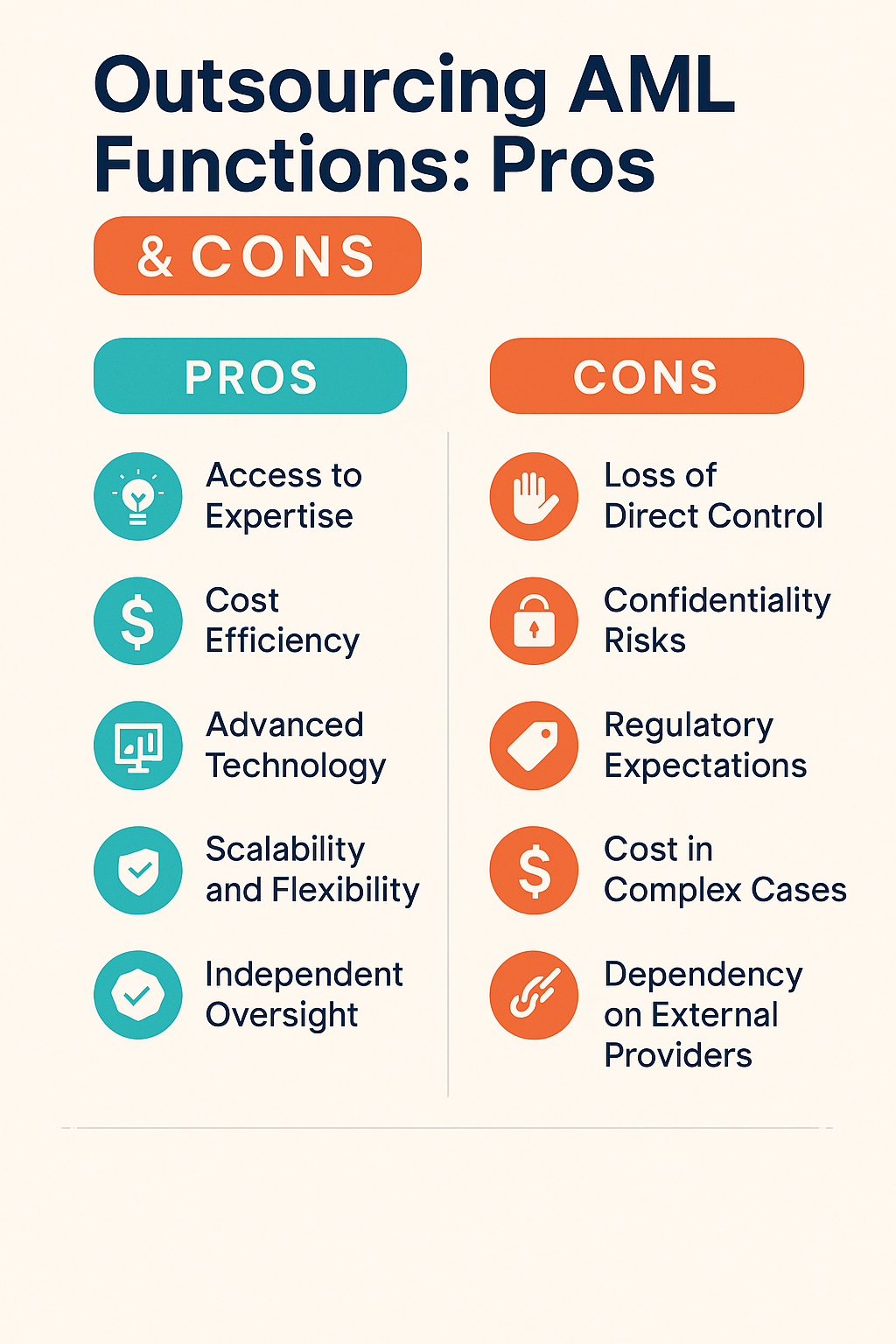
2. Pros of Outsourcing AML Functions
a) Access to Expertise
• External firms specialize in AML regulations and FATF standards.
• They stay updated with evolving UAE laws, ensuring compliance is always aligned with the latest requirements.
b) Cost Efficiency
• Avoids the high cost of hiring, training, and retaining a full in-house compliance team.
• Suitable for small to medium-sized businesses with limited budgets.
c) Advanced Technology
• Many AML service providers use RegTech solutions, such as AI-driven transaction monitoring and real-time sanctions screening.
• Businesses gain access to these tools without heavy investment.
d) Scalability and Flexibility
• Outsourcing allows businesses to scale compliance support based on growth, new markets, or changing risk levels.
e) Independent Oversight
• External professionals can provide unbiased reviews of compliance processes.
• Helps identify weaknesses that internal staff may overlook.
________________________________________
3. Cons of Outsourcing AML Functions
a) Loss of Direct Control
• Outsourcing can create a gap between day-to-day operations and compliance monitoring.
• Management may lose visibility into critical AML decisions.
b) Confidentiality Risks
• Sharing sensitive customer and transaction data with third parties increases the risk of data privacy breaches.
• Businesses must ensure compliance with UAE Federal Decree-Law No. 45 of 2021 on Data Protection.
c) Regulatory Expectations
• Regulators in the UAE emphasize that responsibility for compliance cannot be outsourced.
• Even if an external provider manages AML functions, the business remains accountable for breaches.
d) Cost in Complex Cases
• For larger businesses with high transaction volumes, outsourcing may become more expensive than building in-house compliance capacity.
e) Dependency on External Providers
• Over-reliance on outsourcing can reduce internal compliance awareness and skills.
• Staff may become disengaged from AML responsibilities.
________________________________________
4. When Outsourcing Works Best
Outsourcing AML functions can be most effective when:
• The business is small to medium-sized and lacks specialized compliance staff.
• The organization operates in a high-risk sector (e.g., jewellery, real estate) and requires advanced monitoring systems.
• The firm is newly established and needs immediate compliance support to meet regulatory deadlines.
• The management seeks independent reviews and audits of AML frameworks.
________________________________________
5. Best Practices for Outsourcing AML
• Conduct Due Diligence on Providers: Choose firms with proven expertise in UAE AML laws and FATF standards.
• Define Clear Roles: Clearly outline which functions are outsourced and which remain in-house.
• Maintain Oversight: Assign a senior manager internally to liaise with the outsourcing partner.
• Ensure Data Protection: Sign confidentiality agreements and verify compliance with UAE data privacy laws.
• Regular Reviews: Periodically review the performance of outsourcing partners to ensure compliance standards are met.
________________________________________
Conclusion
Outsourcing AML functions can provide businesses with access to specialized expertise, advanced technology, and cost savings. However, it also presents challenges such as reduced control, confidentiality risks, and the fact that regulatory accountability always remains with the business itself.
The decision to outsource should be based on a careful assessment of the organization’s size, risk profile, and available resources. A hybrid model—where key functions are kept in-house while specialized tasks are outsourced—may provide the most balanced approach for many DNFBPs in the UAE.
________________________________________
About Us
Sheikh Anwar Accounting and Auditing LLC is a Dubai-based auditing and compliance advisory firm specializing in AML frameworks, outsourced MLRO services, corporate tax, VAT, and transfer pricing. We support DNFBPs and financial institutions in strengthening compliance systems—whether in-house or outsourced—to meet UAE regulatory standards and FATF expectations.
📍 Address: Dubai Creek Tower, M 35, Dubai, UAE
📞 Contact: info@sa-auditors.com | +971-XXX-XXXX
🌐 Website: www.sa-auditors.com