OECD Guidelines and UAE Alignment
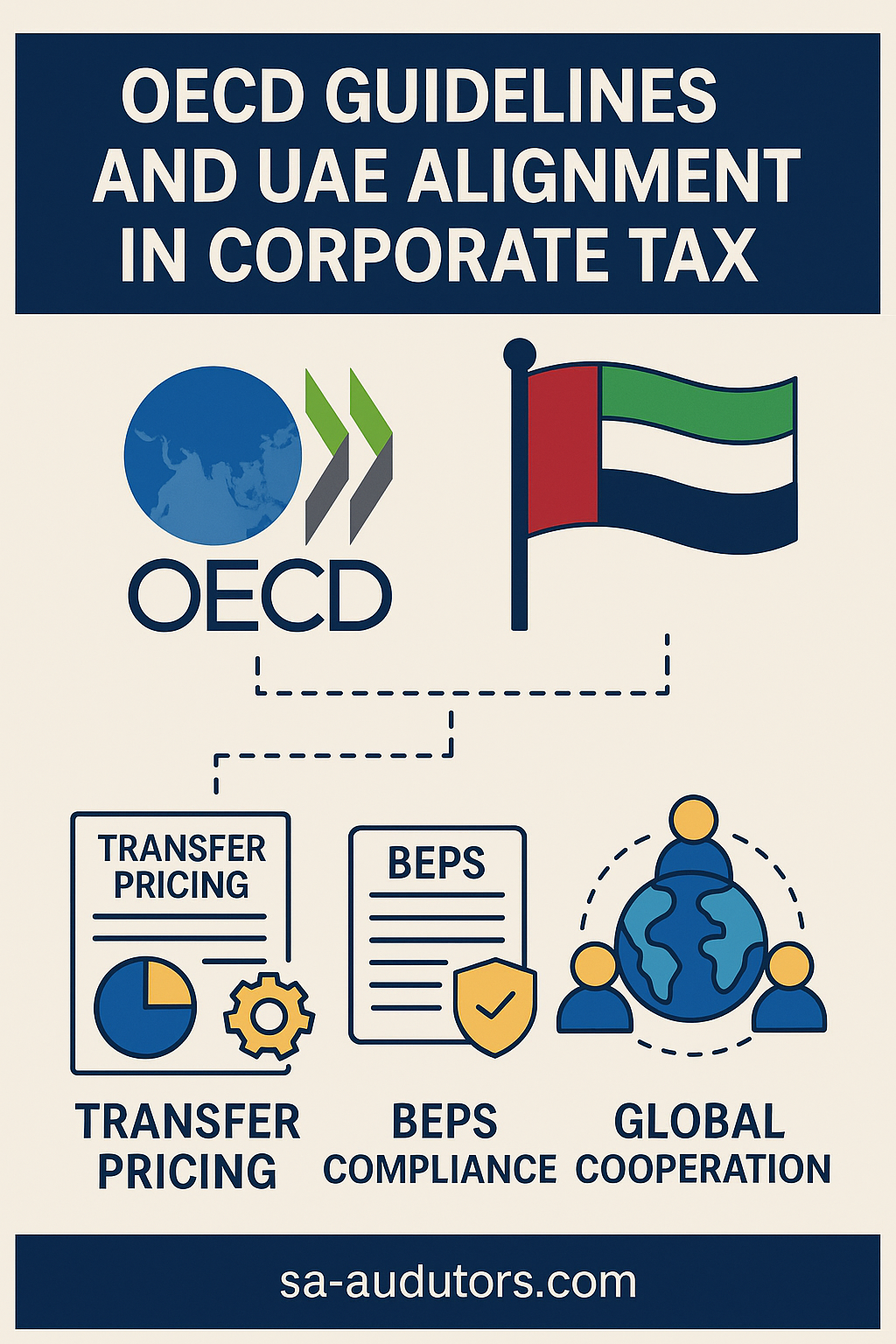
Introduction
The United Arab Emirates (UAE) has positioned itself as a global business hub by creating a transparent, modern, and competitive tax system. With the introduction of Federal Decree-Law No. 47 of 2022 on Corporate Tax, the UAE has explicitly aligned its corporate tax framework with international best practices, particularly the OECD (Organisation for Economic Co-operation and Development) Guidelines.
This alignment ensures that the UAE maintains its reputation as a responsible, cooperative jurisdiction, supports global initiatives against tax evasion, and provides clarity for multinational companies operating within its borders.
1. What are OECD Guidelines?
The OECD Guidelines refer to a set of international tax standards, primarily around:
Transfer Pricing – ensuring transactions between related parties are conducted at arm’s length.
Base Erosion and Profit Shifting (BEPS) Project – preventing artificial shifting of profits to low-tax jurisdictions.
Transparency & Reporting – promoting exchange of information between tax authorities.
Fair Tax Competition – discouraging harmful tax practices.
The OECD Transfer Pricing Guidelines (2022 edition) are the foundation for how countries design and enforce related-party transaction rules globally.
2. Why the UAE Adopted OECD Alignment
The UAE joined the OECD Inclusive Framework on BEPS in 2018, committing to implement minimum standards of tax transparency. This alignment was driven by:
The need to comply with global tax standards to avoid being blacklisted by the EU or OECD.
The UAE’s ambition to strengthen its position as a global financial and investment hub.
Ensuring multinational enterprises (MNEs) operating in the UAE follow the same rules as in other jurisdictions.
Supporting the UAE’s economic diversification strategy by creating a level playing field.
3. Key Areas of UAE Alignment with OECD Guidelines
a) Transfer Pricing Rules
The UAE Corporate Tax Law incorporates Arm’s Length Principle based on OECD TP Guidelines.
Acceptable methods: CUP, Resale Price, Cost Plus, TNMM, and Profit Split.
Requirement for TP Disclosure Forms, Local File, and Master File where thresholds apply.
b) BEPS Compliance
Implementation of Country-by-Country Reporting (CbCR) for MNEs with consolidated revenue ≥ AED 3.15 billion.
Measures to prevent profit shifting via thin capitalization and interest limitation rules.
Rules against artificial arrangements lacking economic substance.
c) Substance & Transparency Requirements
Economic Substance Regulations (ESR) introduced in 2019, aligned with OECD BEPS Action 5.
Mandatory Tax Registration and reporting obligations to the FTA.
Requirement to maintain and submit financial records for 7 years.
d) Double Tax Treaty Network
UAE has signed over 140 Double Tax Treaties, many aligned with OECD’s Model Tax Convention.
Provides relief on withholding taxes, eliminating double taxation.
4. Impact on Multinational Companies (MNEs)
For global businesses operating in the UAE, OECD alignment means:
Consistency: UAE tax rules mirror those in OECD countries.
Clarity: Reduced risk of double taxation disputes.
Compliance Burden: Requirement to prepare TP documentation, CbCR reports, and Local/Master Files.
Reduced Tax Arbitrage: Companies cannot exploit loopholes for profit shifting.
5. Benefits for the UAE Economy
Strengthens the UAE’s position as a trustworthy jurisdiction for global investors.
Encourages foreign direct investment (FDI) due to predictable tax rules.
Enhances international cooperation and exchange of information.
Supports the UAE’s move towards a knowledge-based, diversified economy.
6. Challenges for Businesses
Increased compliance costs for documentation and reporting.
Need for transfer pricing benchmarking studies.
Complexity in structuring cross-border transactions.
Requirement for advanced ERP and tax technology integration.
Conclusion
By aligning with the OECD Guidelines, the UAE has created a transparent, globally recognized corporate tax framework. While this increases compliance requirements for businesses, it enhances the UAE’s reputation as a fair and responsible tax jurisdiction.
For companies, the key to success lies in embracing Transfer Pricing compliance, meeting BEPS standards, and leveraging double tax treaties to ensure efficiency. The UAE’s approach demonstrates its commitment to being a global financial hub built on compliance, cooperation, and competitiveness.
✍️ By Sheikh Anwar Accounting and Auditing LLC (SA-Auditors)
📍 Dubai, United Arab Emirates
🌐 www.sa-auditors.com
| ✉️ info@sa-auditors.com