Must-Have Details in a Tax Invoice
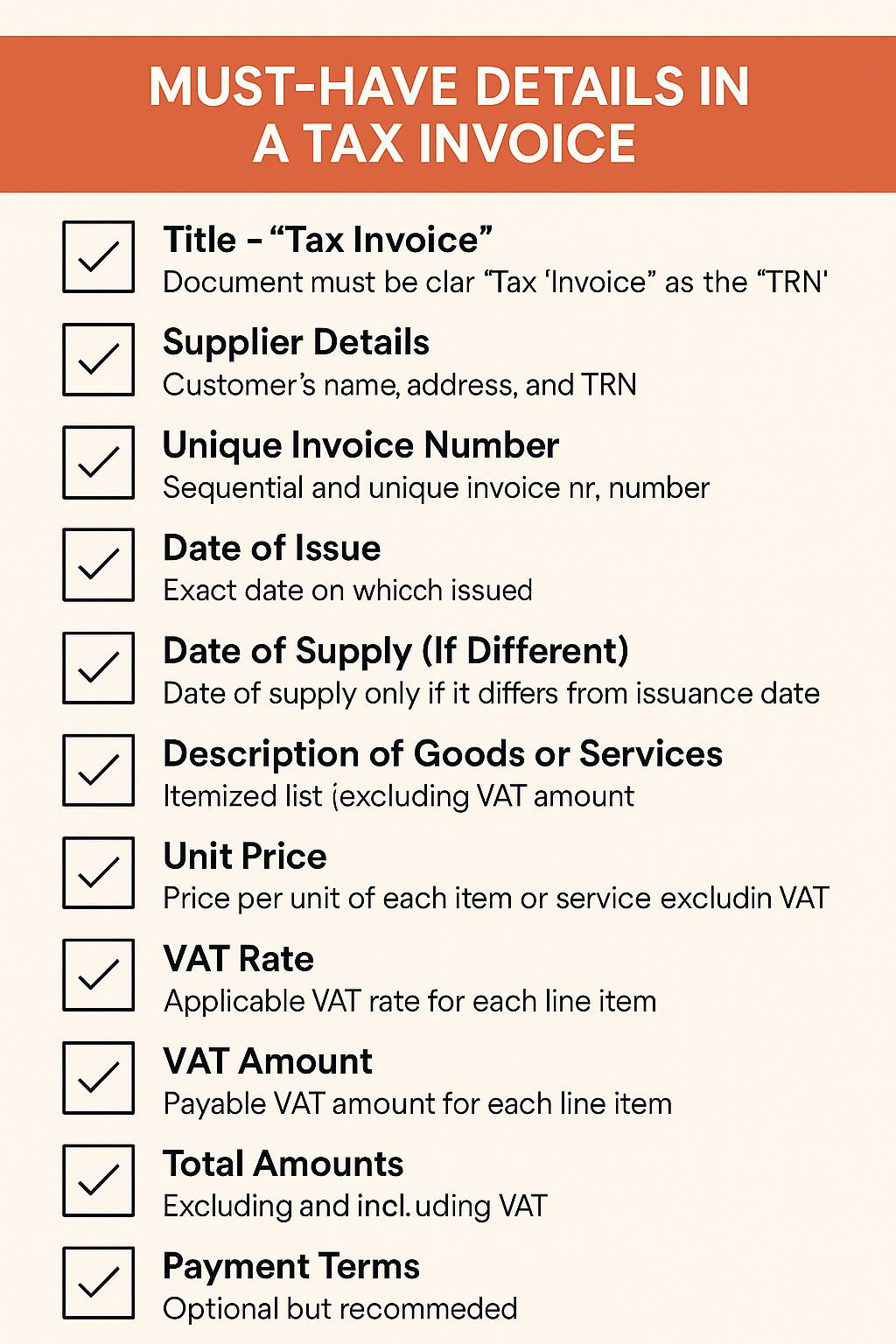
Must-Have Details in a Tax Invoice Under UAE VAT Law
If your business is registered for VAT in the UAE, issuing a valid Tax Invoice is not just a formality—it’s a legal obligation. A tax invoice is the key document that enables your customers to claim input VAT and demonstrates your compliance with the Federal Tax Authority (FTA).
Issuing tax invoices with missing or incorrect information can result in penalties, disallowed VAT claims, and audit risks. In this blog, we outline the mandatory details that every tax invoice must include under UAE VAT regulations.
________________________________________
🧾 What is a Tax Invoice?
A Tax Invoice is a document issued by a VAT-registered supplier when making a taxable supply of goods or services. It must be provided to the customer and retained for five years (or more for certain sectors like real estate).
________________________________________
✅ When is a Tax Invoice Required?
A VAT-registered business must issue a tax invoice when:
• Selling taxable goods or services
• Receiving an advance payment
• Making a supply to another VAT-registered entity
• Providing intra-GCC or export supplies
________________________________________
📋 Must-Have Details in a Full Tax Invoice
As per Article 59 of the Executive Regulations under UAE VAT Law, the following fields are mandatory in a full tax invoice:
1. Title – “Tax Invoice”
The document must be clearly labeled as a “Tax Invoice” at the top.
2. Supplier Details
• Legal name of the supplier
• Physical address
• TRN (Tax Registration Number)
3. Customer Details
• Customer’s name
• Customer’s address
• Customer’s TRN (if VAT-registered)
4. Unique Invoice Number
Every tax invoice must have a sequential and unique identification number.
5. Date of Issue
The date when the invoice is created and issued.
6. Date of Supply (if different)
If the supply date is different from the invoice date, it must be mentioned.
7. Description of Goods or Services
• Clear description of each item or service
• Quantity or volume (for goods)
8. Unit Price and Discount (if any)
The net amount before VAT, and any discounts applied should be mentioned clearly.
9. VAT Rate
The applicable VAT rate for each line item (typically 5% in the UAE).
10. VAT Amount
The amount of VAT charged per line item and in total.
11. Total Amounts
• Total amount excluding VAT
• Total VAT amount
• Total payable amount including VAT
12. Payment Terms (optional but recommended)
Include due date, method of payment, or any other terms to facilitate timely payments.
________________________________________
🧾 Sample Invoice Format (Simplified Example)
Item Qty Unit Price VAT Rate VAT Amount Total (Incl. VAT)
Product A 2 AED 500 5% AED 50 AED 1,050
________________________________________
⚠️ What Happens If You Miss Any of These Details?
• The FTA may reject VAT claims based on incomplete invoices
• You may face penalties during audits or inspections
• Your clients may refuse to accept the invoice
• Delays in payment and tax filing
________________________________________
💡 Best Practices for Tax Invoicing
• Use accounting software that’s VAT-compliant
• Cross-verify TRNs using the FTA TRN verification tool
• Avoid manual invoices to minimize errors
• Always keep digital and physical copies for at least 5 years
________________________________________
✅ Conclusion
Issuing a complete and correct tax invoice ensures that your business remains compliant with UAE VAT laws and builds trust with your customers. By following the FTA’s guidelines, you avoid penalties and ensure smooth operations.
Need help setting up tax invoice templates or automating your VAT documentation? Contact Sheikh Anwar Accounting & Auditing LLC for expert VAT solutions tailored to your business.
________________________________________
📞 Reach Out to Us
📧 Email: info@sa-auditors.com
🌐 Website: www.sa-auditors.com