Ministry of Economy’s AML Inspections on DNFBPs
Introduction
The United Arab Emirates (UAE) has become a leading global hub for trade, finance, and investment. Alongside this growth, the government has prioritized protecting its financial system from money laundering (ML) and terrorist financing (TF). To ensure compliance with Federal Decree-Law No. 20 of 2018, Cabinet Decision No. 10 of 2019, and other AML/CTF regulations, the Ministry of Economy (MOE) conducts periodic inspections of Designated Non-Financial Businesses and Professions (DNFBPs).
For DNFBPs—including real estate brokers, dealers in precious metals and stones, lawyers, accountants, and corporate service providers—these inspections are critical touchpoints with regulators. Understanding how inspections work and preparing for them is essential to avoid penalties and safeguard business reputation.
________________________________________
Why AML Inspections are Conducted
AML inspections serve multiple objectives:
• Ensure Compliance: Verify whether DNFBPs comply with UAE AML regulations.
• Assess Risk Management: Check whether businesses apply a risk-based approach (RBA) in line with FATF standards.
• Evaluate Internal Controls: Assess policies, procedures, and governance structures.
• Test Reporting Practices: Ensure timely filing of Suspicious Transaction Reports (STRs) and Suspicious Activity Reports (SARs) through the goAML system.
• Promote a Compliance Culture: Encourage businesses to integrate AML practices into daily operations.
________________________________________
Scope of Ministry of Economy AML Inspections
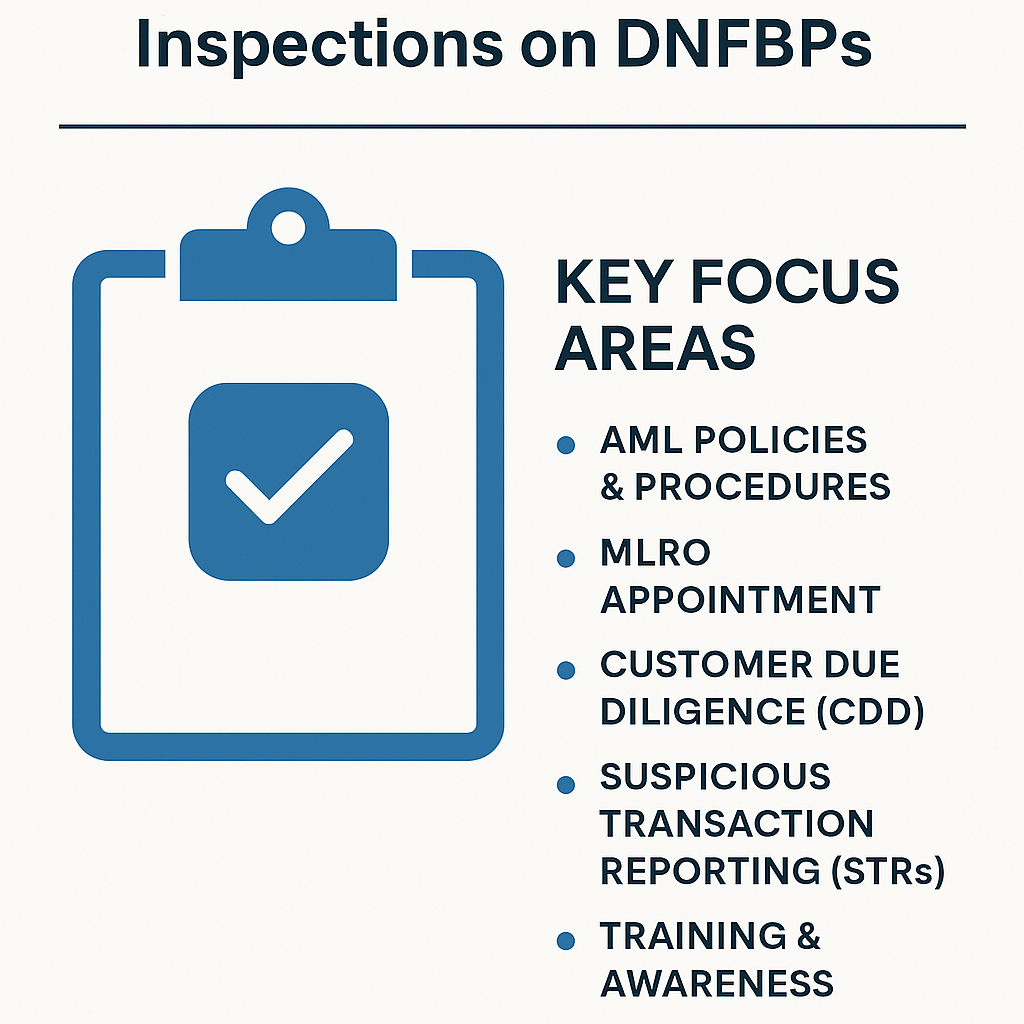
During inspections, the MOE typically reviews the following areas:
1. Registration and Licensing
• Confirmation that the DNFBP is properly licensed and registered with the MOE.
• Verification that the business is registered on the goAML platform.
2. AML Policies and Procedures
• Availability of a documented AML/CFT policy tailored to the DNFBP’s business activities.
• Implementation of procedures for Customer Due Diligence (CDD), Enhanced Due Diligence (EDD), and record-keeping.
3. Risk-Based Approach (RBA)
• Entity-Wide Risk Assessment (EWRA) to identify and mitigate ML/TF risks.
• Risk classification of customers, products, delivery channels, and geographies.
4. MLRO Appointment
• Appointment of a Money Laundering Reporting Officer (MLRO) or Deputy MLRO.
• Evaluation of the MLRO’s independence, authority, and training.
5. Customer Due Diligence (CDD)
• Proper identification and verification of customer identity and beneficial ownership.
• Screening against sanctions lists and PEP databases.
6. Suspicious Transaction Reporting
• Timely filing of STRs/SARs through goAML.
• Internal reporting and escalation mechanisms for suspicious activities.
7. Record-Keeping
• Retention of records for at least five years, including CDD documentation and transaction data.
• Readiness to present records to regulators upon request.
8. Training and Awareness
• Evidence of staff training programs on AML obligations.
• Records of participation, training materials, and frequency of sessions.
________________________________________
Inspection Process: What DNFBPs Can Expect
1. Notification: The MOE informs the DNFBP of an upcoming inspection (sometimes unannounced in high-risk cases).
2. Document Request: Businesses must provide policies, risk assessments, training logs, and evidence of goAML reporting.
3. On-Site Visit / Virtual Inspection: Inspectors review documentation, interview staff, and test processes.
4. Findings and Report: A written report is issued highlighting areas of compliance and non-compliance.
5. Corrective Action Plan: DNFBPs may be required to address deficiencies within a set timeframe.
6. Follow-Up Inspections: Conducted to verify corrective measures.
________________________________________
Penalties for Non-Compliance
Failure to comply with AML regulations or inspection findings can result in:
• Administrative fines up to AED 5 million.
• Business suspension or license cancellation.
• Reputational damage impacting customer and banking relationships.
• Increased scrutiny in future inspections.
________________________________________
Best Practices to Prepare for Inspections
• Maintain updated AML policies and procedures aligned with UAE laws.
• Conduct an annual EWRA and keep documented evidence.
• Appoint and empower an MLRO/Deputy MLRO with sufficient resources.
• Keep training logs, attendance sheets, and training content for regulators.
• Regularly test internal reporting and goAML submission processes.
• Engage external consultants for independent AML compliance reviews.
________________________________________
Conclusion
The Ministry of Economy’s AML inspections are a vital mechanism to ensure DNFBPs contribute to safeguarding the UAE’s financial system. By proactively preparing, maintaining proper documentation, and fostering a culture of compliance, DNFBPs can navigate inspections confidently and avoid penalties.
________________________________________
About Us
Sheikh Anwar Accounting and Auditing LLC is a leading audit and compliance advisory firm in Dubai, UAE. We assist DNFBPs in preparing for AML inspections by offering:
• AML policies and procedures tailored to DNFBPs.
• Entity-Wide Risk Assessment (EWRA) support.
• MLRO and Deputy MLRO outsourcing services.
• Customized AML training programs.
• Pre-inspection readiness assessments and ongoing compliance monitoring.
📍 Office: Dubai Creek Tower, M 35, Dubai, UAE
🌐 Website: www.sa-auditors.com
📧 Email: info@sa-auditors.com