Key Differences Between AML and CTF (Counter-Terrorism Financing)
Introduction
In today’s regulatory environment, businesses in the UAE are required to comply not only with Anti-Money Laundering (AML) laws but also with Counter-Terrorism Financing (CTF) measures. While these terms are often used together, they are not identical. AML and CTF address different threats, have different objectives, and impose distinct obligations on businesses.
Understanding the differences between AML and CTF is crucial for organizations in the UAE—especially banks, gold traders, real estate firms, auditors, and other Designated Non-Financial Businesses and Professions (DNFBPs).
________________________________________
What Is Anti-Money Laundering (AML)?
Anti-Money Laundering (AML) refers to the legal and regulatory framework designed to prevent criminals from disguising the origins of illicit funds.
• Objective: Stop criminals from legitimizing money obtained from illegal activities such as fraud, corruption, drug trafficking, or tax evasion.
• Key UAE Reference: Federal Decree-Law No. 20 of 2018 on Anti-Money Laundering and Combating the Financing of Terrorism.
• Focus Areas: Customer Due Diligence (CDD), Know Your Customer (KYC), Suspicious Transaction Reports (STRs), and record-keeping.
________________________________________
What Is Counter-Terrorism Financing (CTF)?
Counter-Terrorism Financing (CTF) focuses specifically on preventing the funding of terrorism and related activities.
• Objective: Prevent legitimate or illegitimate funds from being used to support terrorist organizations, activities, or individuals.
• Key UAE Reference: Federal Law No. 7 of 2014 on Combating Terrorism Offences, supported by AML regulations that integrate CTF obligations.
• Focus Areas: Monitoring for links to sanctioned persons or entities, screening against UN and UAE terror lists, and reporting Suspicious Activity Reports (SARs) related to terrorism.
________________________________________
Key Differences Between AML and CTF
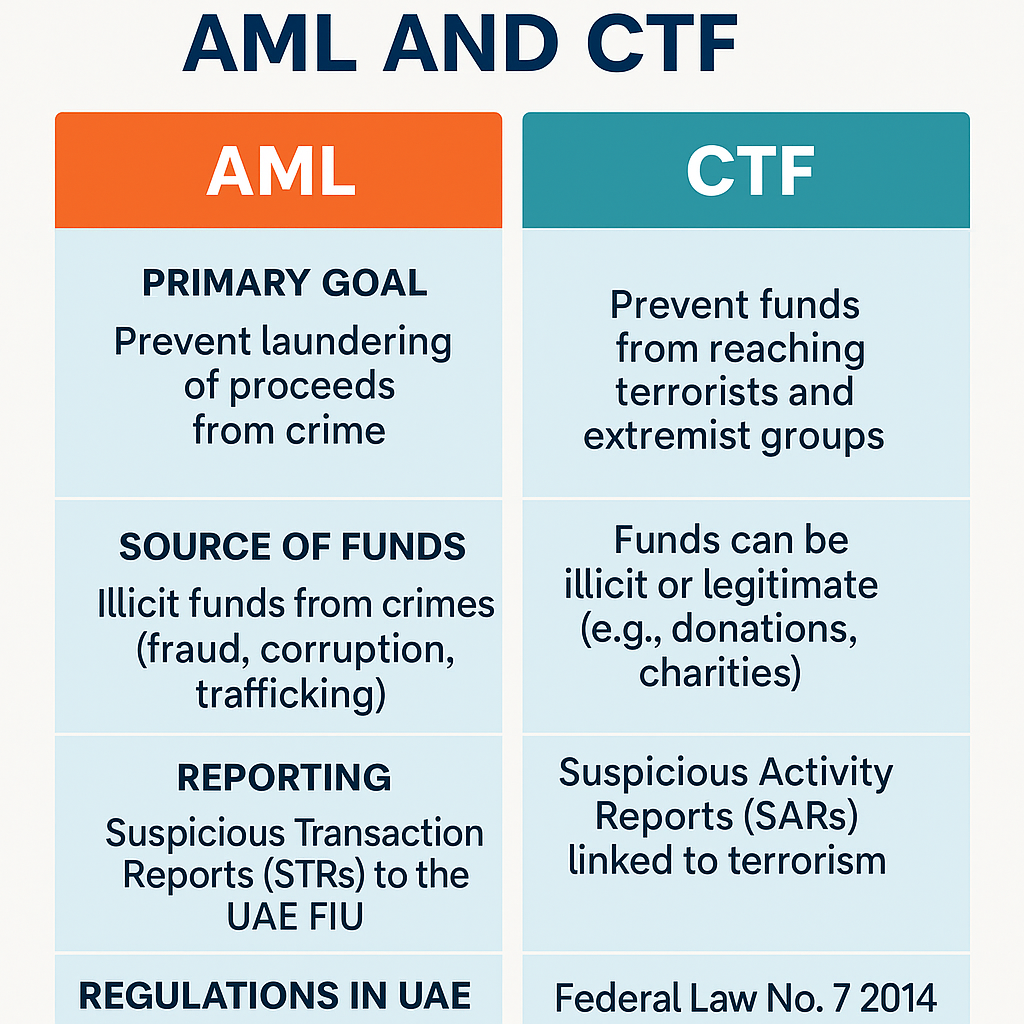
Aspect AML (Anti-Money Laundering) CTF (Counter-Terrorism Financing)
Primary Goal Prevent laundering of proceeds from crime Prevent funds from reaching terrorists and extremist groups
Source of Funds Illicit funds from crimes (fraud, corruption, trafficking) Funds can be illicit or legitimate (e.g., donations, charities)
Focus Concealment of illegal wealth Disruption of terrorist networks’ funding
Reporting Suspicious Transaction Reports (STRs) to the UAE FIU Suspicious Activity Reports (SARs) linked to terrorism
Regulations in UAE Federal Decree-Law No. 20 of 2018 + Cabinet Decision No. 10 of 2019 Federal Law No. 7 of 2014 + UN/UAE sanctions regime
Business Impact Strong KYC/CDD, risk assessments, transaction monitoring Screening against terrorist lists, monitoring donations, cross-border transfers
________________________________________
Why Both AML and CTF Are Critical for UAE Businesses
1. Regulatory Requirement – Compliance is mandatory under UAE law; violations attract severe penalties.
2. International Standards – The UAE aligns its AML/CTF laws with the Financial Action Task Force (FATF) to maintain global credibility.
3. Reputation Protection – Businesses associated with money laundering or terrorism financing—even unintentionally—face irreparable brand damage.
4. Sectoral Risk – Gold and diamond traders, real estate firms, auditors, and corporate service providers are at high risk and under direct supervision of the Ministry of Economy.
5. Severe Penalties – Non-compliance can lead to fines, license suspension, criminal prosecution, and imprisonment.
________________________________________
Practical Steps for Businesses in the UAE
• Perform Enhanced KYC/CDD – Especially for high-risk clients and transactions.
• Screen Against Sanction Lists – Regularly check customers against UAE, UN, and international terror financing lists.
• Report to FIU – File STRs and SARs promptly via the goAML platform.
• Train Employees – Staff must know how to identify red flags of both money laundering and terrorism financing.
• Adopt a Risk-Based Approach – Tailor compliance measures based on the nature of your business and client base.
________________________________________
Conclusion
While AML and CTF are closely related, their objectives, methods, and risks differ significantly. AML focuses on preventing criminals from cleaning illicit funds, while CTF focuses on ensuring that no money—legitimate or otherwise—supports terrorism.
For UAE businesses, compliance with both AML and CTF laws is not just about avoiding penalties—it’s about safeguarding the country’s reputation, financial integrity, and global standing.
________________________________________
About Sheikh Anwar Accounting and Auditing LLC
At Sheikh Anwar Accounting and Auditing LLC, we provide expert advisory services in AML & CTF compliance, corporate tax, VAT, and audit services. We help businesses across high-risk sectors such as gold trading, real estate, and DNFBPs implement strong frameworks to stay compliant with UAE regulations.
• 📍 Head Office: Dubai, UAE
• 🌐 Website: www.sa-auditors.com
• 📧 Email: info@sa-auditors.com
•