Key Definitions in Corporate Tax
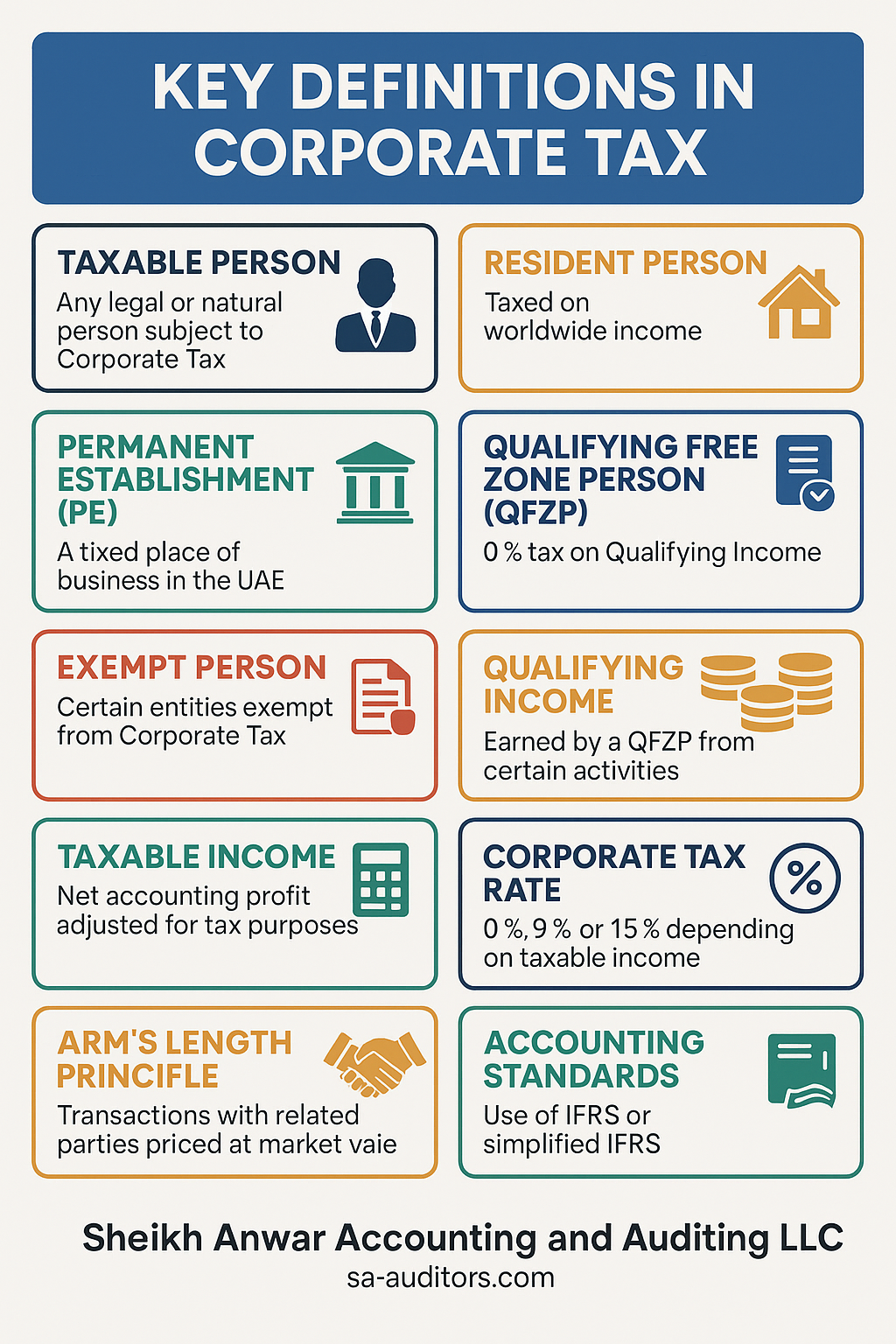
Introduction
With the introduction of Corporate Tax in the UAE effective from 1st June 2023, it’s essential for businesses and professionals to understand the key terminology used in the Corporate Tax Law. Whether you're a startup, a free zone entity, or a multinational, understanding these definitions is critical for compliance and tax planning.
Here, we simplify the most important definitions from the UAE Corporate Tax framework under Federal Decree-Law No. 47 of 2022.
________________________________________
🧾 Key Definitions Under UAE Corporate Tax Law
1. Taxable Person
A Taxable Person is any legal or natural person subject to Corporate Tax. This includes:
• UAE-incorporated companies
• Foreign companies with UAE-sourced income or a permanent establishment
• Individuals conducting business in the UAE
• Certain partnerships (depending on structure)
________________________________________
2. Resident Person
A Resident Person is:
• A juridical person incorporated in the UAE
• A foreign company effectively managed and controlled from the UAE
• A natural person conducting business in the UAE
Resident persons are taxed on worldwide income, unless exempted.
________________________________________
3. Non-Resident Person
A Non-Resident Person is any entity that:
• Has no incorporation or effective management in the UAE, and
• Derives income from the UAE, or
• Has a Permanent Establishment (PE) in the UAE
They are taxed only on UAE-sourced income or income attributable to the PE.
________________________________________
4. Permanent Establishment (PE)
This refers to a fixed place of business or dependent agent through which a foreign business partly or wholly carries on its business in the UAE.
Examples include:
• A branch, office, or warehouse
• A construction site (if it meets time thresholds)
• An agent who habitually concludes contracts on behalf of the foreign company
________________________________________
5. Qualifying Free Zone Person (QFZP)
A QFZP is a Free Zone entity that:
• Maintains adequate substance in the UAE
• Derives Qualifying Income
• Prepares audited financial statements
• Complies with transfer pricing rules
QFZPs can benefit from 0% Corporate Tax on qualifying income, but are subject to 9% on non-qualifying income.
________________________________________
6. Qualifying Income
This is income earned by a QFZP from:
• Transactions with other Free Zone Persons
• Certain income from mainland UAE or foreign parties (like re-exports, warehousing, inter-group services, and qualifying trading)
Non-qualifying income will be taxed at 9%.
________________________________________
7. Exempt Person
Entities that are exempt from Corporate Tax, such as:
• Government entities
• Qualifying public benefit entities
• Qualifying investment funds
• Natural resource businesses (taxed locally)
However, registration with the FTA may still be required.
________________________________________
8. Taxable Income
This refers to the net accounting profit (from IFRS-compliant financials), adjusted for:
• Exempt income
• Non-deductible expenses
• Reliefs and losses carried forward
This figure determines your actual tax liability.
________________________________________
9. Corporate Tax Rate
UAE Corporate Tax rates are:
• 0%: For taxable income up to AED 375,000
• 9%: For taxable income exceeding AED 375,000
• 15%: For multinational groups under OECD Pillar Two
________________________________________
10. Arm’s Length Principle
This principle ensures that transactions with related parties are priced as if between unrelated parties in an open market. It prevents profit shifting and ensures fair taxation.
________________________________________
11. Transfer Pricing
These are rules that apply to related party transactions, requiring:
• Documentation (Master File and Local File)
• Disclosure in tax returns
• Justification of pricing using international methods
________________________________________
12. Business
“Business” includes any activity conducted regularly, such as:
• Commercial, industrial, professional, or vocational activities
• Earning income from the use of property or services
If conducted with a valid license, the income may be subject to tax.
________________________________________
13. Accounting Standards
Businesses are required to use International Financial Reporting Standards (IFRS) or simplified IFRS (for small businesses) to compute profits and taxable income.
________________________________________
14. Small Business Relief
Businesses with revenue less than AED 3 million in a tax period may qualify for Small Business Relief and be treated as if they have no taxable income (until 2026).
________________________________________
💼 Why These Definitions Matter
Understanding these definitions helps businesses:
✅ Determine their tax residency and obligations
✅ Accurately calculate and report taxable income
✅ Make strategic decisions (e.g., Free Zone structures)
✅ Avoid penalties due to misclassification or non-compliance
________________________________________
📌 Let Us Help You Stay Compliant
At Sheikh Anwar Accounting and Auditing LLC, we provide:
• Tax health checks and reviews
• Assistance with FTA Corporate Tax registration
• Advice on Free Zone eligibility
• Transfer Pricing compliance documentation
• Corporate Tax filing and representation
________________________________________
📞 Contact Us Today!
📍 Dubai | 🌐 www.sa-auditors.com
📩 info@sa-auditors.com | 📱 +971-XXX-XXXX

