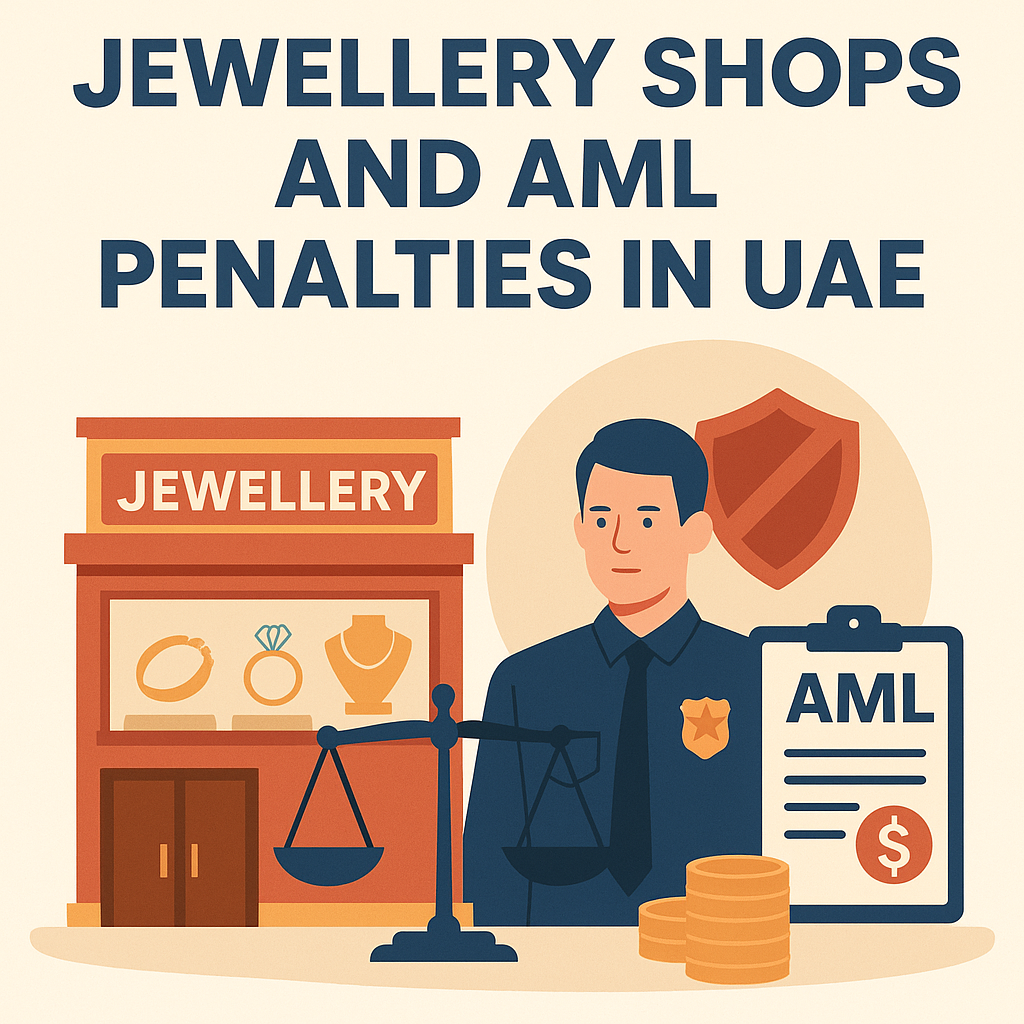
Jewellery Shops and AML Penalties in UAE
Introduction
The jewellery and precious metals sector in the UAE has always been a cornerstone of the nation’s economy, attracting global investors, traders, and customers. However, its unique nature—high-value transactions, portability of assets, and global trade exposure—also makes it particularly vulnerable to money laundering and terrorist financing activities. Recognizing these risks, the UAE has placed jewellery shops, officially categorized as Dealers in Precious Metals and Stones (DPMS), under strict Anti-Money Laundering (AML) regulations.
Non-compliance is not just a regulatory breach; it can lead to severe penalties, reputational damage, and even the closure of business operations. It highlights the AML obligations of jewellery shops in the UAE and the penalties they may face for violations.
________________________________________
AML Framework for Jewellery Shops in the UAE
The Federal Decree-Law No. 20 of 2018 on Anti-Money Laundering and Combating the Financing of Terrorism, along with Cabinet Decision No. 10 of 2019, sets the foundation of AML regulations in the UAE. These laws are complemented by sector-specific guidelines issued by the Ministry of Economy for DPMS entities.
Under these regulations, jewellery shops are required to:
• Perform Customer Due Diligence (CDD): Verify customer identities, beneficial ownership, and source of funds.
• Apply Enhanced Due Diligence (EDD): For high-risk clients, including politically exposed persons (PEPs) or high-value cross-border transactions.
• Monitor Transactions: Especially cash transactions of AED 55,000 or above, whether conducted as a single deal or split into related transactions.
• Report Suspicious Transactions: File Suspicious Transaction Reports (STRs) or DPMS Reports (DPMSR) through the goAML portal.
• Maintain Records: Preserve customer and transaction records for at least five years.
• Appoint a Compliance Officer/MLRO: Oversee AML compliance and act as the point of contact with regulators.
• Conduct Ongoing Training and Risk Assessments: Ensure staff are trained to detect red flags and mitigate risks.
________________________________________
Why Jewellery Shops Are High Risk
The sector is globally recognized as high-risk for money laundering due to:
• The ability to conceal large value in small, portable assets such as gold and diamonds.
• Heavy reliance on cash transactions.
• Cross-border trade complexities, with suppliers and buyers often from high-risk jurisdictions.
• Potential exposure to trade-based money laundering and smuggling.
________________________________________
Penalties for Non-Compliance
Failure to comply with AML obligations can lead to serious consequences. UAE regulators, including the Ministry of Economy, Central Bank, and Financial Intelligence Unit (FIU), impose penalties based on the severity of the breach.
Common penalties include:
• Fines: Ranging from AED 50,000 to AED 10 million, depending on the violation.
• Imprisonment: In cases of intentional money laundering or gross negligence, sentences can extend up to 10 years.
• Business Suspension or License Revocation: Authorities may suspend or cancel trade licenses for repeated non-compliance.
• Asset Freezing and Confiscation: Funds and assets linked to illicit transactions may be seized.
• Reputational Damage: Non-compliance leads to loss of trust with customers, suppliers, and banking partners.
________________________________________
Recent Enforcement Trends
The UAE has intensified its AML enforcement in recent years:
• In 2024, over 30 gold refineries faced license suspensions due to AML shortcomings.
• Regulators issued hundreds of fines exceeding AED 339 million across DNFBPs, including jewellery dealers, for failing to meet compliance standards.
• Businesses that ignored reporting obligations or failed to register on the goAML platform were among those penalized.
These actions highlight the authorities’ zero-tolerance approach and reinforce the need for strict compliance by jewellery shops.
________________________________________
Best Practices for Jewellery Shops
To avoid penalties, jewellery businesses should:
• Register on the goAML portal without delay.
• Implement robust KYC and transaction monitoring systems.
• Train employees regularly on AML obligations and red flag identification.
• Develop a documented AML/CFT compliance program aligned with UAE law.
• Carry out periodic risk assessments to adapt to evolving threats.
________________________________________
Conclusion
For jewellery shops in the UAE, AML compliance is no longer optional—it is an operational necessity. Failure to comply with the law not only invites heavy penalties but also endangers the long-term sustainability of the business. By implementing effective compliance systems, jewellers can protect themselves, build customer confidence, and contribute to the UAE’s strong reputation as a transparent and trusted global business hub.
________________________________________
About Us
Sheikh Anwar Accounting and Auditing LLC is a trusted auditing and compliance partner in Dubai, specializing in Anti-Money Laundering (AML) advisory, compliance frameworks, and regulatory support for businesses in the gold, diamond, and jewellery sectors.
With extensive experience in AML compliance, corporate tax, VAT, and transfer pricing, our firm supports clients in navigating complex UAE regulations with confidence.
📍 Address: Dubai Creek Tower, M 35, Dubai, UAE
📞 Contact: info@sa-auditors.com | +971-XXX-XXXX
🌐 Website: www.sa-auditors.com