Jewellery Sector Risk Assessment Best Practices
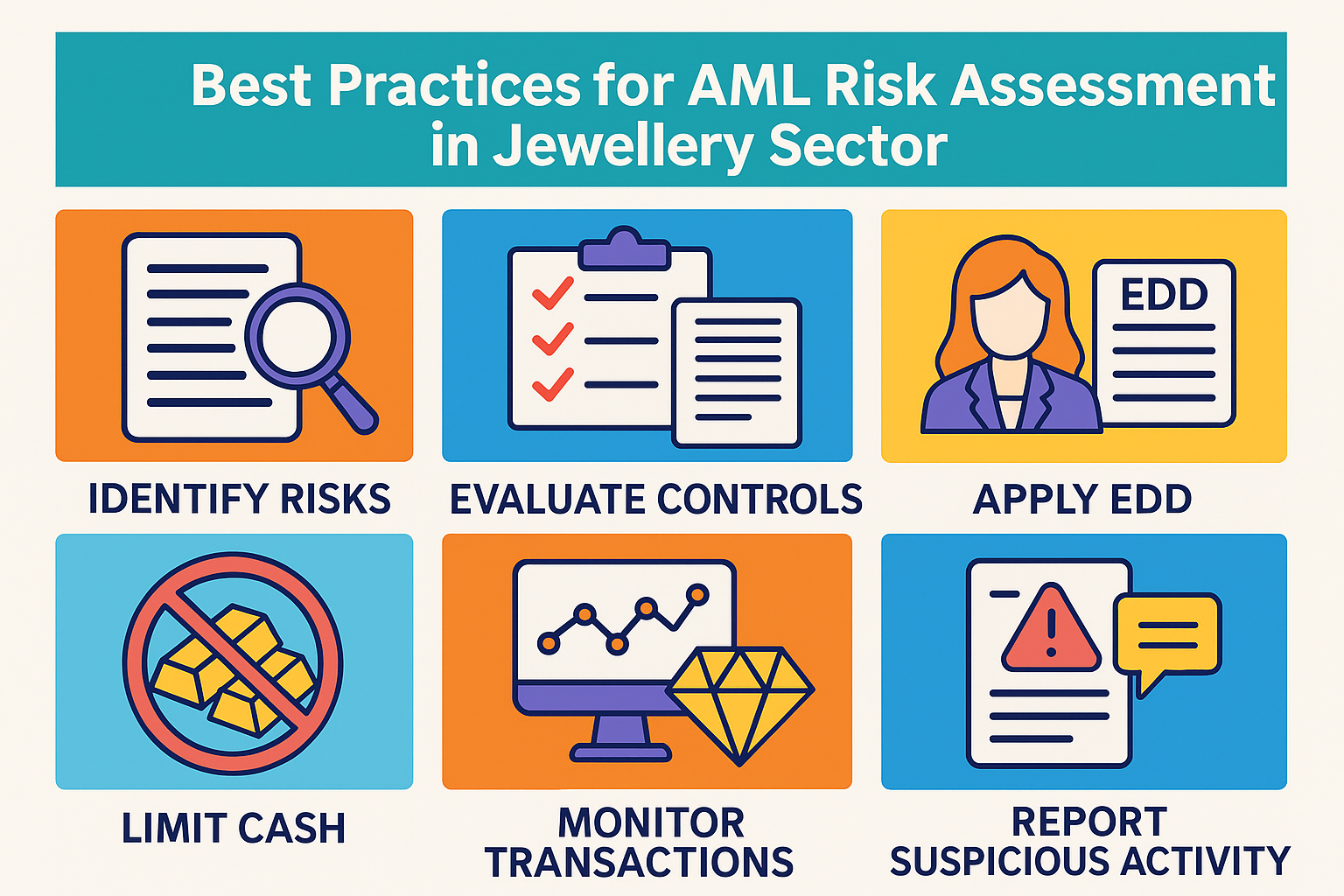
Introduction
The jewellery and precious metals sector is one of the most vulnerable industries to money laundering and terrorist financing risks.
Criminals often exploit this sector because gold, diamonds, and other precious stones are portable, easily convertible to cash, and difficult to trace.
Recognizing this vulnerability, the UAE authorities—through Federal Decree-Law No. (20) of 2018 on AML/CFT and Cabinet Decision No. (10) of 2019, reinforced by Cabinet Decision No. (109) of 2023—require Designated Non-Financial Businesses and Professions (DNFBPs) such as gold and jewellery dealers to perform comprehensive AML Risk Assessments.
A proper risk assessment not only ensures compliance but also safeguards your business reputation and strengthens customer trust.
It aexplains the best practices for conducting a risk assessment tailored to the jewellery sector.
________________________________________
1. Understanding AML Risks in the Jewellery Sector
Jewellery businesses face unique risks because gold and precious stones can:
• Be purchased anonymously with cash;
• Cross borders with minimal documentation;
• Be used to store or transfer illicit value;
• Involve high-value transactions in a short time.
The Financial Action Task Force (FATF) identifies the jewellery and precious metals industry as high-risk for money laundering, making risk-based AML compliance mandatory for all dealers and traders.
________________________________________
2. Legal Framework in the UAE
The following UAE laws and guidelines govern AML compliance for jewellery businesses:
• Federal Decree-Law No. (20) of 2018 on Anti-Money Laundering and Countering Terrorist Financing;
• Cabinet Decision No. (10) of 2019 – Implementing Regulations;
• Cabinet Decision No. (109) of 2023 – Strengthened provisions for DNFBPs;
• Ministry of Economy (MOE) AML Guidelines for Dealers in Precious Metals and Stones;
• goAML reporting system under the UAE Financial Intelligence Unit (FIU).
These regulations mandate jewellery firms to:
• Identify and assess ML/TF risks;
• Apply customer due diligence (CDD/EDD);
• Maintain transaction and risk documentation;
• File Suspicious Transaction Reports (STRs);
• Conduct regular AML training and reviews.
________________________________________
3. Key Risk Factors in Jewellery Sector
A proper AML Risk Assessment begins with identifying risk factors across several dimensions:
a. Customer Risk
• Politically Exposed Persons (PEPs) or their associates;
• Non-resident customers;
• Walk-in or cash-based buyers;
• Corporate customers with complex ownership;
• Clients unwilling to provide identification or source of funds.
b. Product/Service Risk
• High-value items like gold bars, bullion, or diamonds;
• Re-sale or exchange of pre-owned jewellery;
• Refining or melting services (transforming the form of gold);
• Custom or bulk orders without commercial logic.
c. Geographic Risk
• Clients from or transactions linked to FATF grey/black-listed countries;
• Offshore or high-risk jurisdictions (e.g., tax havens);
• Cross-border deals with limited documentation.
d. Transaction Risk
• Large cash payments;
• Third-party payments or layering of funds;
• Frequent buying and selling in short intervals;
• Invoices with mismatched values or inconsistent descriptions.
e. Delivery Channel Risk
• Non face-to-face sales (online or agent-based);
• Remote transfers without proper verification;
• Agents handling gold movement across borders.
________________________________________
4. Step-by-Step Risk Assessment Process for Jewellery Businesses
Step 1 – Identify and Document Risks
List all risks associated with your business operations, including products, clients, geography, and transaction types.
Use internal data (e.g., sales patterns) and external sources (FATF lists, MOE advisories).
________________________________________
Step 2 – Evaluate Inherent Risks
Determine how likely each risk could lead to ML/TF and its potential impact.
Risk Factor Likelihood Impact Risk Level
High-value gold sales paid in cash High High High
Verified local customers with small purchases Low Low Low
Offshore entity buyers High Medium High
________________________________________
Step 3 – Assess Control Effectiveness
Evaluate the strength of existing controls, such as:
• Customer Due Diligence (CDD) processes;
• Transaction monitoring systems;
• Sanctions and PEP screening;
• Record retention and reporting mechanisms;
• Staff AML training frequency.
Identify gaps or weaknesses in these controls.
________________________________________
Step 4 – Determine Residual Risk
After controls are applied, assess what residual risk remains.
For example:
If a firm has strong KYC verification but still accepts high-value cash deals, residual risk remains Medium to High.
________________________________________
Step 5 – Apply Mitigation Measures
For higher-risk activities:
• Conduct Enhanced Due Diligence (EDD) (verify source of funds/wealth);
• Restrict cash transactions over the legal threshold (AED 55,000 as per MOE requirement);
• Report suspicious activity through goAML portal;
• Maintain proper documentation for all transactions;
• Involve senior management in high-risk approvals.
________________________________________
Step 6 – Document and Review
Prepare a written AML Risk Assessment Report including:
• Identified risks and categories;
• Ratings (Low/Medium/High);
• Controls and mitigation plans;
• Responsibilities and timelines for corrective actions.
Review the report annually or whenever business operations or regulations change.
________________________________________
5. Best Practices for Jewellery Sector AML Risk Assessment
1. Adopt a Risk-Based Approach (RBA): Focus resources on high-risk customers and products.
2. Integrate Technology: Use AML tools like MyAML.io for screening, monitoring, and risk scoring.
3. Set Clear Policies: Define procedures for CDD, EDD, record keeping, and STR filing.
4. Enhance Staff Training: Ensure all sales and finance staff understand AML indicators.
5. Maintain Transparency: Keep all transaction documentation ready for MOE inspection.
6. Collaborate with Compliance Experts: Engage licensed AML advisors for independent review and updates.
7. Regularly Review FATF and MOE Updates: Stay informed about new high-risk jurisdictions and red flags.
________________________________________
6. Common Red Flags in Jewellery Transactions
Jewellery firms must be alert to the following suspicious indicators:
• Customers seeking to buy high-value items in cash without valid reason.
• Frequent small purchases designed to avoid reporting thresholds.
• Purchases made by third parties unrelated to the beneficiary.
• Customers requesting to melt gold without commercial justification.
• Sudden increase in volume of transactions from new clients.
• Transactions inconsistent with the customer’s known business profile.
Whenever these occur, an internal review must be done, and if suspicion persists, a Suspicious Transaction Report (STR) should be filed through goAML.
________________________________________
7. Technology in Jewellery AML Compliance
Modern AML tools like Finabooks.com and MyAML.io offer:
• Automated customer onboarding;
• Real-time PEP and sanctions screening;
• Customer risk scoring and dashboard reports;
• Auto-generated AML Risk Assessment templates;
• Centralized documentation and audit trail.
Technology reduces human error, enhances accuracy, and provides regulatory assurance during inspections.
________________________________________
8. Continuous Monitoring and Review
Jewellery businesses must treat AML Risk Assessment as a continuous cycle, not a one-time task.
This means:
• Reassessing risks annually or upon new product launches;
• Updating AML policies and controls accordingly;
• Monitoring changes in customer behavior;
• Keeping evidence of all reviews for inspection readiness.
________________________________________
Conclusion
The jewellery and precious metals sector plays a vital role in the UAE economy, but it also carries significant AML risk exposure.
Conducting a comprehensive and documented AML Risk Assessment is not just a regulatory requirement—it is a proactive strategy to protect your business from financial crime, regulatory penalties, and reputational damage.
By following these best practices, leveraging technology, and maintaining a culture of compliance, jewellery firms can ensure their operations remain transparent, trusted, and fully aligned with UAE AML/CFT laws.
________________________________________
Sheikh Anwar Accounting & Auditing LLC
Licensed Auditor – Ministry of Economy (Entry No. 5817)
📍 Dubai Creek Tower, Office M35, Dubai, UAE
🌐 www.sa-auditors.com
✉️ info@sa-auditors.com