Invoicing for Composite and Mixed Supplies
Introduction
In the UAE, businesses often offer packages that include multiple goods or services. Understanding how to invoice these correctly is crucial for VAT compliance. The UAE VAT Law distinguishes between composite and mixed supplies, each with specific invoicing and VAT treatment rules.
________________________________________
1. What are Composite and Mixed Supplies?
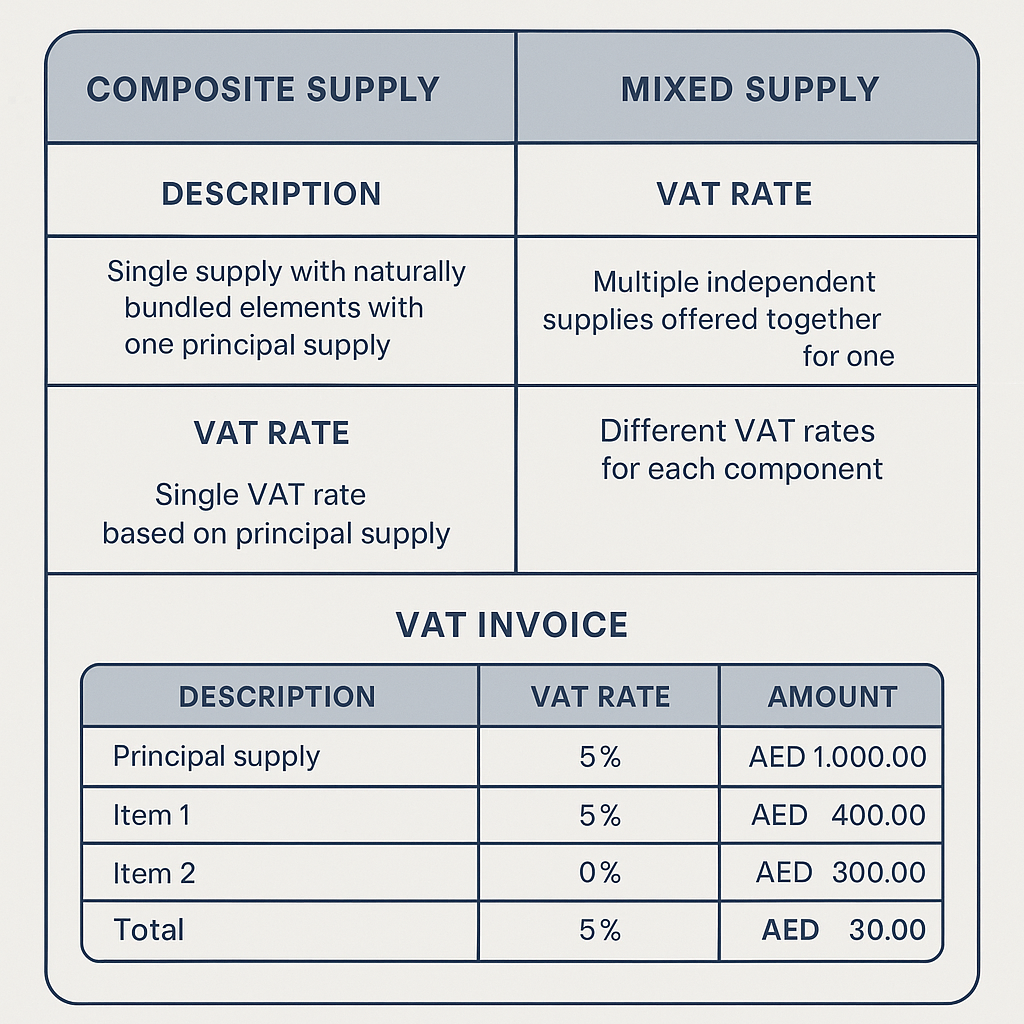
Type of Supply Description VAT Implication
Composite Supply A supply consisting of multiple elements that are naturally bundled and supplied together, with one being the principal supply. VAT rate applicable to the principal supply applies to the entire transaction.
Mixed Supply A supply consisting of multiple elements that are independent and not naturally bundled, offered for a single price. Each component is taxed based on its individual VAT rate.
________________________________________
2. Key Examples
• Composite Supply: A hotel package that includes room, breakfast, and Wi-Fi – the principal supply is hotel accommodation.
• Mixed Supply: A Diwali gift box with chocolates (standard-rated), a book (zero-rated), and a toy (standard-rated) – each item has its own VAT rate.
________________________________________
3. VAT Invoicing Requirements
A. For Composite Supplies
• Issue a single VAT invoice.
• The invoice should reflect:
o The principal supply
o A single VAT rate (the rate of the principal supply)
o Total consideration
• No need to split VAT among elements.
B. For Mixed Supplies
• Issue a single or multiple VAT invoice(s) depending on clarity.
• The invoice must:
o Clearly itemize each supply
o Indicate separate taxable amounts for each component
o Show respective VAT rates (e.g., 5%, 0%, exempt)
o Include total VAT amount charged
________________________________________
4. Common Mistakes to Avoid
• Applying a single VAT rate to a mixed supply.
• Failing to identify the principal supply in composite transactions.
• Issuing lump-sum invoices without itemized VAT details for mixed supplies.
________________________________________
5. Best Practices
• Classify the transaction correctly before invoicing.
• Train invoicing staff on VAT rules for mixed and composite supplies.
• Use automated invoicing software that supports multiple VAT rates per invoice.
• Maintain supporting documentation to justify supply classification in case of FTA audit.
________________________________________
Conclusion
Correct invoicing for composite and mixed supplies is essential for UAE VAT compliance. Misclassification can lead to underpayment or overpayment of VAT and potential penalties. Businesses should review their supply structures and ensure invoices are issued in line with FTA guidelines.
📧 info@sa-auditors.com
🌐 www.sa-auditors.com
Popular Blogs