Invoice Adjustments Due to Exchange Rate Fluctuations
Introduction
In today’s global business landscape, many UAE companies issue invoices in foreign currencies. However, since VAT in the UAE must be reported in AED, any exchange rate fluctuation between the invoice date and payment date can lead to discrepancies in VAT accounting.
It explains how to issue VAT-compliant invoices in foreign currencies, how to handle adjustments due to exchange rate fluctuations, and how to stay compliant with Federal Tax Authority (FTA) rules.
________________________________________
📘 Can You Issue VAT Invoices in Foreign Currencies?
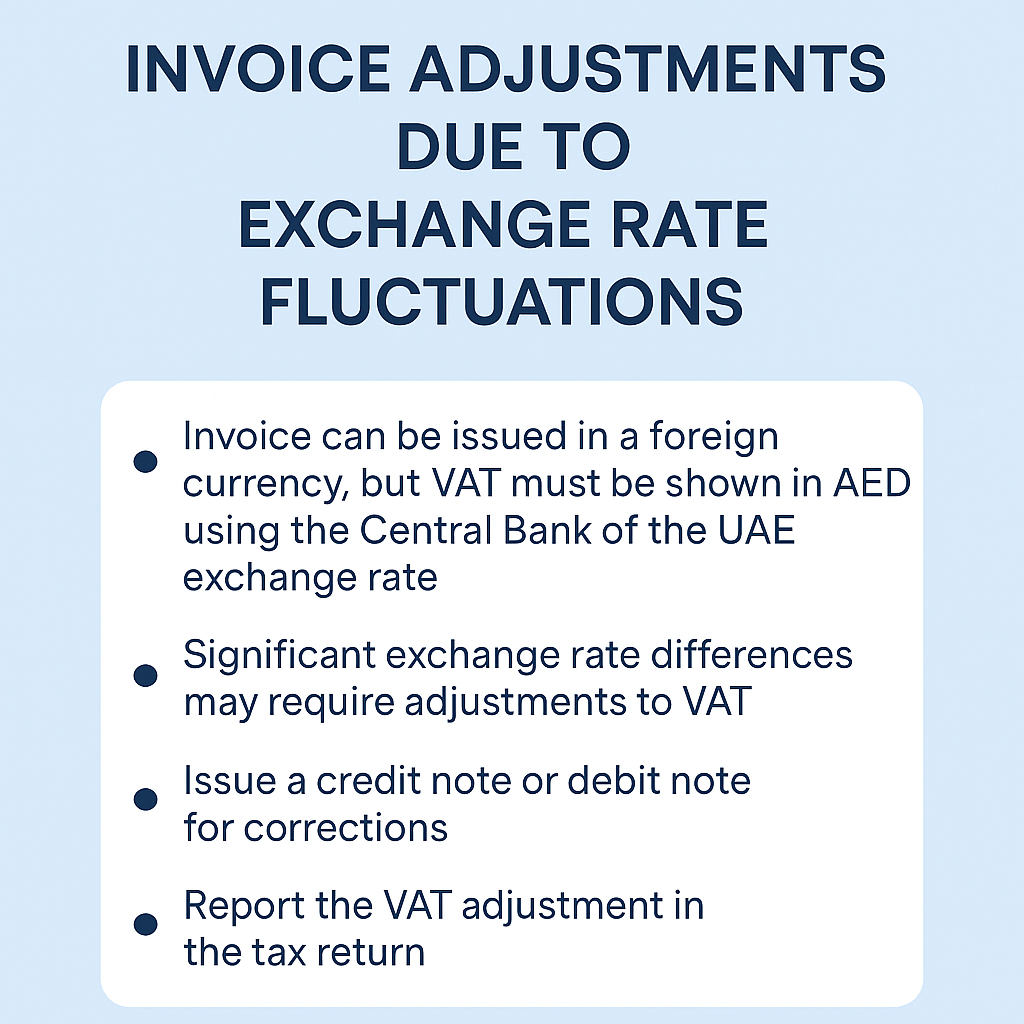
Yes, UAE VAT law allows invoices to be issued in currencies other than AED (such as USD, EUR, INR, etc.). However, the VAT amount must always be shown in AED using the exchange rate published by the Central Bank of the UAE (CBUAE) on the date of supply.
________________________________________
✅ Mandatory Requirements for Foreign Currency Invoices
Requirement Explanation
Invoice can be in any currency USD, EUR, etc.
VAT amount in AED Must be shown separately
Exchange rate used CBUAE rate on date of supply
Retention of evidence Screenshot or record of rate used
________________________________________
🔄 Why Exchange Rate Fluctuations Cause Adjustments
If:
• You issue an invoice in USD using the exchange rate on the invoice date, but
• Your customer pays at a different rate (on the payment date),
then the AED amount received may be more or less than the VAT originally declared.
This can cause:
• Over-reporting or under-reporting of VAT
• Misalignment in accounting books vs VAT returns
________________________________________
🧾 How to Adjust for Exchange Rate Differences
1️⃣ Use Correct Exchange Rate Initially
Always use the CBUAE published rate on the actual date of supply (not invoice creation or payment date).
📌 This fixes the VAT liability at the time of supply, regardless of actual cash received later.
________________________________________
2️⃣ Issue Credit or Debit Notes (If Adjustment Required)
If there is a significant difference between:
• The AED value of payment received, and
• The AED value of the VAT already declared
Then issue:
Situation Use
Overpaid VAT Issue a credit note to reduce VAT
Underpaid VAT Issue a debit note to increase VAT
✅ Mention the reason:
“Exchange rate difference adjustment based on final payment date”
________________________________________
3️⃣ Account for VAT Adjustment in Form 201
• Box 1-3 (Sales) or Box 9 (Purchases): Reflect original supply
• Box 6 (Adjustments): Use this to report debit or credit notes linked to exchange rate changes
________________________________________
📦 Example Scenario
You issue an invoice on 01 July 2024:
• Amount: USD 1,000
• Exchange rate (CBUAE): 3.672
• AED amount: AED 3,672
• VAT @ 5%: AED 183.60
Payment received on 25 July 2024:
• Bank converts at 3.65
• AED received: AED 3,650
• Short by AED 22
📌 Result:
• You may issue a credit note for AED 22 (if the difference is material)
• Adjust your VAT return accordingly
________________________________________
📎 Best Practices for Managing Exchange Rate Fluctuations
Practice Benefit
Always use official CBUAE rate Ensures VAT compliance
Attach exchange rate evidence to invoice Audit-proof
Issue timely credit/debit notes Keeps VAT return accurate
Maintain reconciliation logs Helps track foreign currency collections
Use accounting software with auto-conversion Avoid manual errors
________________________________________
⚠️ Common Mistakes to Avoid
Mistake Risk
Using bank exchange rate instead of CBUAE VAT non-compliance
Not converting VAT to AED FTA audit penalty
Ignoring exchange difference Over-/under-statement of VAT
Using invoice creation date instead of supply date Wrong exchange rate
________________________________________
🧠 Final Thoughts
While UAE VAT Law allows invoicing in foreign currencies, the VAT must be clearly calculated and reported in AED. Exchange rate fluctuations should be handled transparently using CBUAE rates, and any differences reconciled using credit/debit notes when needed.
💼 Need help with foreign currency VAT invoicing or exchange rate reconciliation?
Contact Sheikh Anwar Accounting & Auditing LLC to streamline your VAT compliance and avoid costly FTA penalties.
📧 info@sa-auditors.com
🌐 www.sa-auditors.com