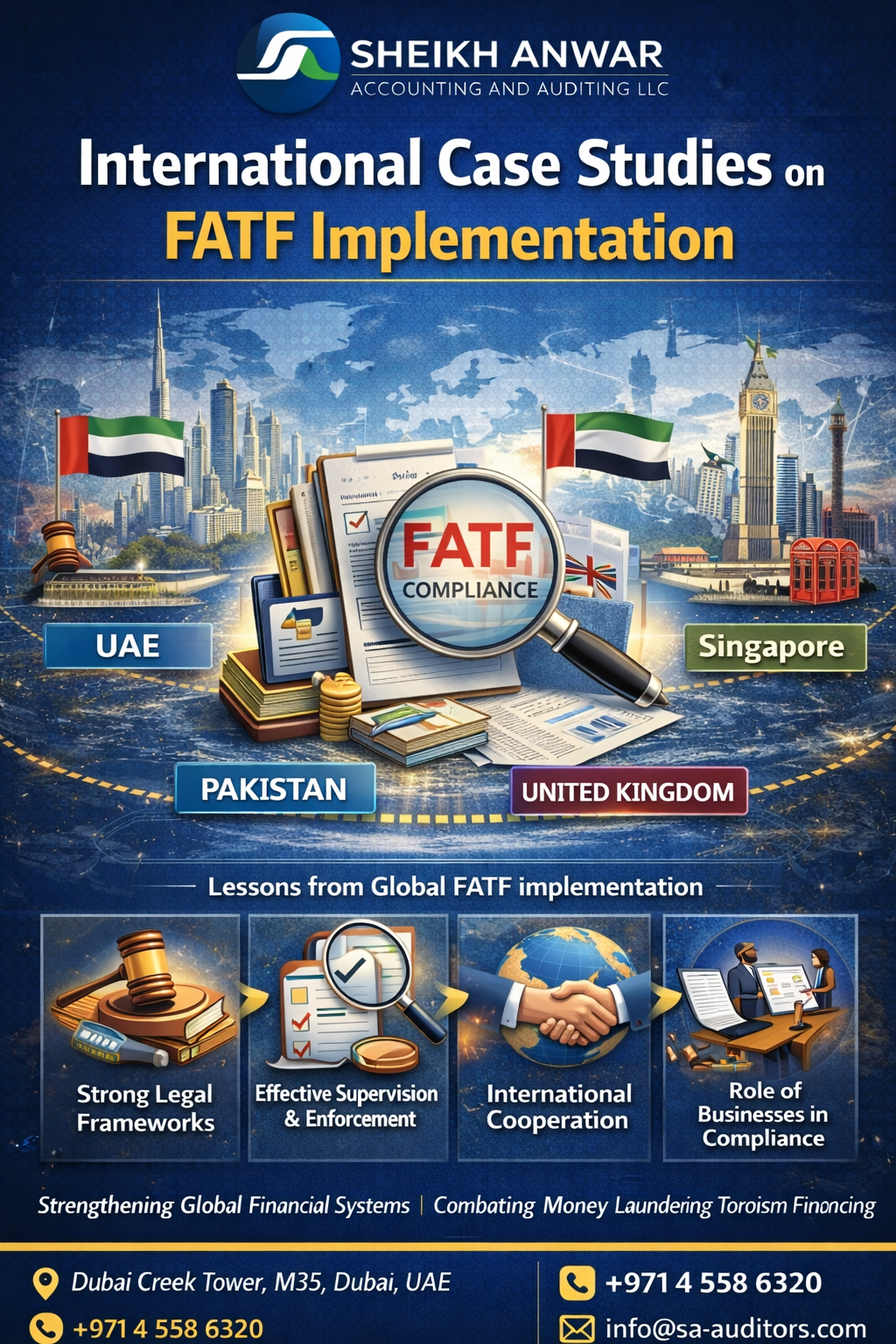
International Case Studies on FATF Implementation
Introduction
The Financial Action Task Force (FATF) plays a central role in setting global standards to combat money laundering (ML), terrorism financing (TF), and other financial crimes. Since its establishment in 1989, FATF has issued 40 Recommendations that serve as the international framework for Anti-Money Laundering (AML) and Counter-Terrorism Financing (CFT).
Countries around the world have adopted FATF standards to strengthen financial transparency and prevent financial systems from being misused for illicit activities. Examining international case studies helps businesses and regulators understand how different jurisdictions have implemented FATF requirements and the impact of these measures.
________________________________________
Importance of FATF Implementation
The implementation of FATF standards helps countries:
• Strengthen financial system integrity
• Prevent financial crimes such as money laundering and terrorism financing
• Improve international cooperation and information sharing
• Enhance investor confidence and financial transparency
Countries that fail to implement FATF recommendations risk being placed on the FATF Grey List or Black List, which can significantly affect international trade and financial relationships.
________________________________________
Case Study 1: United Arab Emirates
The United Arab Emirates (UAE) has taken significant steps to strengthen its AML and CFT framework in recent years. After being placed on the FATF Grey List, the UAE implemented several reforms including:
• Strengthening supervision of Designated Non-Financial Businesses and Professions (DNFBPs)
• Enhancing the role of the Financial Intelligence Unit (FIU)
• Increasing inspections and enforcement actions
• Introducing stricter beneficial ownership transparency requirements
These reforms significantly improved the UAE’s regulatory framework and reinforced its commitment to global compliance standards.
________________________________________
Case Study 2: Pakistan
Pakistan has been a notable example of FATF monitoring. The country remained on the FATF Grey List for several years due to concerns about its AML and CFT systems.
To address these issues, Pakistan implemented several measures:
• Strengthening laws related to terrorism financing
• Enhancing regulatory oversight of financial institutions
• Increasing prosecutions related to terrorism financing
• Improving cooperation between financial regulators and law enforcement agencies
Following significant reforms, Pakistan was eventually removed from the Grey List after demonstrating progress in meeting FATF requirements.
________________________________________
Case Study 3: Singapore
Singapore is widely recognized for maintaining one of the strongest AML and CFT frameworks globally. The country has implemented FATF recommendations through:
• Strict financial regulations enforced by the Monetary Authority of Singapore (MAS)
• Strong customer due diligence and transaction monitoring requirements
• Effective financial intelligence analysis
• Robust enforcement actions against non-compliant institutions
Singapore’s compliance framework has strengthened its position as a trusted international financial hub.
________________________________________
Case Study 4: United Kingdom
The United Kingdom has implemented FATF recommendations through a comprehensive regulatory framework covering financial institutions and professional service providers.
Key measures include:
• Strong beneficial ownership transparency through public registers
• Strict AML regulations for financial institutions and DNFBPs
• Enhanced suspicious transaction reporting mechanisms
• Coordination between regulators, law enforcement agencies, and financial intelligence units
These measures ensure effective detection and prevention of financial crimes.
________________________________________
Lessons from Global FATF Implementation
International case studies highlight several key lessons for countries and businesses:
1. Strong Regulatory Frameworks Are Essential
Countries must establish clear legal frameworks to combat money laundering and terrorism financing.
2. Effective Supervision and Enforcement
Regulators must conduct regular inspections and enforce compliance through penalties and corrective actions.
3. International Cooperation
Financial crimes often involve cross-border transactions, making global cooperation critical.
4. Role of Businesses in Compliance
Businesses play a key role in implementing FATF standards by maintaining robust compliance systems and reporting suspicious activities.
________________________________________
Impact on Businesses and Compliance Professionals
For businesses operating globally, understanding FATF implementation in different countries is crucial. Companies must ensure they follow international compliance standards when dealing with cross-border transactions.
This includes:
• Conducting Customer Due Diligence (CDD)
• Monitoring transactions for suspicious activities
• Ensuring sanctions screening and risk assessments
• Maintaining transparent ownership structures
Strong compliance systems protect businesses from regulatory risks and enhance their credibility in international markets.
________________________________________
Conclusion
FATF implementation has significantly strengthened global efforts to combat financial crimes. Countries that adopt and enforce FATF standards benefit from improved financial stability, increased investor confidence, and stronger international cooperation.
International case studies demonstrate that effective AML and CFT frameworks require strong legal systems, regulatory enforcement, and active participation from businesses and financial institutions.
For organizations operating in today’s global economy, compliance with FATF standards is not just a regulatory requirement—it is a fundamental component of responsible and sustainable business operations.
________________________________________
About Our Company
Sheikh Anwar Accounting & Auditing LLC is a professional consulting and advisory firm based in Dubai, United Arab Emirates. The firm specializes in:
• AML/CFT Compliance Advisory
• FATF Compliance Implementation
• UAE Corporate Tax Consultancy
• VAT Advisory and Compliance
• External Audit and Risk Advisory
Our experts assist businesses in implementing effective compliance frameworks aligned with FATF standards and UAE regulatory requirements.
Company Details
Sheikh Anwar Accounting & Auditing LLC
📍 Dubai Creek Tower, M35, Dubai, UAE
📞 +971 4 558 6320
📧 info@sa-auditors.com
🌐 www.sa-auditors.com