Intercompany Transactions in Free Zones
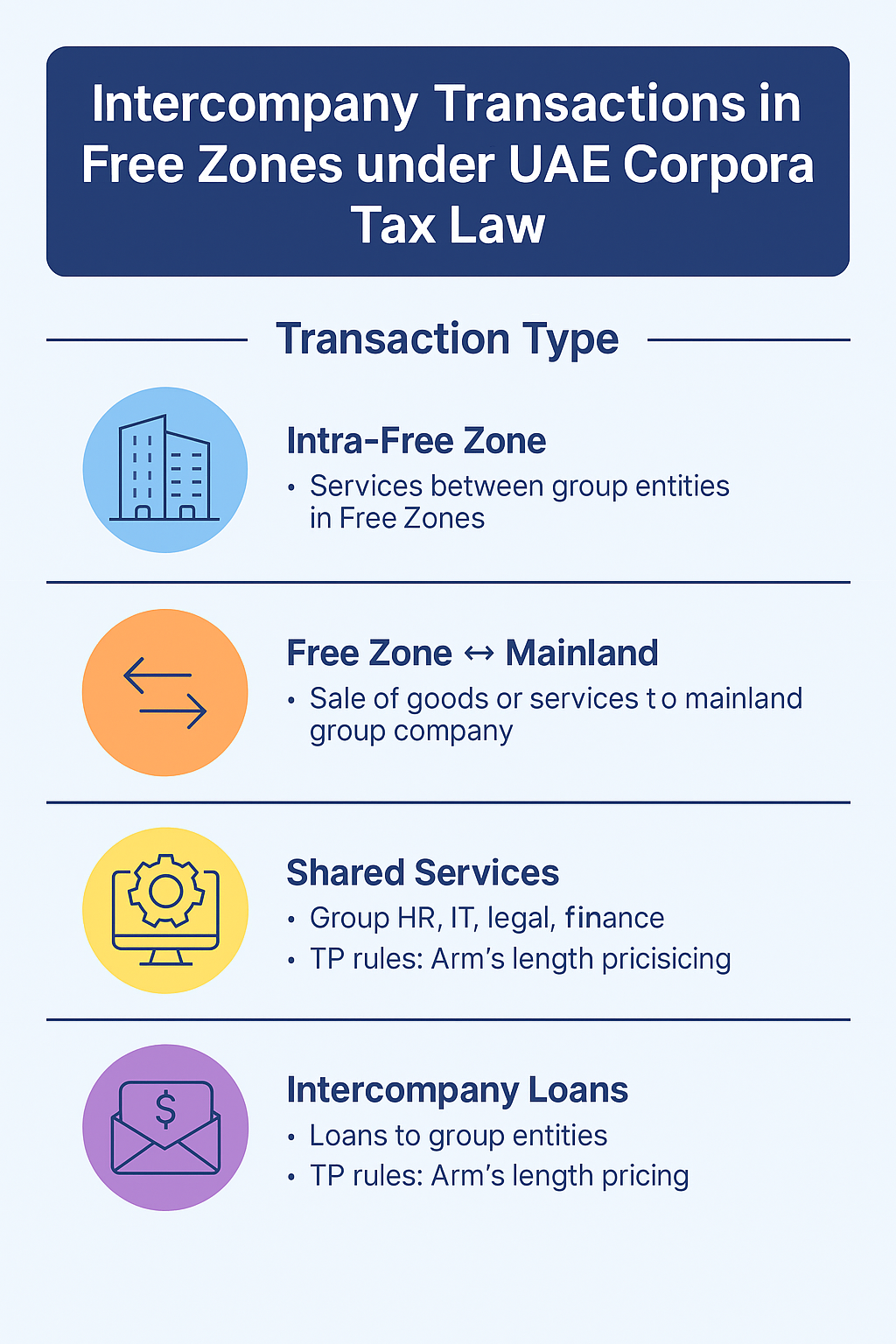
🔄 Intercompany Transactions in Free Zones: Tax Treatment and Compliance under UAE Corporate Tax
Intercompany transactions are common in group structures operating in UAE Free Zones, especially where holding companies, shared services, or group finance arrangements exist. However, with the introduction of UAE Corporate Tax (Federal Decree-Law No. 47 of 2022), these transactions are now under greater regulatory and tax scrutiny — particularly when entities claim Qualifying Free Zone Person (QFZP) status.
Here, we explain the treatment, documentation, and compliance requirements for intercompany transactions involving Free Zone entities, including those with mainland or foreign related parties.
________________________________________
📌 Key Concepts
✅ What are Intercompany Transactions?
Intercompany transactions refer to any transfer of goods, services, funds, or intangibles between related parties, including:
• Parent and subsidiary
• Sister companies under common control
• Branch and head office
• Group treasury and operating companies
________________________________________
✅ Importance Under Corporate Tax
Intercompany transactions are subject to:
1. Transfer Pricing (TP) rules – to ensure transactions are conducted at arm’s length.
2. Documentation requirements – for entities crossing TP thresholds.
3. Implications for QFZP status – where income must qualify under Article 18 and related ministerial decisions.
________________________________________
⚖️ Legal Framework
The following laws govern intercompany dealings in Free Zones:
• Federal Decree-Law No. 47 of 2022 – Corporate Tax Law
• Ministerial Decision No. 97 of 2023 – Definition of Related Parties & Connected Persons
• Ministerial Decision No. 139 of 2023 – Qualifying Activities & Excluded Income
• Ministerial Decision No. 265 of 2023 – Transfer Pricing Documentation Requirements
________________________________________
🧾 Types of Intercompany Transactions in Free Zones
Transaction Type Examples Tax Relevance
Intra-Free Zone Services between group entities in same or different Free Zones May qualify as 0% taxable qualifying income
Free Zone ↔ Mainland Sale of goods/services from Free Zone to UAE mainland group company Income is non-qualifying unless pass-through
Free Zone ↔ Foreign Export of goods/services to related foreign entities Treated as qualifying income if activity is eligible
Shared Services Group HR, IT, legal, finance billed across entities TP rules apply; must be at arm’s length
Intercompany Loans Loans from Free Zone holding company to mainland or vice versa Interest income must follow TP rules
Management Fees / Royalties Charges for brand usage or corporate oversight Need benchmarking support and TP documentation
________________________________________
🧾 Transfer Pricing Compliance for Intercompany Transactions
All Free Zone entities must comply with Article 34 & 35 of the Corporate Tax Law, which requires:
• Transactions with related parties to be at arm’s length
• Documentation of pricing methodology
• Filing of TP Disclosure Form annually
• Preparation of Master File and Local File if:
o Annual revenue > AED 200 million, or
o Related party transactions > AED 50 million
Accepted TP Methods:
• Comparable Uncontrolled Price (CUP)
• Transactional Net Margin Method (TNMM)
• Cost Plus, Resale Price, or Profit Split
📌 FTA may reject QFZP status if pricing is not substantiated or documentation is missing.
________________________________________
💼 Intercompany Transactions & QFZP Status
Entities claiming QFZP status must ensure:
1. Income from related Free Zone entities is derived from qualifying activities (e.g., distribution, manufacturing, logistics).
2. Income from mainland group companies is non-qualifying unless:
o It's derived passively, or
o The mainland entity acts as customer, not end-user
3. Pricing is at arm’s length with proper agreements and invoices
4. Records are maintained to distinguish between:
o Qualifying income
o Non-qualifying income
o Excluded income (e.g., from immovable property in mainland)
________________________________________
📝 Required Documentation
To support intercompany transactions, maintain:
• Intercompany agreements (clearly specifying scope, pricing)
• Invoices and payment records
• TP benchmarking reports
• Master & Local Files (if applicable)
• Board approvals or internal policies
• Segregated financial reporting for QFZP compliance
________________________________________
🛡️ Common Mistakes to Avoid
❌ Assuming all intra-group transactions in Free Zone are qualifying
❌ Charging arbitrary or flat fees without benchmarking
❌ Missing TP documentation thresholds
❌ Mixing qualifying and non-qualifying income in accounts
❌ No written agreements for services or loans
________________________________________
✅ Best Practices
• 📌 Draft formal intercompany agreements
• 📊 Conduct TP benchmarking annually
• 🧾 Prepare a QFZP file with all necessary compliance documents
• 🗂️ Use separate GL accounts for related party income
• 🔍 Review transaction flows to avoid QFZP violations
________________________________________
🧑💼 How We Can Help
At Sheikh Anwar Accounting and Auditing LLC, we specialize in:
• Intercompany TP analysis and benchmarking
• QFZP classification and audit support
• TP Disclosure Form filing and documentation
• Corporate Tax filing for Free Zone entities
📧 Email: info@sa-auditors.com
🌐 Website: https://www.sa-auditors.com