Impact of VAT on Corporate Tax
Introduction
With the UAE now operating under two federal tax systems—Value Added Tax (VAT) and Corporate Tax (CT)—businesses must understand how these regimes interact and how VAT affects the Corporate Tax computation and reporting obligations.
Although VAT and Corporate Tax are separate in scope and administration, they are closely connected in areas like financial accounting, compliance, and tax planning.
It explores the impact of VAT on Corporate Tax in the UAE, covering deductibility, accounting implications, and practical examples.
________________________________________
🔍 Overview: VAT vs. Corporate Tax
Aspect VAT Corporate Tax
Type of tax Indirect tax on goods/services Direct tax on net business income
Rate 5% (standard) 9% (above AED 375,000 net profit)
Administered by Federal Tax Authority (FTA) Federal Tax Authority (FTA)
Filing frequency Monthly/quarterly Annually
Input/Output matching Yes (input VAT credit) No
________________________________________
🧾 How VAT Affects Corporate Tax
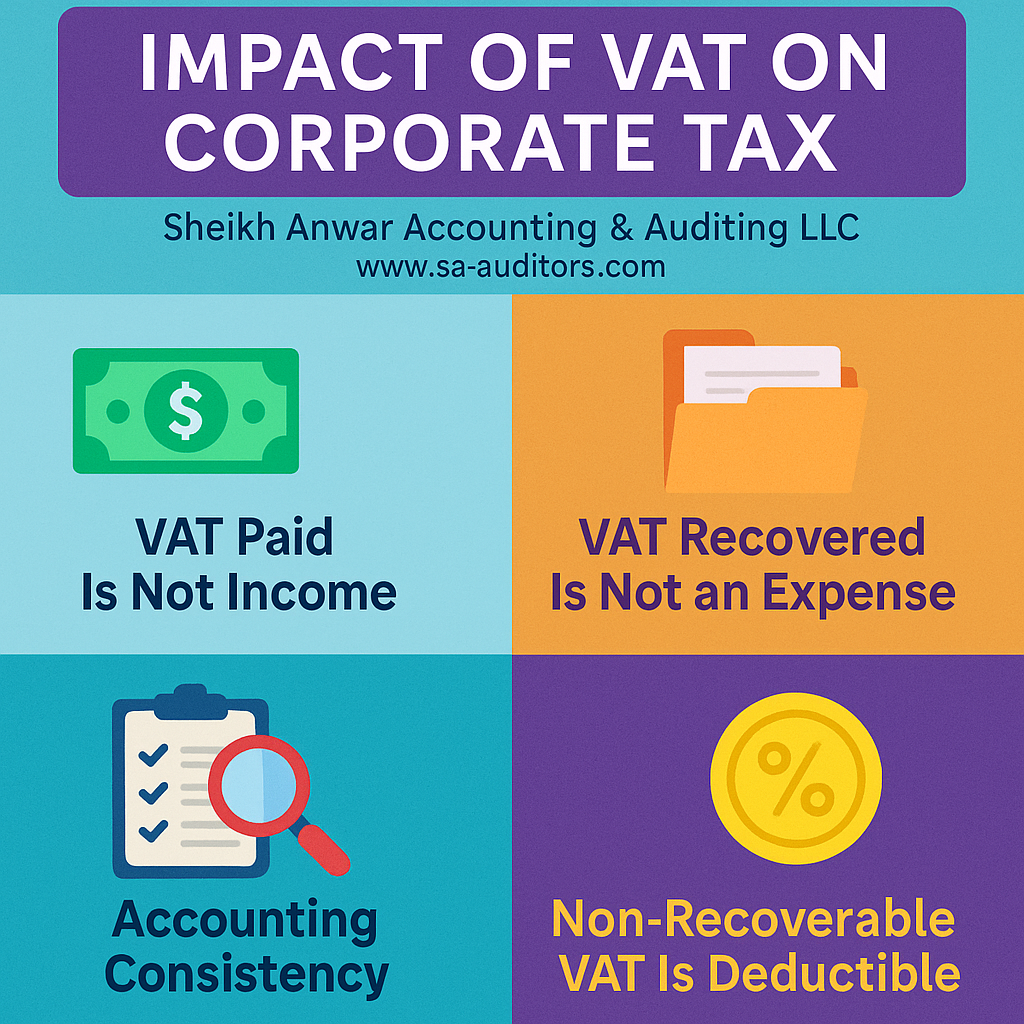
✅ 1. VAT Paid Is Not Income
VAT collected from customers is not business income for Corporate Tax purposes.
Example:
If a company invoices AED 105 (AED 100 service + AED 5 VAT), only AED 100 is revenue for CT, not AED 105.
________________________________________
✅ 2. VAT Recovered Is Not an Expense
Input VAT that is recoverable under VAT rules cannot be deducted as an expense in Corporate Tax.
You cannot claim VAT twice—once as a recovery under VAT, and again as an expense under Corporate Tax.
________________________________________
⚠️ 3. Non-Recoverable VAT Is Deductible
VAT that is irrecoverable (blocked) under UAE VAT law can be treated as a tax-deductible expense under Corporate Tax.
Common examples:
• VAT on entertainment expenses
• VAT on passenger vehicles
• VAT on employee benefits
Such VAT amounts can be included as part of the total business cost when calculating taxable income.
________________________________________
🔍 4. Accounting Consistency
VAT must be correctly segregated in accounting records to ensure:
• Accurate profit calculation under Corporate Tax
• No double-counting of VAT as income or expense
• Compliance during FTA audits or assessments
Businesses should maintain separate GL accounts for VAT receivable and VAT payable.
________________________________________
💡 Example: Service Company
Details Amount (AED)
Service Revenue (excluding VAT) 1,000,000
Output VAT @5% 50,000
Total Invoiced 1,050,000
Input VAT (on purchases) 30,000
VAT payable to FTA 20,000
Business expenses 600,000 (net of VAT)
Corporate Taxable Income = Revenue – Expenses = AED 1,000,000 – AED 600,000 = AED 400,000
Tax Payable = (400,000 – 375,000) × 9% = AED 2,250
________________________________________
🧾 Reporting Considerations
• VAT-registered entities should reconcile VAT returns with accounting and CT records
• Corporate Tax returns must be prepared excluding VAT from revenue and expense figures
• If VAT records are inaccurate, it can result in:
o Overstated/understated profits
o Penalties during FTA review
o Misleading financial statements
________________________________________
🧠 Implications for CT Compliance
• ✅ Keep invoices segregated for VAT and CT
• ✅ Record non-recoverable VAT properly for expense deduction
• ✅ Ensure adjustments for VAT in profit calculations
• ✅ Prepare working papers linking VAT returns to financial statements
________________________________________
🧾 VAT Refunds and Corporate Tax
VAT refunds do not impact Corporate Taxable income. If the FTA refunds AED 10,000 VAT to a company, it is not taxable income under CT.
However, input VAT wrongly claimed under CT as an expense can lead to tax penalties.
________________________________________
🧾 Audit Trail Best Practices
• Maintain VAT invoices and payment proofs
• Ensure GL codes clearly differentiate between:
o VAT recoverable
o VAT paid and blocked
o Expense categories relevant to CT
• Reconcile VAT return summaries with your income and expenses before filing CT return
________________________________________
📋 Summary Table
VAT Treatment CT Treatment
Output VAT collected Not included in income
Recoverable Input VAT Not deductible as expense
Non-recoverable VAT Deductible under CT
VAT refunds Not taxable income
VAT penalties/fines Not deductible under CT
VAT interest (late payment interest) Not deductible
________________________________________
🧠 How Sheikh Anwar Accounting & Auditing LLC Can Help
We support businesses in:
✅ Setting up correct VAT and CT accounting structures
✅ Reconciling VAT returns with CT financials
✅ Identifying deductible and non-deductible VAT
✅ Avoiding double claims and FTA penalties
✅ Filing accurate CT returns in line with VAT data
________________________________________
📞 Contact Us
📍 Sheikh Anwar Accounting & Auditing LLC
🌐 www.sa-auditors.com
📧 info@sa-auditors.com
📞 +971-XX-XXX-XXXX
________________________________________