Identifying Suspicious Beneficial Ownership
Introduction
In the UAE, businesses and DNFBPs are required to comply with strict AML/CFT regulations to prevent money laundering, terrorist financing, and tax evasion. One of the biggest challenges in compliance is identifying the true Beneficial Owner (BO) — the individual(s) who ultimately own or control a company.
Criminals often use complex corporate structures, offshore entities, and nominee arrangements to obscure beneficial ownership. Recognizing suspicious indicators is critical to effective AML risk management.
________________________________________
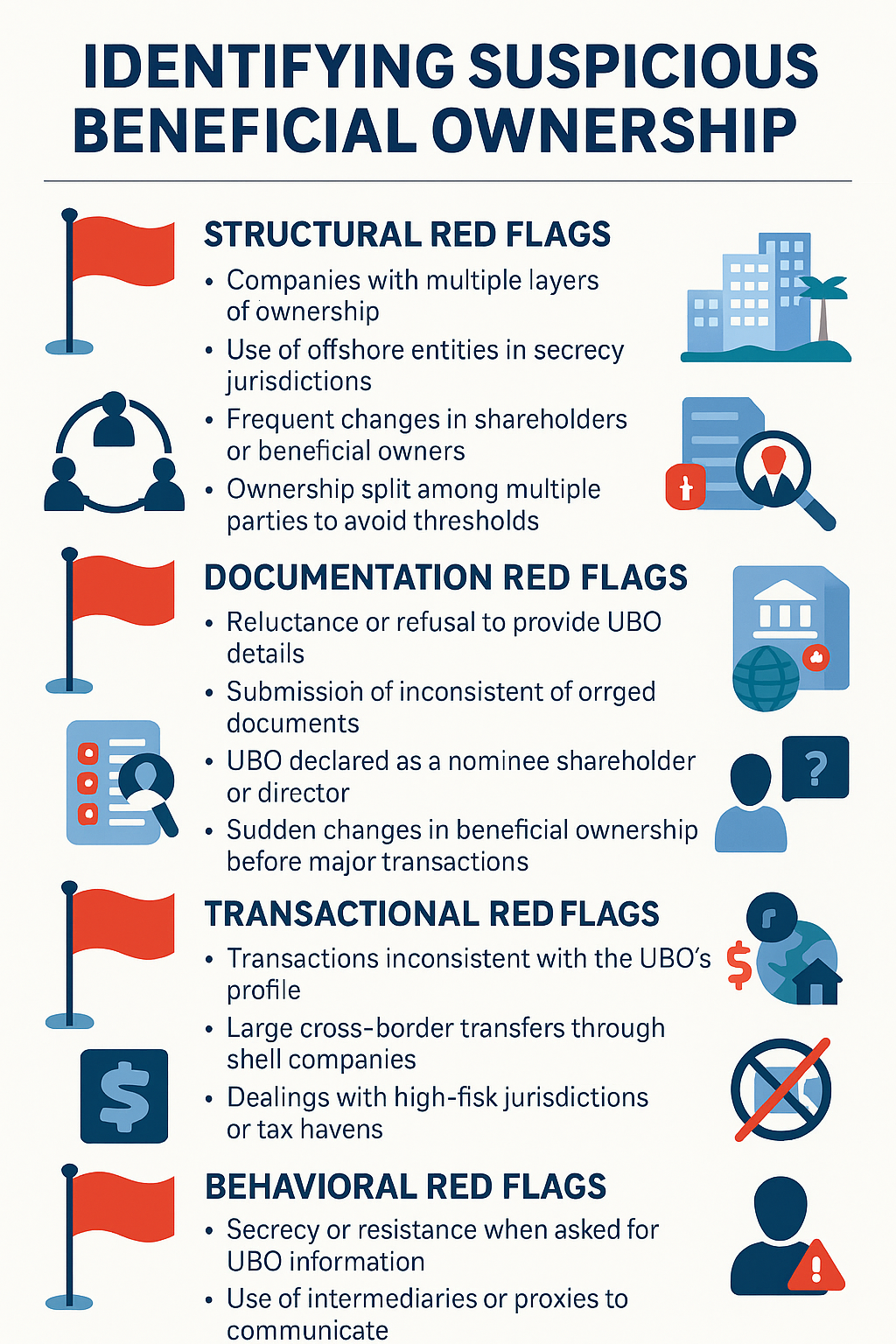
1. Structural Red Flags
• Companies with multiple layers of ownership spanning across jurisdictions.
• Use of offshore entities in secrecy jurisdictions with no legitimate business rationale.
• Frequent changes in shareholders, directors, or beneficial owners.
• Ownership split among multiple parties to avoid crossing regulatory thresholds.
________________________________________
2. Documentation Red Flags
• Reluctance or refusal to provide Ultimate Beneficial Owner (UBO) details.
• Submission of inconsistent, forged, or unverifiable documents.
• UBO declared as a nominee shareholder or director without real control.
• Sudden changes in beneficial ownership just before major transactions.
________________________________________
3. Transactional Red Flags
• Transactions inconsistent with the UBO’s known profile or declared business activity.
• Large cross-border transfers routed through companies with no clear operations.
• Frequent dealings with high-risk jurisdictions or tax havens.
• Payments made or received by entities with no commercial justification.
________________________________________
4. Behavioural Red Flags
• Clients who show secrecy or resistance when asked for UBO information.
• Use of intermediaries or proxies to communicate instead of the actual owner.
• Beneficial owners who avoid face-to-face meetings or verification procedures.
• Aggressive behaviour when questioned about ownership structures.
________________________________________
5. Sector-Specific Risks in the UAE
Real Estate
• Properties purchased via offshore companies with no identifiable UBO.
• High-value real estate bought in cash by corporate structures with no clear activity.
Gold and Jewellery
• Shell companies in free zones declaring jewellery trade but showing no real staff or office presence.
• UBOs linked to high-risk jurisdictions engaging in bulk cash purchases.
Professional Services (Lawyers, Auditors, Company Formation Agents)
• Requests to set up foundations, trusts, or layered structures with no genuine rationale.
• Clients resisting UBO disclosure citing “confidentiality.”
________________________________________
6. Mitigation Measures for DNFBPs and Financial Institutions
• Apply Enhanced Due Diligence (EDD) where ownership structures are complex.
• Use UBO verification tools and public registries to confirm identities.
• Screen UBOs against PEP lists, sanctions, and adverse media.
• Report suspicious ownership arrangements via goAML.
• Maintain clear records of ownership structures for at least 5 years.
________________________________________
✅ Conclusion
Suspicious beneficial ownership is one of the most common methods used to disguise illicit activity. By identifying red flags in ownership structures, documentation, and client behaviour, UAE businesses and DNFBPs can protect themselves against regulatory penalties, financial crime, and reputational harm.
________________________________________
📌 About Us
At Sheikh Anwar Accounting & Auditing LLC, we provide AML compliance services, UBO verification, outsourced MLRO support, and regulatory reporting. Our expertise helps businesses in the UAE navigate complex ownership structures and remain compliant with AML/CFT frameworks.
📧 Email: info@sa-auditors.com
🌐 Website: www.sa-auditors.com