How UAE Aligns with FATF Standards
Introduction
The United Arab Emirates (UAE) has established itself as a major global financial and trade hub. With increasing international business activities, the country has taken strong measures to ensure that its financial system remains transparent, secure, and compliant with international regulations.
One of the most important global frameworks for combating financial crime is issued by the Financial Action Task Force (FATF). The FATF sets international standards for Anti-Money Laundering (AML), Counter-Terrorism Financing (CTF), and Proliferation Financing.
Over the past few years, the UAE has significantly strengthened its legal and regulatory framework to align with FATF recommendations, demonstrating its commitment to maintaining a safe and trusted financial environment.
________________________________________
Understanding FATF Standards
The Financial Action Task Force developed 40 global recommendations that guide countries in building effective systems to prevent money laundering and terrorism financing.
These standards require countries to:
• Identify and manage financial crime risks
• Implement strong AML regulations
• monitor financial institutions and high-risk sectors
• enforce compliance through regulatory supervision
Countries that fail to meet these standards may be placed under monitoring, which can affect their global financial reputation.
________________________________________
UAE’s Legal Framework for AML Compliance
To align with FATF standards, the UAE introduced a comprehensive legal framework to combat financial crime.
Federal Decree Law No. 20 of 2018
One of the most important AML laws in the UAE is Federal Decree Law No. 20 of 2018 on Anti-Money Laundering and Combating the Financing of Terrorism and Illegal Organizations.
This law requires businesses to:
• Conduct customer due diligence
• Report suspicious transactions
• maintain proper records
• implement internal compliance programs
The law also introduced strict penalties for businesses that fail to comply with AML regulations.
________________________________________
Key Authorities Supervising AML Compliance in the UAE
To ensure effective implementation of FATF standards, several regulatory authorities supervise AML compliance across different sectors.
Financial Intelligence and National Coordination
• UAE Financial Intelligence Unit (FIU)
Responsible for receiving and analyzing suspicious transaction reports through the goAML system.
• Executive Office for Control and Non-Proliferation
Oversees the implementation of targeted financial sanctions and ensures compliance with UN sanctions.
________________________________________
Financial Sector Regulators
Financial institutions are supervised by:
• Central Bank of the UAE – regulates banks, finance companies, and exchange houses.
• Securities and Commodities Authority – supervises capital markets and investment firms.
• Dubai Financial Services Authority – regulates financial services in the Dubai International Financial Centre.
• Financial Services Regulatory Authority – supervises financial institutions in Abu Dhabi Global Market.
________________________________________
DNFBP Supervisory Authorities
Certain non-financial sectors are considered high-risk for money laundering and are regulated as Designated Non-Financial Businesses and Professions (DNFBPs).
Key supervisors include:
• UAE Ministry of Economy – supervising precious metals dealers, auditors, and corporate service providers.
• Dubai Land Department – supervising real estate brokers and developers.
• Various Free Zone Authorities such as DMCC, SAIF Zone, and DAFZA.
________________________________________
Key Measures Implemented by the UAE to Align with FATF
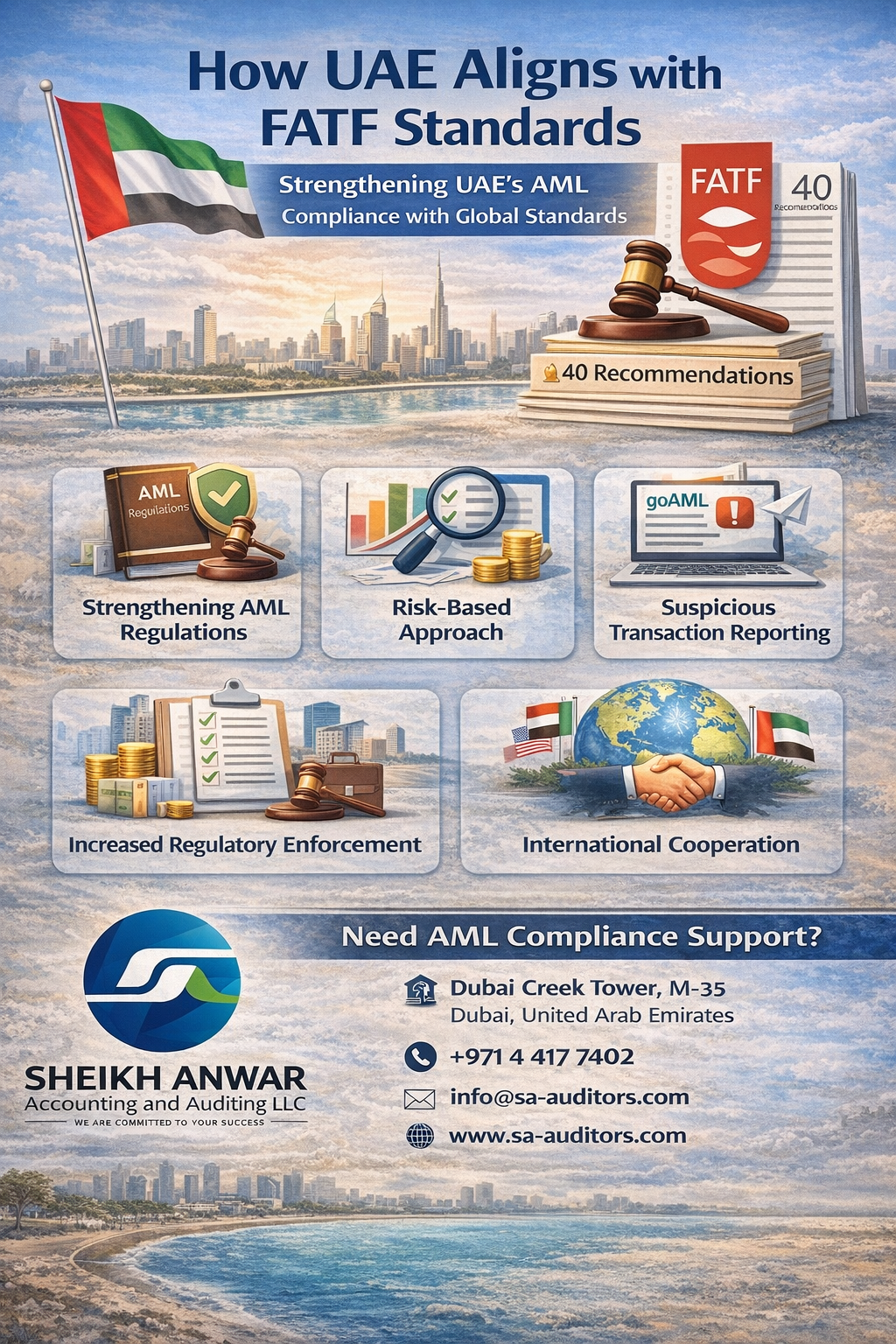
1. Strengthening AML Regulations
The UAE enhanced AML legislation and regulatory guidelines to ensure alignment with international standards.
Businesses are required to implement:
• AML policies and procedures
• Customer Due Diligence (CDD)
• Enhanced Due Diligence (EDD) for high-risk customers
________________________________________
2. Risk-Based Approach
The UAE adopted a risk-based approach to identify sectors that are more vulnerable to financial crimes.
High-risk sectors include:
• precious metals trading
• real estate
• financial services
• corporate service providers
Regulators conduct regular inspections in these sectors to ensure compliance.
________________________________________
3. Suspicious Transaction Reporting
Businesses must report suspicious transactions through the goAML platform managed by the UAE Financial Intelligence Unit.
Reports include:
• Suspicious Transaction Reports (STR)
• Suspicious Activity Reports (SAR)
• sanctions-related reporting
________________________________________
4. Increased Regulatory Enforcement
Authorities have increased inspections and administrative penalties for non-compliance.
Companies failing to comply with AML regulations may face:
• financial penalties
• license suspension
• regulatory investigations
________________________________________
5. International Cooperation
The UAE has strengthened its cooperation with international regulators and financial intelligence units to combat cross-border financial crimes.
This cooperation helps authorities track illicit financial flows and improve global enforcement efforts.
________________________________________
Impact on Businesses Operating in the UAE
Businesses operating in the UAE must ensure that they maintain strong AML compliance systems.
Organizations should:
• implement AML policies and procedures
• appoint a Money Laundering Reporting Officer (MLRO)
• conduct risk assessments
• maintain proper documentation and records
• train employees on AML obligations
Failure to comply with AML regulations can result in significant penalties and reputational damage.
________________________________________
Importance for Precious Metals and Gold Trading Companies
The UAE is one of the world's largest trading hubs for gold and precious metals. As a result, authorities have strengthened AML monitoring in this sector.
Businesses dealing in precious metals must comply with strict regulations supervised by the UAE Ministry of Economy and other regulatory authorities.
Companies must ensure transparency in transactions and maintain robust due diligence procedures.
________________________________________
Conclusion
The UAE has made significant progress in aligning its regulatory framework with the standards set by the Financial Action Task Force.
Through stronger legislation, improved supervision, and enhanced enforcement measures, the country continues to strengthen its financial system and maintain its reputation as a secure global business hub.
Businesses operating in the UAE must remain proactive in maintaining AML compliance to support the country’s ongoing efforts to combat financial crime.
________________________________________
About Us
Sheikh Anwar Accounting and Auditing LLC is a Dubai-based professional firm providing expert services in:
• AML Compliance & Audits
• AML Risk Assessments
• AML Policy Development
• goAML Registration & Reporting
• UAE Corporate Tax Advisory
• VAT Compliance & Filing
• Financial Audit & Accounting Services
📍 Office Address:
Dubai Creek Tower, M-35, Dubai, United Arab Emirates
📞 Phone: +971 4 417 7402
📧 Email: info@sa-auditors.com
🌐 Website: www.sa-auditors.com