How to Verify RCM on Your VAT Return
Introduction
The Reverse Charge Mechanism (RCM) plays a crucial role in VAT compliance, especially when dealing with cross-border transactions. However, many businesses fail to verify RCM entries properly in their VAT Return (Form 201), leading to mismatches and potential penalties.
It will walk you through the step-by-step process of verifying RCM entries in your VAT return to ensure everything is accurate and compliant.
________________________________________
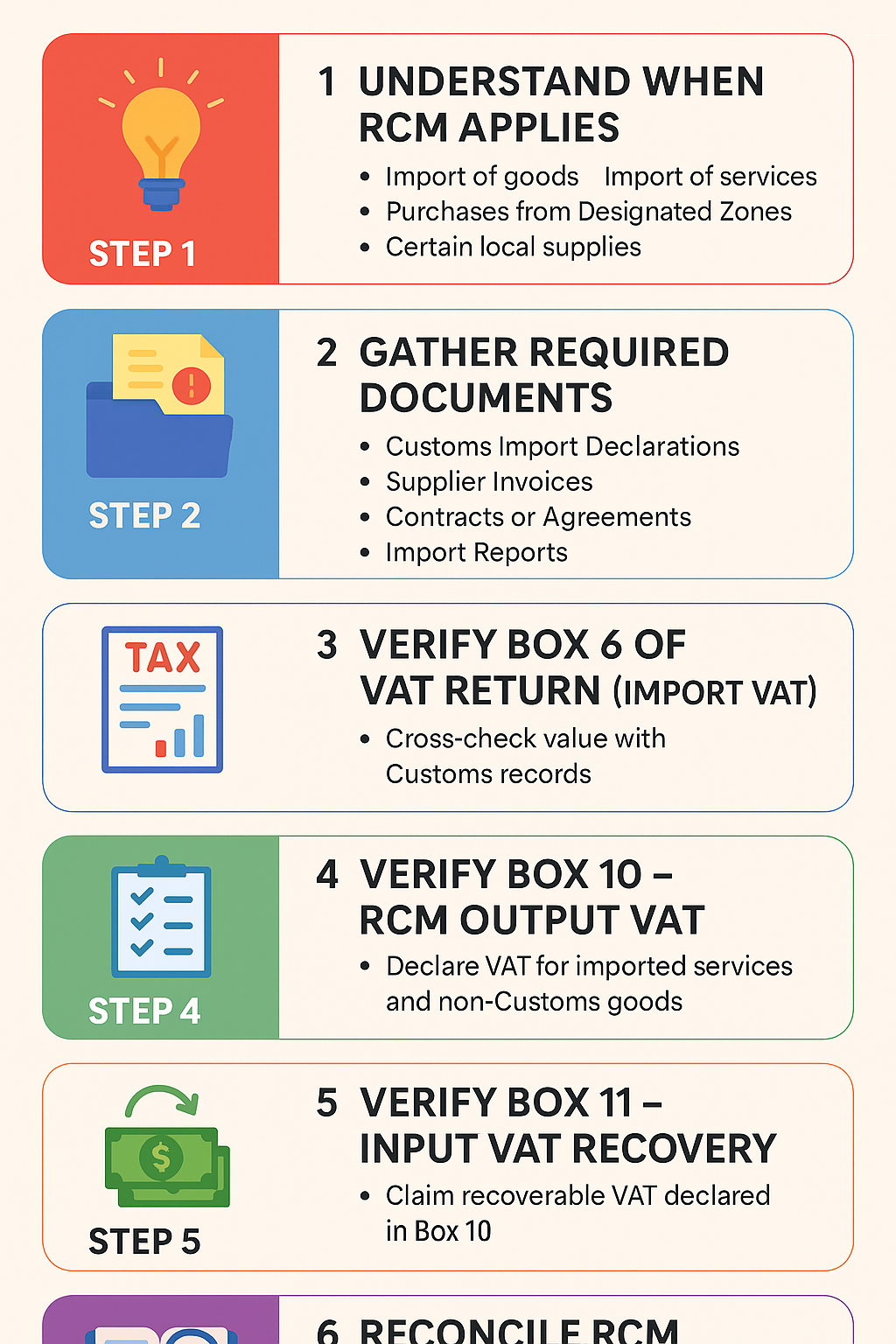
📌 Step 1: Understand When RCM Applies
Before you verify, know when RCM is relevant:
RCM typically applies to:
• Import of goods into the UAE (Customs-cleared)
• Import of services from outside the UAE
• Purchases from Designated Zones (if supply is considered to take place in UAE)
• Certain notified local supplies (e.g., crude oil, gold, hydrocarbons)
________________________________________
🗂 Step 2: Gather Required Documents
Collect and review the documents related to RCM transactions:
• Customs Import Declarations (Bills of Entry)
• Supplier Invoices from overseas vendors
• Contracts or Agreements for cross-border services
• Emirates Import Code Reports (from UAE Customs)
• Internal ledger entries
________________________________________
🧾 Step 3: Verify Box 6 of VAT Return (Import VAT)
This box is auto-populated in Form 201 based on your Customs records. It shows the VAT calculated on goods imported into the UAE.
✔️ Cross-check this value with:
• Total VAT from customs bills of entry (for the period)
• Emirates Import Report (downloadable from EmaraTax)
________________________________________
📤 Step 4: Verify Box 10 – RCM Output VAT
You must manually declare VAT under RCM for:
• Imported services
• Goods purchased from Free Zones or foreign suppliers (non-Customs)
✔️ Verify that:
• All applicable invoices are included
• Correct VAT rate (usually 5%) is applied
• Amount aligns with your input VAT claim
________________________________________
📥 Step 5: Verify Box 11 – Input VAT Recovery
This is where you recover the same VAT declared in Box 10 if you’re eligible (i.e., you make taxable supplies).
✔️ Confirm that:
• Only recoverable Input VAT is claimed
• There is no claim on exempt/non-business use
• Matching entries exist in Box 10
________________________________________
🔍 Step 6: Reconcile RCM Ledger Entries
Internally, you should maintain a Reverse Charge Ledger or Journal that:
• Lists every RCM transaction by date, supplier, and amount
• Shows Output VAT and matching Input VAT
• Helps you reconcile monthly or quarterly with VAT Return
________________________________________
📊 Sample RCM Journal Entry
Date Supplier Description Value (AED) Output VAT (AED) Input VAT (AED)
10-Jun-24 ABC Ltd (UK) Legal Consultancy 10,000 500 500
________________________________________
⚠️ Common Errors to Avoid
❌ Missing imported service entries in Box 10
❌ Claiming VAT without eligible use in Box 11
❌ Mismatch between Customs data and Box 6
❌ Double claiming RCM entries
________________________________________
✅ Best Practices
✔ Review all overseas supplier invoices each return period
✔ Match Customs VAT data to Box 6 entries
✔ Maintain a dedicated RCM ledger
✔ Consult your VAT advisor in case of uncertainty
________________________________________
🧠 Conclusion
Verifying RCM in your VAT return is essential to ensure full compliance and avoid unnecessary penalties. While the process may seem technical, a structured approach, good recordkeeping, and periodic reconciliation can help you stay fully compliant with UAE VAT laws.
🌐 Visit us: www.sa-auditors.com
📧 Email: info@sa-auditors.com
📱 WhatsApp: +971-XX-XXXXXXX

