How to Prepare for First Year of Corporate Tax
Introduction
With the introduction of UAE Corporate Tax (Federal Decree-Law No. 47 of 2022), businesses are entering a new era of compliance and reporting. The first year of Corporate Tax is particularly important because it sets the foundation for future tax filings, risk management, and planning strategies.
Whether a company is a small business, a Free Zone entity, or part of a large multinational group, early preparation is key to ensuring smooth compliance and avoiding costly penalties.
________________________________________
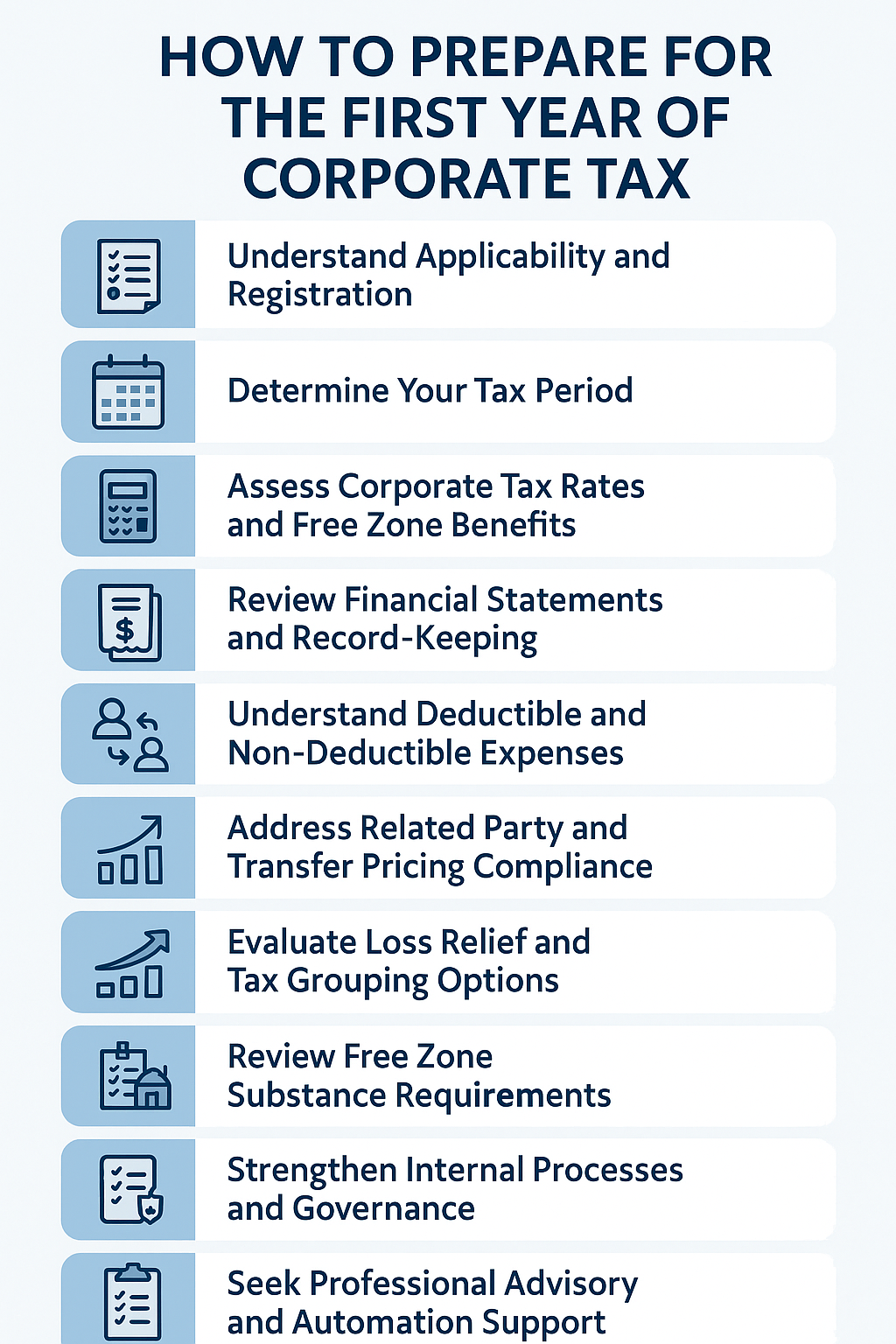
1. Understand Applicability and Registration
• Who is subject to Corporate Tax?
o All UAE-incorporated companies, including Free Zone Persons (subject to specific rules).
o Foreign entities with a permanent establishment (PE) or taxable presence in the UAE.
• Exempt Entities: Government entities, certain extractive industries, and charities (subject to conditions).
• Action Step: Register on the EmaraTax portal within the FTA-prescribed deadlines to obtain a Tax Registration Number (TRN).
________________________________________
2. Determine Your Tax Period
• The standard tax period is the financial year adopted by the company (usually 1 January to 31 December).
• Companies with different financial years (e.g., April–March) must align their tax filing deadlines accordingly.
• Action Step: Confirm your financial year and ensure your accounting system aligns with Corporate Tax reporting timelines.
________________________________________
3. Assess Corporate Tax Rates and Free Zone Benefits
• General Rate: 9% on taxable income above AED 375,000.
• Small Business Relief: Available if revenues are below AED 3 million (until 2026).
• Free Zone Incentives: Qualifying Free Zone Persons (QFZPs) may enjoy 0% tax on qualifying income if substance requirements are met.
• Action Step: Review whether your business qualifies for 0% tax treatment or small business relief.
________________________________________
4. Review Financial Statements and Record-Keeping
Financial statements are the backbone of Corporate Tax compliance.
• Ensure your books are prepared under IFRS/IFRS for SMEs as mandated.
• Segregate taxable income, exempt income, and out-of-scope transactions.
• Maintain records of:
o Invoices, contracts, and supporting documentation.
o Fixed asset registers (for depreciation claims).
o Related-party agreements (for Transfer Pricing compliance).
• Action Step: Strengthen bookkeeping and audit practices to ensure reliable financial data.
________________________________________
5. Understand Deductible and Non-Deductible Expenses
• Deductible: Salaries, rent, depreciation, utilities, R&D.
• Non-Deductible: Fines, penalties, personal expenses, certain entertainment costs.
• Interest Deduction: Subject to 30% EBITDA cap under the Interest Deduction Limitation Rule (IDLR).
• Action Step: Review expense classification to maximize deductions without triggering disallowances.
________________________________________
6. Address Related Party and Transfer Pricing (TP) Compliance
• Businesses with related-party transactions must comply with TP rules.
• Documentation required: Local File, Master File, Benchmarking (depending on thresholds).
• All intragroup transactions must follow the arm’s length principle.
• Action Step: Conduct a Transfer Pricing review and prepare documentation in advance.
________________________________________
7. Evaluate Loss Relief and Tax Grouping Options
• Losses can be carried forward and offset against future taxable income (subject to limits).
• Tax grouping allows consolidated filing where 95% ownership conditions are met.
• Action Step: Evaluate whether forming a tax group will benefit your structure.
________________________________________
8. Review Free Zone Substance Requirements
• QFZPs must:
o Maintain adequate substance in the UAE.
o Derive qualifying income (e.g., dividends, capital gains, transactions with other Free Zone entities).
o Avoid disqualifying activities with mainland UAE unless structured properly.
• Action Step: Assess operations to ensure compliance with Free Zone CT regulations.
________________________________________
9. Strengthen Internal Processes and Governance
• Establish a Corporate Tax compliance calendar with filing dates and reporting obligations.
• Train staff on tax documentation and reporting.
• Assign responsibility to a Tax Manager / Compliance Officer / External Auditor.
• Action Step: Integrate Corporate Tax readiness into internal policies and reporting frameworks.
________________________________________
10. Seek Professional Advisory and Automation Support
• Advisory: Consult tax advisors to assess your structure, evaluate exemptions, and plan strategies.
• Technology: Use accounting/ERP systems that integrate VAT + Corporate Tax reporting for efficiency.
• Action Step: Consider outsourcing compliance to professionals for the first year to avoid errors.
________________________________________
Conclusion
The first year of UAE Corporate Tax is a milestone that will shape the way businesses operate going forward. By taking proactive steps in registration, financial reporting, Transfer Pricing, expense classification, and Free Zone compliance, businesses can minimize risks while taking advantage of available reliefs.
Preparation today ensures smooth compliance tomorrow — positioning your business for growth under the new Corporate Tax regime.
________________________________________
✍️ By Sheikh Anwar Accounting and Auditing LLC (SA-Auditors)
📍 Dubai, United Arab Emirates
🌐 www.sa-auditors.com | ✉️ info@sa-auditors.com