How to Handle Foreign Currency Invoices in VAT
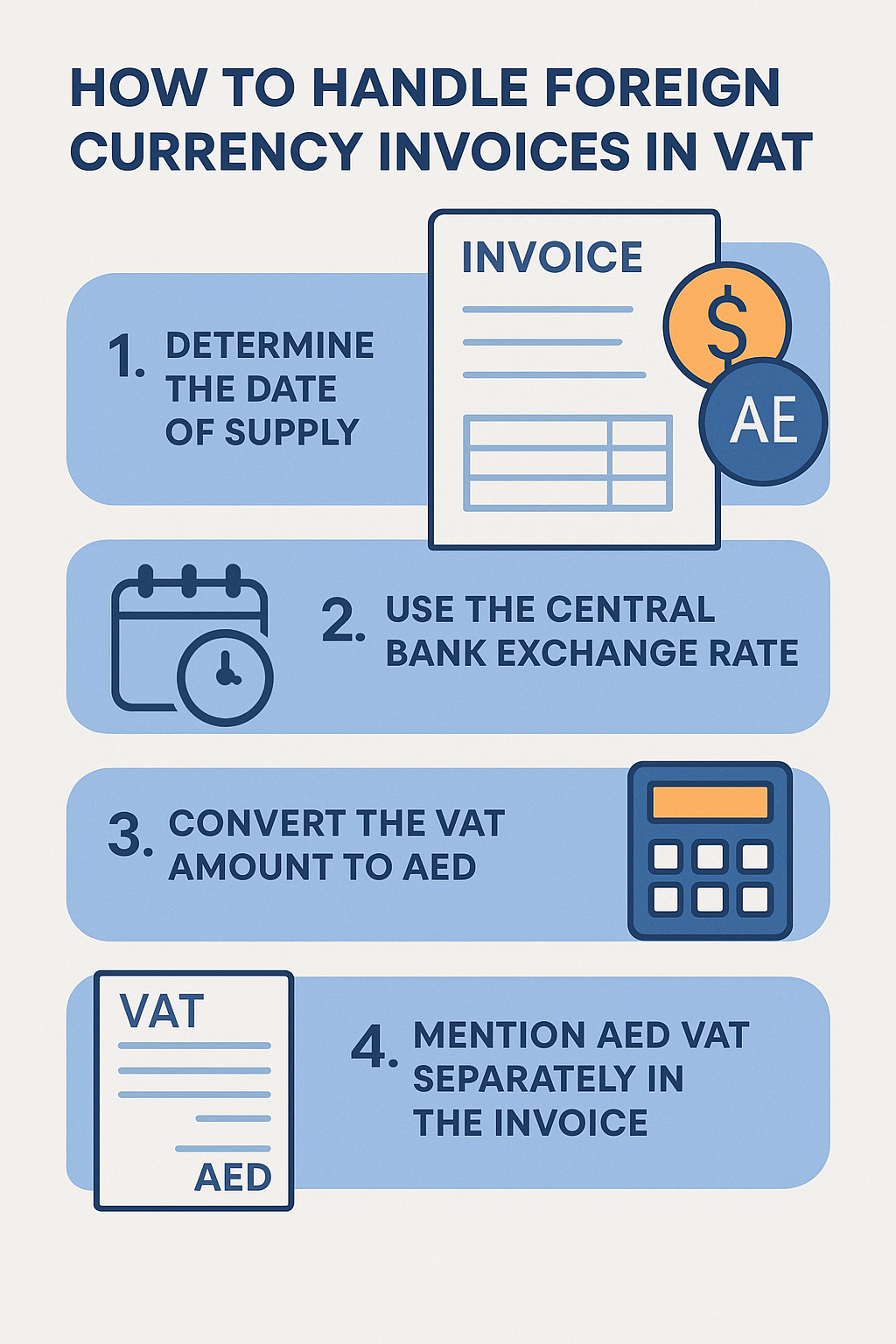
🌍 How to Handle Foreign Currency Invoices in VAT – UAE Guide
In today's globalized economy, many UAE businesses engage in cross-border transactions and issue or receive invoices in foreign currencies like USD, EUR, GBP, etc. But when it comes to Value Added Tax (VAT), the UAE Federal Tax Authority (FTA) requires all VAT amounts to be recorded and reported in UAE Dirhams (AED).
So, how do you handle foreign currency invoices under UAE VAT Law?
Let’s break it down.
________________________________________
✅ Legal Requirement: VAT Must Be in AED
According to Article 59 of the UAE Executive Regulations on VAT, even if the invoice is issued in a foreign currency, the VAT amount must be shown in UAE Dirhams (AED) using the exchange rate approved by the Central Bank of the UAE on the date of supply.
________________________________________
🔄 Step-by-Step: Handling Foreign Currency Invoices for VAT
1. Determine the Date of Supply
The date of supply is critical because the exchange rate applicable is based on this date. This could be:
• The date of invoice issuance,
• Date of payment, or
• Date goods/services are delivered (as per VAT rules)
2. Use the Central Bank Exchange Rate
Check the Central Bank of the UAE for the official exchange rate on the supply date.
📌 Visit: www.centralbank.ae
3. Convert the VAT Amount to AED
Use the official rate to convert the VAT portion of the foreign invoice to AED.
Example:
• Invoice in USD: $1,000
• 5% VAT = $50
• Central Bank rate = 3.67
• VAT in AED = 50 × 3.67 = AED 183.50
4. Mention AED VAT Separately in the Invoice
Clearly display the VAT amount in AED even if the rest of the invoice is in a foreign currency. This is required for the buyer to claim input VAT and for accurate VAT return filing.
________________________________________
🧾 Sample Invoice Format (in USD)
Description Amount (USD)
Product Value $1,000.00
VAT @ 5% (AED) AED 183.50
Total (USD) $1,000.00
________________________________________
⚠️ Common Mistakes to Avoid
❌ Using unofficial exchange rates (e.g., market or bank-specific rates)
❌ Not converting the VAT amount to AED
❌ Using the wrong date for exchange rate application
❌ Missing AED VAT details on invoices
________________________________________
📋 FTA VAT Return Filing
When filing VAT returns through the EmaraTax portal, all values must be in AED. If your records contain invoices in foreign currencies, you must:
• Convert values before entering them into the return
• Ensure proper exchange rate documentation is retained
________________________________________
🧑💼 Can You Use Accounting Software?
Yes, many VAT-compliant accounting software solutions in the UAE offer automatic currency conversion features using Central Bank rates. However, it's essential to verify their accuracy and audit logs.
________________________________________
📌 Conclusion
Handling foreign currency invoices under UAE VAT is straightforward if you follow the legal guidelines:
• Always convert VAT into AED using the Central Bank rate
• Mention the AED VAT clearly on invoices
• Maintain documentation of the exchange rates used
________________________________________
💼 Need Help with Foreign Currency VAT?
At Sheikh Anwar Accounting & Auditing LLC, we assist businesses with multi-currency invoicing, VAT compliance, and EmaraTax filing to avoid fines and ensure smooth operations.
📞 Reach out to us at www.sa-auditors.com for expert support.