How to File VAT Returns in the UAE
How to File VAT Returns in the UAE
Introduction
If your business is registered for Value Added Tax (VAT) in the UAE, filing VAT returns is a legal obligation. The return provides the Federal Tax Authority (FTA) with a summary of your sales, purchases, output VAT, and input VAT, and determines the net tax payable or refundable.
While the process is digital via the EmaraTax portal, accuracy is essential to avoid penalties and audits. In this guide, we’ll walk you through:
• What a VAT return is
• When and how often to file
• What information to include
• A step-by-step guide to submitting your return
• Penalties for non-compliance
________________________________________
What is a VAT Return?
A VAT return is a periodic submission that reports:
• Output VAT: VAT you collected on sales
• Input VAT: VAT you paid on business purchases
• Net VAT Payable or Refundable: Difference between output and input VAT
The standard form used is VAT201, filed via the FTA’s EmaraTax system.
________________________________________
When to File VAT Returns?
VAT returns are generally filed on a quarterly basis, but some businesses are assigned monthly filing by the FTA based on turnover.
🗓 Filing Deadline:
VAT returns must be filed within 28 days after the end of the tax period.
Example:
If your tax period ends on 30 June, your return must be submitted by 28 July.
________________________________________
Required Information for Filing
Before filing, gather:
• Sales and purchase invoices
• Credit and debit notes
• Import and export records
• Customs declarations (if applicable)
• Records of zero-rated, exempt, and reverse charge transactions
• Any input VAT adjustments
Using VAT-compliant accounting software makes this process easier.
________________________________________
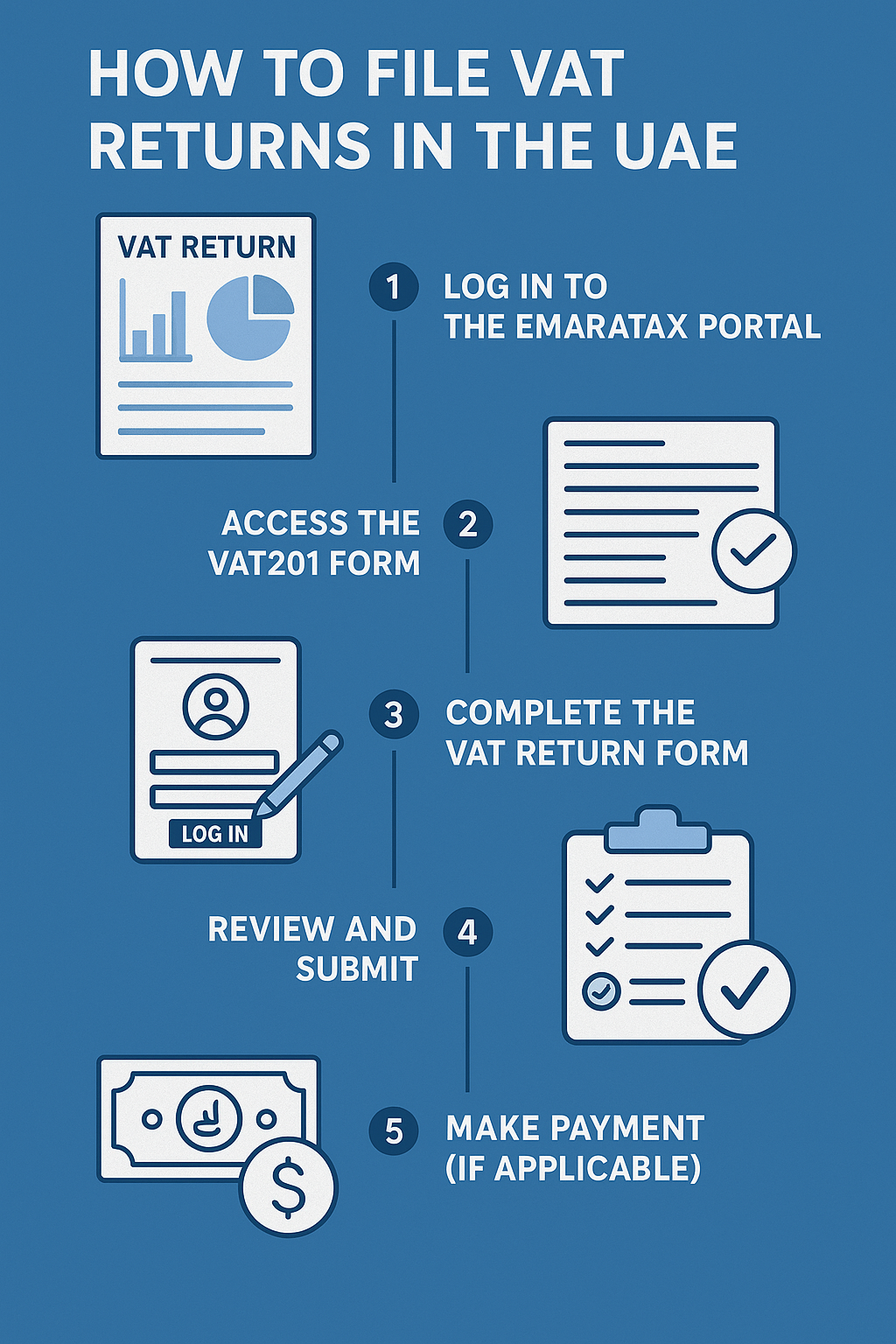
Step-by-Step Guide to Filing VAT Returns in UAE
🔹 Step 1: Log in to the EmaraTax Portal
• Visit: https://eservices.tax.gov.ae
• Enter your Emirates ID-linked credentials or email login
________________________________________
🔹 Step 2: Access the VAT201 Form
• On your dashboard, select “VAT”
• Click on your Taxable Person Record
• Click “File Return” under your respective tax period
________________________________________
🔹 Step 3: Complete the VAT Return Form
You’ll need to complete the following sections:
Section Description
Box 1 Standard-rated supplies (within the UAE)
Box 2 Taxable supplies in Designated Zones
Box 3 Zero-rated supplies
Box 4 Exempt supplies
Box 5 Total value of supplies
Box 6–9 Adjustments, goods imported, reverse charge
Box 10–12 Input VAT and recoverable amounts
Box 13 Net VAT due (payable or refundable)
Check your values carefully—errors can lead to penalties.
________________________________________
🔹 Step 4: Review and Submit
• Review the summary screen
• Ensure all values are accurate
• Click “Submit”
Once submitted, you will receive an acknowledgment and summary.
________________________________________
🔹 Step 5: Make Payment (If VAT is Payable)
• Go to My Payments section
• Choose “Pay Now”
• Pay via:
o e-Dirham
o Credit Card
o Bank transfer using GIBAN
Always keep proof of payment for your records.
________________________________________
Late Filing or Payment Penalties
Type Penalty
Late filing AED 1,000 (first time), AED 2,000 (repeat)
Late payment 2% of unpaid VAT immediately, 4% after 7 days, 1% daily (up to 300%)
Incorrect return AED 3,000 to AED 5,000, plus 50% of the unpaid tax
________________________________________
Tips for a Smooth Filing Experience
• Use VAT-compliant software for real-time calculations
• Reconcile input and output VAT monthly
• Set calendar reminders before the due date
• Always retain invoices, contracts, and customs records
• Seek professional help for complex cases or errors
________________________________________
Can You Amend a Submitted VAT Return?
Yes. If you discover an error within AED 10,000, you can amend it in your next return.
If it’s more than AED 10,000, you must file a Voluntary Disclosure Form (VAT211).
________________________________________
Conclusion
Filing VAT returns in the UAE is more than just data entry—it's a compliance duty that impacts your financial credibility and legal standing. With the right tools, records, and guidance, VAT return filing can be efficient and penalty-free.
Need assistance?
At Sheikh Anwar Accounting & Auditing LLC, we provide:
• Accurate VAT return filing
• EmaraTax portal management
• Voluntary disclosure and error correction
• Full VAT compliance reviews
📞 +971-58-562-1786
🌐 www.sa-auditors.com
✉️ info@sa-auditors.com