How Technology Will Reduce AML Compliance Costs
Introduction
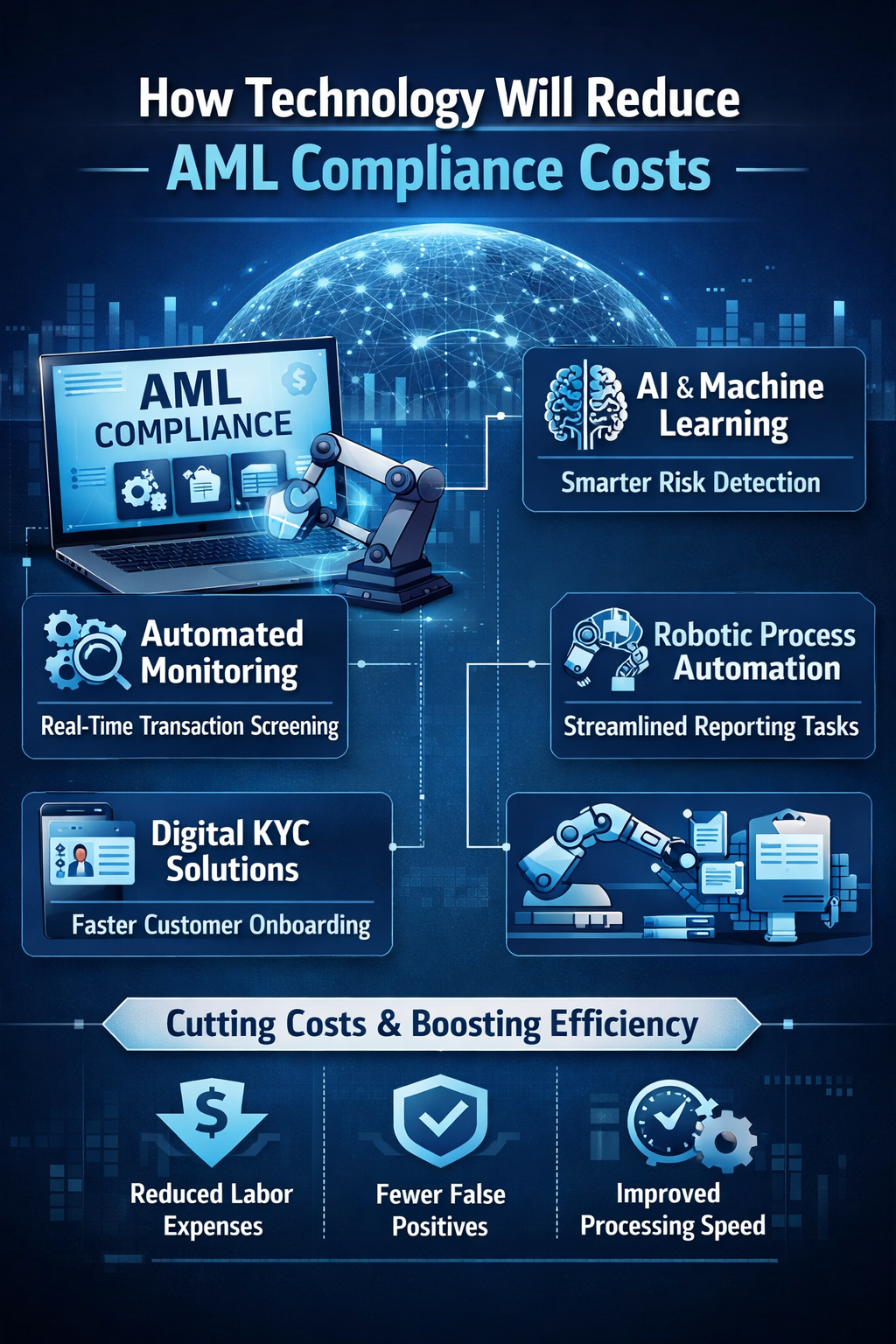
Anti-Money Laundering (AML) compliance has become one of the most resource-intensive obligations for financial institutions and regulated businesses worldwide. Companies must invest heavily in monitoring systems, compliance staff, reporting processes, and regulatory controls to prevent financial crime. As regulations continue to evolve, the cost of maintaining effective AML programs has increased significantly.
However, emerging technologies are transforming the compliance landscape. By automating processes, improving risk detection, and enhancing data analysis, technology can significantly reduce AML compliance costs while improving efficiency and accuracy.
________________________________________
1. Automation of Compliance Processes
Traditional AML compliance involves extensive manual processes such as customer due diligence (CDD), transaction monitoring, and report preparation. These activities often require large compliance teams and substantial operational costs.
Modern AML software solutions can automate many of these tasks, including:
• Customer identity verification (KYC)
• Sanctions and politically exposed persons (PEP) screening
• Transaction monitoring
• Suspicious activity reporting
Automation reduces the need for manual intervention, allowing compliance teams to focus on higher-risk cases and strategic oversight.
________________________________________
2. Artificial Intelligence for Transaction Monitoring
Artificial Intelligence (AI) is increasingly used to detect suspicious financial patterns that traditional rule-based systems may miss. AI-powered AML systems can analyze large volumes of financial transactions in real time and identify unusual activities more accurately.
Benefits of AI-driven monitoring include:
• Reduced false positive alerts
• Faster detection of suspicious transactions
• Improved accuracy in risk assessments
• Lower operational costs for financial institutions
By minimizing unnecessary alerts, organizations can significantly reduce investigation costs.
________________________________________
3. Machine Learning and Risk Scoring
Machine learning models can continuously learn from historical financial data and improve risk detection over time. These systems can automatically assign risk scores to customers based on their behavior, transaction patterns, and geographic risk factors.
This allows compliance teams to:
• Focus on high-risk customers
• Reduce time spent reviewing low-risk activities
• Improve overall AML efficiency
Such targeted monitoring helps organizations optimize resources and reduce compliance expenses.
________________________________________
4. Digital Identity Verification and e-KYC
Digital identity verification technologies allow institutions to verify customer identities remotely through biometric verification, document authentication, and database checks.
Electronic Know Your Customer (e-KYC) systems reduce costs associated with traditional onboarding processes by:
• Eliminating physical documentation requirements
• Accelerating customer onboarding
• Reducing manual verification procedures
These technologies enhance both compliance efficiency and customer experience.
________________________________________
5. RegTech Solutions for Compliance Management
Regulatory Technology (RegTech) platforms are designed specifically to help organizations manage regulatory obligations more efficiently. These platforms provide integrated compliance tools such as:
• Automated regulatory reporting
• Risk assessment dashboards
• Compliance workflow management
• Data analytics and monitoring
RegTech solutions allow companies to centralize compliance activities and reduce administrative overhead.
________________________________________
6. Improved Data Analytics and Reporting
Advanced data analytics enables organizations to analyze large datasets quickly and identify patterns associated with financial crime. This helps compliance teams make informed decisions and generate regulatory reports more efficiently.
Technology-driven reporting systems can also ensure accurate documentation and improve communication with regulatory authorities.
________________________________________
Conclusion
Technology is reshaping the future of AML compliance by making processes faster, more accurate, and significantly more cost-efficient. Automation, artificial intelligence, digital identity verification, and RegTech platforms are enabling organizations to maintain strong compliance frameworks while reducing operational costs.
As financial institutions and businesses continue to adopt these technological solutions, AML compliance will become more proactive, data-driven, and efficient.
Organizations that embrace technology will not only reduce compliance expenses but also strengthen their ability to detect and prevent financial crime in an increasingly complex financial environment.
________________________________________
About Sheikh Anwar Accounting & Auditing LLC
Sheikh Anwar Accounting & Auditing LLC is a Dubai-based professional advisory firm specializing in financial compliance, regulatory advisory, and audit services.
Our key services include:
• AML / CFT Compliance Advisory
• Corporate Tax Consultancy
• VAT Advisory and Filing Services
• Audit & Assurance
• Risk Assessment and Regulatory Compliance
We assist businesses across sectors including gold & jewellery trading, real estate, fintech, and financial services in meeting UAE regulatory requirements and strengthening compliance frameworks.
📍 Address: Dubai Creek Tower, M-35, Dubai, UAE
🌐 Website: www.sa-auditors.com
📧 Email: info@sa-auditors.com
📞 Phone: +971 50 625 2031