How RegTech Is Transforming AML Compliance in UAE
Introduction
The United Arab Emirates (UAE) has rapidly positioned itself as a leading international financial hub, attracting businesses across banking, trade, real estate, and digital assets. With this growth comes increased scrutiny from regulators to ensure robust Anti-Money Laundering (AML) and Counter-Terrorist Financing (CTF) controls. Traditional compliance approaches—manual reviews, rule-based systems, and fragmented reporting—are no longer sufficient in today’s high-volume, fast-moving financial environment.
Regulatory Technology (RegTech) is revolutionizing compliance by automating processes, improving accuracy, and enabling real-time monitoring. In the UAE, RegTech adoption is accelerating as regulators and businesses recognize its value in meeting evolving global and local AML requirements.
________________________________________
What Is RegTech in AML?
RegTech refers to the use of advanced technology—such as Artificial Intelligence (AI), Machine Learning (ML), data analytics, automation, and blockchain—to enhance regulatory compliance processes.
In AML, RegTech solutions are deployed to:
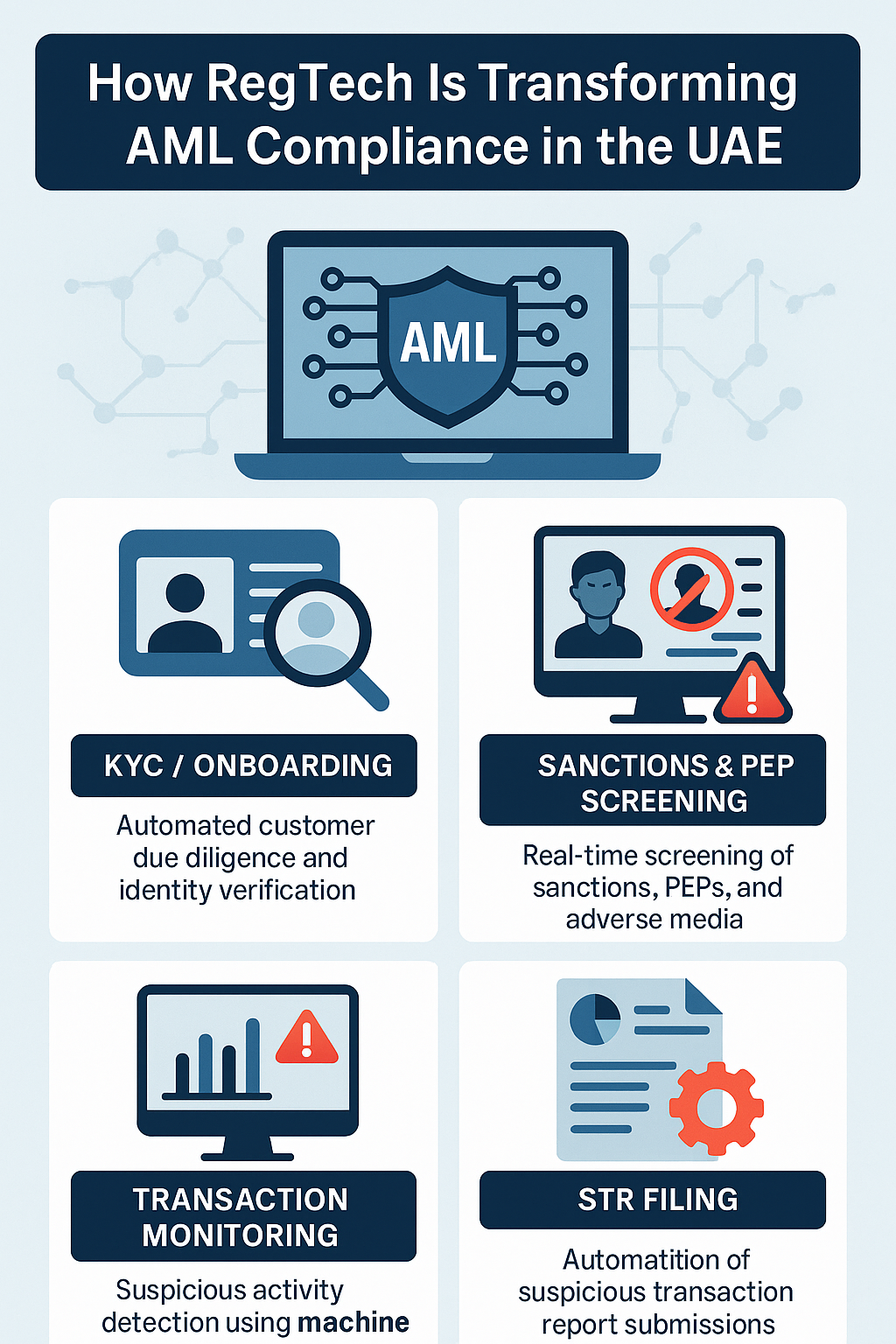
• Automate Customer Due Diligence (CDD) and KYC
• Screen against sanctions, PEP, and adverse media lists
• Monitor transactions for suspicious activity
• File Suspicious Transaction Reports (STRs) via goAML
• Maintain robust audit trails and compliance dashboards
These tools reduce manual burden, cut costs, and improve effectiveness, ensuring that financial institutions and DNFBPs (Designated Non-Financial Businesses and Professions) in the UAE remain regulator-ready.
________________________________________
Why the UAE Is Leading in RegTech Adoption
1. Regulatory Pressure
• Federal Decree-Law No. 20 of 2018 and Cabinet Decision No. 10 of 2019 set stringent AML obligations.
• Regulators like the Ministry of Economy, Central Bank, DIFC, and ADGM require entities to demonstrate effective compliance frameworks.
• Heavy penalties for AML breaches incentivize investment in advanced compliance technology.
2. High Transaction Volumes
• The UAE’s role as a global trade and financial hub creates massive data flows—cross-border payments, remittances, and digital transactions—that cannot be effectively monitored using manual systems.
3. Evolving Risks
• Complex money laundering typologies, including trade-based laundering, real estate misuse, and cryptocurrency exploitation, demand more sophisticated detection methods.
4. Government & Regulator Support
• Free zones like DIFC and ADGM actively promote innovation and host regulatory sandboxes for testing RegTech.
• UAE regulators themselves are embracing SupTech (Supervisory Technology) to strengthen oversight.
5. Operational Efficiency & Cost Reduction
• RegTech reduces repetitive compliance tasks, freeing teams to focus on investigations.
• Over time, automation lowers compliance costs compared to expanding manpower.
________________________________________
Core Applications of RegTech in UAE AML Compliance
Area How RegTech Transforms It UAE Application
KYC / Onboarding Biometric ID checks, eKYC, automated verification Integration with Emirates ID, residency data
Sanctions & PEP Screening AI-driven list matching, multi-language adverse media scanning Real-time screening across Arabic & English sources
Transaction Monitoring ML models detect anomalies & hidden patterns Tailored for UAE’s trade, remittance, and gold/jewelry sectors
STR Filing Automated case building & submission Direct integration with UAE FIU goAML portal
Regulatory Change Management Automated alerts on new circulars or laws UAE AML law & free zone rulebook updates
Audit & Documentation Immutable logs, compliance dashboards Evidence for MOE & Central Bank inspections
________________________________________
Benefits of RegTech for UAE Businesses
• Enhanced Detection – Identifies sophisticated laundering methods beyond static rules.
• Reduced False Positives – Improves efficiency by focusing only on high-risk alerts.
• Regulatory Confidence – Provides auditable evidence of AML compliance.
• Scalability – Handles UAE’s high transaction volumes across diverse sectors.
• Cost Savings – Reduces manpower and penalties through smarter compliance.
________________________________________
Challenges in Implementation
1. Data Quality & Integration – Incomplete or fragmented data reduces model accuracy.
2. Model Explainability – Regulators demand transparency in AI-driven decisions.
3. Legacy Systems – Many firms must modernize IT infrastructure to adopt RegTech.
4. Vendor Risk – Choosing reliable RegTech providers is critical for compliance success.
5. Costs – Initial investment can be significant, especially for SMEs and DNFBPs.
________________________________________
Best Practices for Successful Adoption
• Start Small, Scale Fast – Pilot RegTech in one function (e.g., KYC) before full rollout.
• Combine Tech with Human Oversight – Use AI for detection, but keep compliance officers in control.
• Engage Regulators Early – Seek approval and feedback to ensure alignment with UAE AML standards.
• Invest in Training – Staff must understand both the technology and AML laws.
• Monitor & Improve Continuously – Regularly retrain ML models to adapt to new risks.
________________________________________
The Future of RegTech in UAE AML
• Explainable AI (XAI): Regulators will demand greater transparency in AI decisions.
• Blockchain-Based Identity Solutions: UAE may adopt decentralized eKYC platforms.
• Crypto-Focused RegTech: As the UAE regulates Virtual Asset Service Providers (VASPs), blockchain analytics tools will play a major role.
• Regulator-Driven SupTech: Authorities will use RegTech themselves to monitor entities in real time.
• Collaborative Platforms: Shared industry-wide AML intelligence systems could emerge across the GCC.
________________________________________
Conclusion
RegTech is no longer optional—it is the future of AML compliance in the UAE. By embracing technology, businesses can detect financial crime more effectively, reduce operational costs, and build regulator confidence. While challenges exist, a risk-based, phased, and well-governed approach to RegTech adoption will allow both financial institutions and DNFBPs to thrive in a compliance-driven market.
________________________________________
About Us
Sheikh Anwar Accounting and Auditing LLC is a UAE-based auditing and compliance advisory firm specializing in AML, VAT, and Corporate Tax compliance. We support businesses in adopting RegTech-driven AML monitoring solutions and provide outsourced MLRO and training services.
📧 Email: info@sa-auditors.com
🌐 Website: www.sa-auditors.com
☎️ Contact: +971 4 123 4567