How Jewellery Shops Faced AML Penalties in UAE
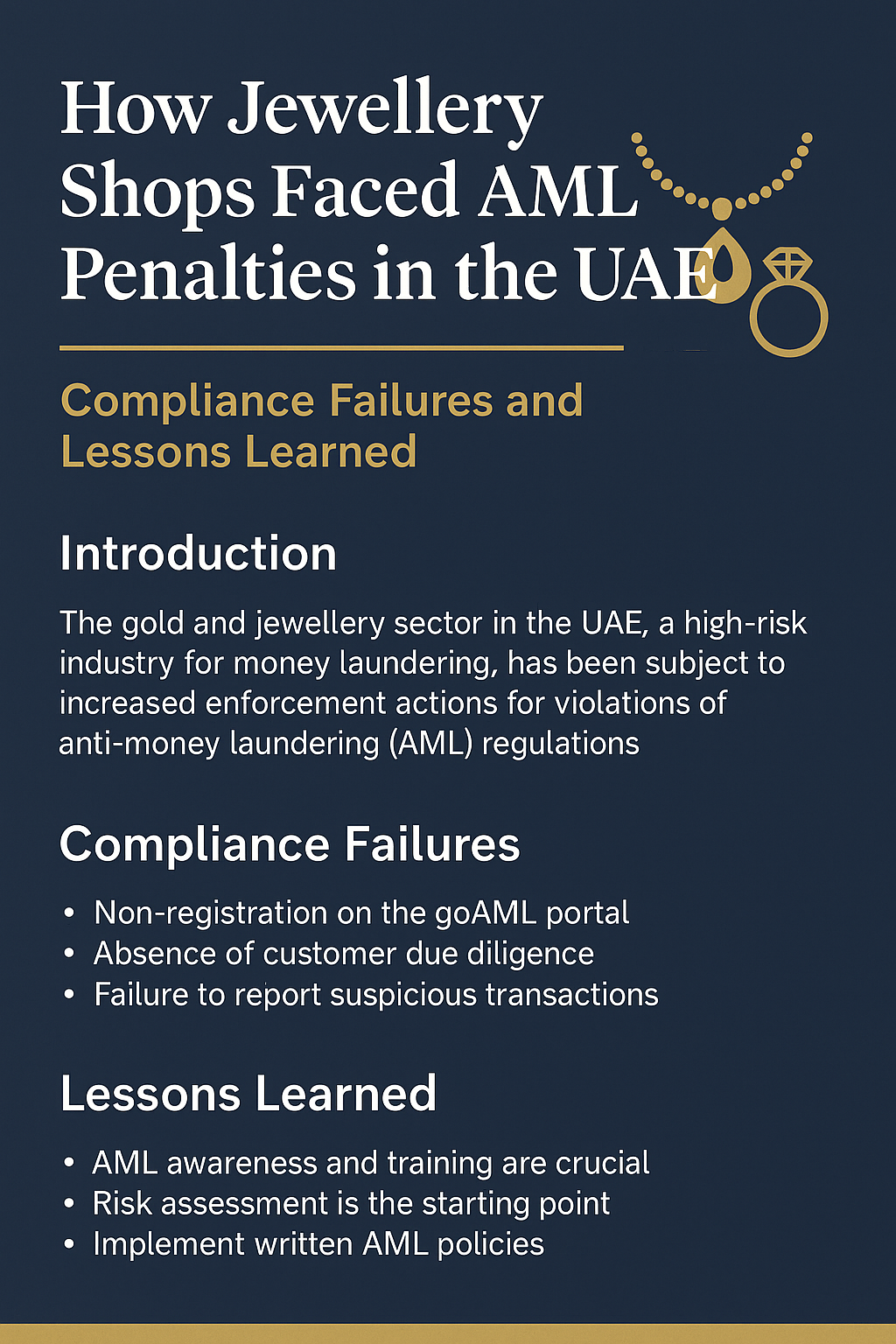
Introduction
The gold and jewellery industry has long been a cornerstone of the UAE’s economy, contributing significantly to trade, tourism, and employment. However, its cash-intensive nature, cross-border dealings, and high-value transactions make it a prime target for money laundering (ML) and terrorist financing (TF) activities.
In response to international expectations and Financial Action Task Force (FATF) recommendations, the UAE has intensified enforcement actions against Designated Non-Financial Businesses and Professions (DNFBPs)—particularly jewellery shops and precious metal traders—for non-compliance with Anti-Money Laundering (AML) laws.
This examines how jewellery businesses in the UAE faced AML penalties, the specific compliance failures identified, and the lessons other businesses can learn to avoid similar sanctions.
________________________________________
1. The Regulatory Framework for Jewellery Sector AML Compliance
Jewellery and precious metal traders in the UAE are classified as DNFBPs under:
• Federal Decree-Law No. (20) of 2018 – On Anti-Money Laundering and Combating the Financing of Terrorism and Illegal Organisations.
• Cabinet Decision No. (10) of 2019 – Executive Regulations outlining AML obligations.
• Cabinet Decision No. (16) of 2021 – Administrative penalties for AML non-compliance.
Supervision of this sector is carried out by the Ministry of Economy (MOE), which monitors traders registered in both the mainland and free zones.
All jewellery businesses are required to:
• Register on the goAML portal.
• Conduct Customer Due Diligence (CDD) for every transaction.
• File Suspicious Transaction Reports (STRs) and Designated Precious Metals and Stones Reports (DPMSRs).
• Maintain AML policies, procedures, and risk assessments.
________________________________________
2. Overview of AML Enforcement in the Jewellery Sector
Between 2022 and 2024, the Ministry of Economy imposed millions of dirhams in fines against jewellery shops across the UAE for AML non-compliance.
Key enforcement highlights:
• More than 200 jewellery and gold trading companies were fined for failure to comply with AML obligations.
• Penalties ranged from AED 50,000 to AED 5 million, depending on the severity of the violation.
• Several shops were issued warnings and suspension notices, while some cases were referred to Public Prosecution for repeated non-compliance.
These actions followed multiple on-site inspections conducted by the MOE as part of the UAE’s efforts to enhance AML oversight in the DNFBP sector.
________________________________________
3. Common AML Failures by Jewellery Shops
a. Non-Registration on goAML Platform
A large number of jewellers failed to register with the UAE Financial Intelligence Unit’s (FIU) goAML system.
This is a mandatory requirement for all DNFBPs to report suspicious transactions.
Unregistered entities were fined between AED 50,000 and AED 200,000, even if no illicit transaction had occurred.
________________________________________
b. Absence of Customer Due Diligence (CDD)
Regulators found that many jewellery shops:
• Did not collect or verify customer identification documents.
• Accepted high-value purchases in cash without documenting source of funds.
• Ignored Enhanced Due Diligence (EDD) requirements for Politically Exposed Persons (PEPs) or foreign customers.
This directly violated Articles 4 and 5 of Cabinet Decision No. (10) of 2019.
________________________________________
c. Lack of Internal AML Policies and Procedures
Many traders operated without a written AML policy or internal control framework.
Regulatory audits found that:
• There was no appointment of a Compliance Officer or MLRO.
• Risk assessments were missing or generic.
• Employees were unaware of AML reporting procedures.
Without formal policies, businesses were unable to demonstrate compliance readiness.
________________________________________
d. Failure to Report Suspicious Transactions
Despite identifying unusual or high-value purchases, several jewellers:
• Did not submit Suspicious Transaction Reports (STRs) or DPMSRs.
• Lacked training to recognize red flags such as multiple small cash purchases by the same individual or third-party payments.
This was viewed by regulators as a serious breach, with fines reaching up to AED 1 million in certain cases.
________________________________________
e. Record-Keeping and Transaction Documentation Failures
The law requires DNFBPs to maintain transaction and CDD records for at least five years.
Many businesses failed to maintain:
• Copies of customer documents.
• Cash transaction logs exceeding AED 55,000.
• Training and compliance reports.
These deficiencies resulted in non-compliance with Article 16 of Cabinet Decision No. (10) of 2019.
________________________________________
4. Notable AML Penalty Cases in the UAE Jewellery Industry
Case 1: Gold Retailers Fined for AML Negligence (2023)
In mid-2023, the MOE imposed AED 22 million in fines against a group of jewellery and gold traders across Dubai and Sharjah.
Violations included:
• Failure to register on goAML.
• Absence of AML risk assessments.
• Inadequate CDD and record-keeping.
These enforcement actions were part of a nationwide inspection campaign targeting over 6,000 DNFBPs.
________________________________________
Case 2: Dubai-Based Jeweller Penalized for Cash Transactions
A luxury jewellery shop in Dubai was fined AED 500,000 after accepting multiple cash payments above AED 55,000 without filing the required DPMSR.
The inspection revealed:
• No awareness of the reporting threshold.
• No internal AML policy or compliance officer.
• Incomplete customer identification records.
This case demonstrated regulators’ zero-tolerance approach to AML ignorance.
________________________________________
Case 3: Repeat Offenders Referred for Prosecution (2024)
The MOE referred several jewellery companies to the Public Prosecution for repeat non-compliance despite previous warnings.
These businesses were found to have:
• Ignored corrective instructions.
• Continued operating without AML frameworks.
• Failed to respond to regulatory inquiries.
Such cases are now treated as criminal violations under UAE AML law.
________________________________________
5. Lessons for Jewellery Businesses
✅ Lesson 1: AML Awareness and Training Are Crucial
Every staff member—from the sales associate to the owner—must understand:
• How to identify suspicious customers or transactions.
• When and how to file STRs or DPMSRs.
• The penalties for non-reporting.
Regular training sessions are mandatory under MOE guidelines.
________________________________________
✅ Lesson 2: Risk Assessment Is the Starting Point
Every jewellery company must conduct an AML Risk Assessment to identify exposure based on:
• Customer type,
• Geography,
• Product and service risks, and
• Transaction methods (cash, transfer, etc.).
The assessment should be documented, reviewed annually, and signed by management.
________________________________________
✅ Lesson 3: Register and Report through goAML
• Register immediately on goAML.
• Assign a trained compliance officer to handle reporting.
• Maintain a log of all filed and pending reports for audit purposes.
________________________________________
✅ Lesson 4: Implement Written AML Policies
Develop and enforce:
• An AML Policy Manual tailored to the business.
• Procedures for CDD, EDD, STR filing, and record retention.
• A governance framework defining compliance responsibilities.
________________________________________
✅ Lesson 5: Maintain Proper Records
Ensure documentation for:
• All cash transactions above AED 55,000.
• All CDD information and ID copies.
• AML training logs and internal audit reports.
These will serve as evidence during MOE inspections.
________________________________________
6. The Road Ahead – Regulator Expectations
The UAE Ministry of Economy has made it clear that jewellery traders must demonstrate proactive AML compliance.
Future inspections will emphasize:
• Enterprise-wide AML risk assessments.
• Use of digital compliance tools.
• Board-level accountability for AML failures.
Firms that continue to neglect AML obligations risk license suspension, financial penalties, and criminal prosecution.
________________________________________
Conclusion
The penalties imposed on UAE jewellery businesses reflect the regulators’ determination to eliminate AML weaknesses and align with international standards.
Jewellery shops must transition from a reactive to a proactive compliance model—adopting digital screening systems, conducting proper risk assessments, and ensuring consistent staff training.
Compliance is not just a legal requirement; it is essential to protect business integrity, customer trust, and the UAE’s reputation as a global trade hub.
________________________________________
About Sheikh Anwar Accounting & Auditing LLC
Sheikh Anwar Accounting & Auditing LLC (MOE Entry No. 5817) is a leading UAE-licensed firm specializing in AML/CFT compliance audits, risk assessments, and AML training programs for gold and jewellery businesses.
Our experts assist DNFBPs in implementing full AML frameworks—covering risk analysis, policy creation, goAML registration, and regulatory inspection readiness.
📍 Office: Dubai Creek Tower, M-35, Dubai, UAE
📞 Phone: +971 4 000 0000
📧 Email: info@sa-auditors.com
🌐 Website: www.sa-auditors.com