How AML Laws Protect the UAE Financial System
Introduction
The United Arab Emirates (UAE) has rapidly evolved into a global financial and trade hub, attracting investors, entrepreneurs, and multinational corporations. However, with its open economy and strategic location comes the challenge of money laundering and illicit financial flows. To safeguard its financial system, the UAE has developed strong Anti-Money Laundering (AML) laws and regulations that align with global standards.
These laws not only protect the integrity of the UAE economy but also help businesses maintain credibility and trust in international markets.
________________________________________
Why AML Laws Are Important for the UAE
Money laundering threatens the financial system in several ways:
• It allows criminals to disguise illegal proceeds, damaging economic transparency.
• It can finance terrorism and organized crime, threatening national security.
• It undermines investor confidence in financial markets.
• It exposes businesses and financial institutions to reputational and legal risks.
By enforcing strong AML laws, the UAE ensures that its financial system remains transparent, trusted, and internationally compliant.
________________________________________
Key AML Laws in the UAE
The UAE has enacted comprehensive legislation to prevent and combat money laundering:
• Federal Decree-Law No. 20 of 2018 – The primary AML law, targeting money laundering and terrorism financing.
• Cabinet Decision No. 10 of 2019 – Detailed implementing regulations for compliance obligations.
• Federal Decree-Law No. 26 of 2021 – Strengthened supervisory powers and penalties.
• Cabinet Decision No. 111 of 2022 – Enhanced obligations for Designated Non-Financial Businesses and Professions (DNFBPs).
These laws are enforced by regulators such as the Central Bank of the UAE, Ministry of Economy, Securities and Commodities Authority, and the Financial Intelligence Unit (FIU).
________________________________________
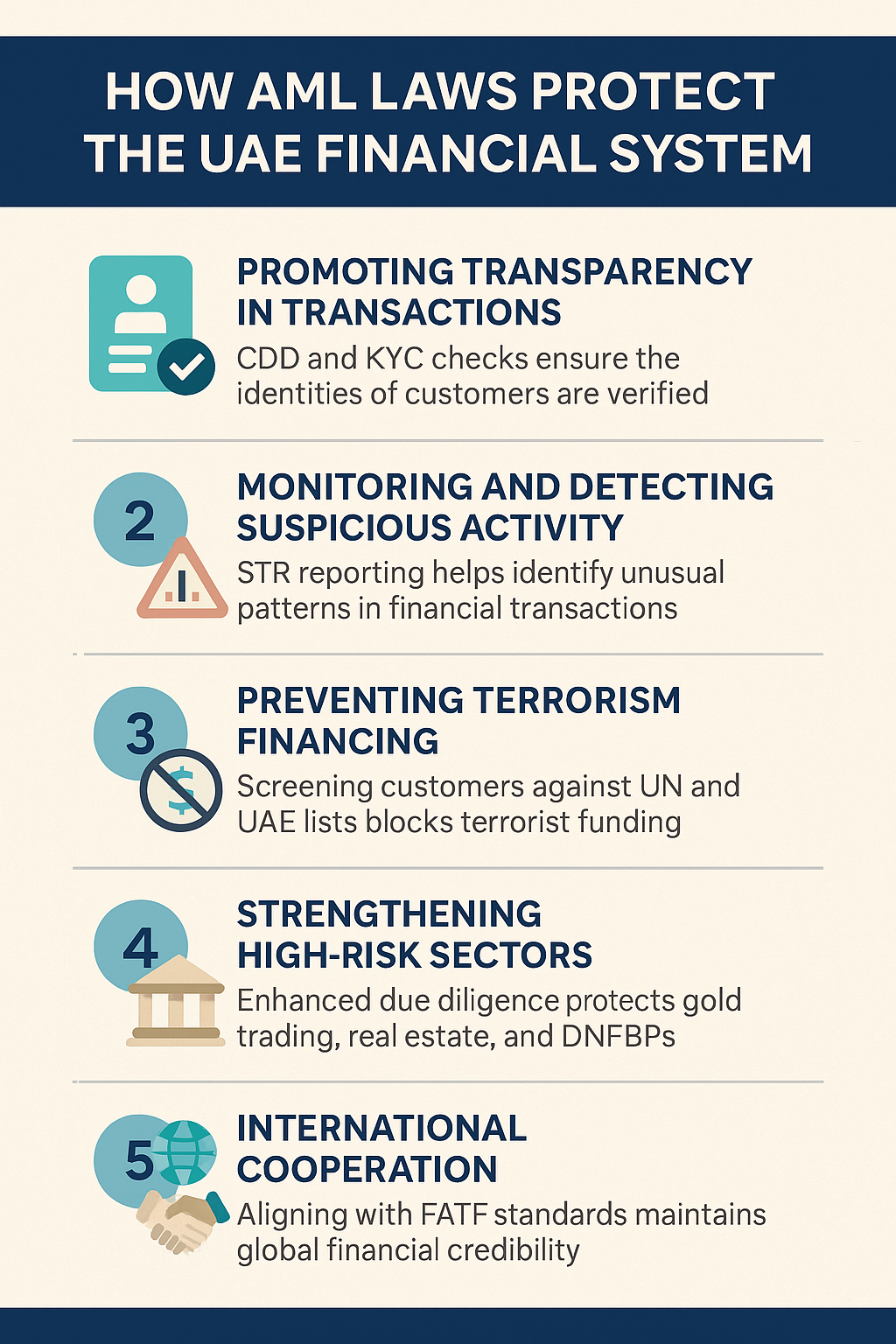
How AML Laws Protect the UAE Financial System
1. Promoting Transparency in Transactions
AML laws require businesses and financial institutions to perform Customer Due Diligence (CDD) and Know Your Customer (KYC) checks. This ensures that clients’ identities, sources of funds, and ultimate beneficial owners (UBOs) are clearly documented, preventing anonymity in financial dealings.
2. Monitoring and Detecting Suspicious Activity
Under UAE AML rules, companies must report Suspicious Transaction Reports (STRs) to the FIU through the goAML platform. This monitoring helps identify unusual patterns, trade-based laundering, and cross-border risks.
3. Preventing Terrorism Financing
AML laws integrate Counter-Terrorism Financing (CTF) measures by requiring businesses to screen customers against UN and UAE terrorism sanction lists. This ensures that funds do not support extremist groups.
4. Strengthening High-Risk Sectors
The UAE has identified gold trading, real estate, and DNFBPs as high-risk sectors. AML regulations impose enhanced due diligence in these industries to ensure that criminals cannot exploit them for laundering illicit money.
5. International Cooperation
As a member of the Financial Action Task Force (FATF), the UAE aligns with international AML standards. This helps the country maintain global financial credibility, avoid grey-list risks, and strengthen ties with foreign investors and institutions.
6. Deterrence Through Penalties
AML laws include heavy fines (AED 50,000 to AED 5 million), suspension of licenses, and even imprisonment for non-compliance. These penalties act as a deterrent, encouraging businesses to prioritize compliance.
________________________________________
Impact on UAE Businesses
For businesses, AML compliance is no longer optional—it is essential for survival and growth. Proper adherence:
• Protects businesses from regulatory penalties.
• Builds client and investor confidence.
• Reduces exposure to financial crimes.
• Ensures alignment with global partners.
________________________________________
Conclusion
AML laws play a crucial role in protecting the UAE’s financial system from abuse by criminals and terrorists. By promoting transparency, monitoring transactions, and enforcing strict compliance, these laws strengthen the UAE’s reputation as a secure, reliable, and globally integrated economy.
For businesses, compliance with AML regulations is not just about avoiding fines—it is about contributing to a safer financial system and maintaining trust in one of the world’s fastest-growing economies.
________________________________________
About Sheikh Anwar Accounting and Auditing LLC
At Sheikh Anwar Accounting and Auditing LLC, we provide specialized support in AML compliance, audits, corporate tax, and VAT advisory. We help high-risk sector businesses, including gold and diamond traders, real estate firms, and DNFBPs, to establish strong compliance frameworks, perform ongoing monitoring, and train staff to detect red flags.
• 📍 Head Office: Dubai, UAE
• 🌐 Website: www.sa-auditors.com
• 📧 Email: info@sa-auditors.com