Global AML Standards vs UAE AML Laws
Introduction
Money laundering is a global issue that undermines financial systems, fuels organized crime, and threatens national security. To combat this, international bodies like the Financial Action Task Force (FATF) set global standards that countries adopt into their domestic frameworks.
The United Arab Emirates (UAE), being a major financial and trade hub, has aligned its AML laws with these international standards while tailoring them to its unique economy—particularly high-risk sectors such as gold trading, real estate, and corporate services.
This explores how global AML standards compare with UAE AML laws, and what it means for businesses operating in the UAE.
________________________________________
Global AML Standards (FATF Framework)
The Financial Action Task Force (FATF) is the leading international body that sets AML and Counter-Terrorism Financing (CTF) guidelines. Its 40 Recommendations form the basis for AML laws worldwide.
Key Global Standards:
1. Risk-Based Approach (RBA): Countries and businesses must assess and mitigate money laundering risks proportionately.
2. Customer Due Diligence (CDD): Identifying and verifying customers, beneficial owners, and monitoring transactions.
3. Suspicious Transaction Reporting (STRs): Mandatory reporting to national Financial Intelligence Units (FIUs).
4. Record-Keeping: Businesses must retain documents for at least five years.
5. Sanctions & PEP Screening: Businesses must check customers against sanctions lists and Politically Exposed Persons (PEPs).
6. International Cooperation: Countries must share information across borders to combat global financial crime.
7. High-Risk Sectors: Additional measures for sectors vulnerable to money laundering, such as banking, real estate, and precious metals.
________________________________________
UAE AML Laws
The UAE has developed a robust AML framework based on FATF standards, with additional local requirements.
Key Legislations:
• Federal Decree-Law No. 20 of 2018 – Main AML-CFT law.
• Cabinet Decision No. 10 of 2019 – Implementing regulations.
• Federal Decree-Law No. 26 of 2021 – Strengthened penalties and supervisory powers.
• Cabinet Decision No. 111 of 2022 – Expanded DNFBP obligations.
Supervisory Authorities:
• Ministry of Economy (MoE): Supervises DNFBPs (auditors, real estate, gold dealers, corporate service providers).
• Central Bank of the UAE (CBUAE): Oversees banks, exchange houses, and finance companies.
• Securities and Commodities Authority (SCA): Supervises securities and investment sectors.
• Financial Intelligence Unit (FIU): Receives and analyzes STRs and CTRs through the goAML platform.
UAE-Specific Measures:
1. Cash Transaction Reporting (CTR): Mandatory reporting of cash transactions above AED 55,000.
2. Ultimate Beneficial Ownership (UBO): Mandatory disclosure of ownership for companies registered in the UAE.
3. High-Risk Sector Oversight: Special focus on gold & jewellery, real estate, and free zones.
4. goAML Portal: A centralized digital system for STR/CTR filing, unique to the UAE.
5. Severe Penalties: Non-compliance fines range from AED 50,000 to AED 5 million, with possible imprisonment.
________________________________________
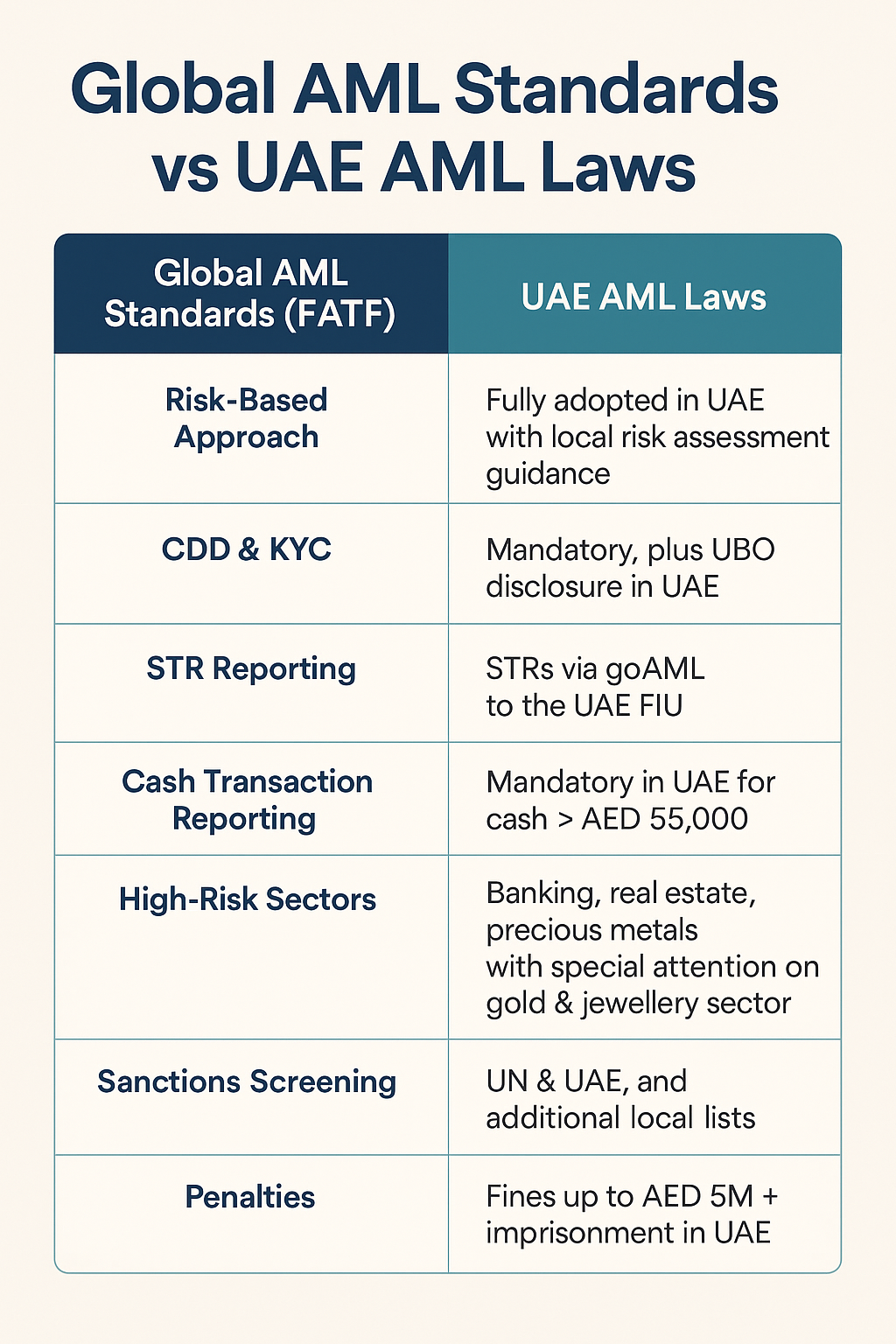
Global Standards vs UAE AML Laws – Key Comparisons
Aspect Global AML Standards (FATF) UAE AML Laws
Risk-Based Approach Required globally. Fully adopted in UAE with local risk assessment guidance.
CDD & KYC Mandatory. Mandatory, plus UBO disclosure in UAE.
STR Reporting FIUs globally. STRs via goAML to the UAE FIU.
Cash Transaction Reporting Recommended globally (varies by country). Mandatory in UAE for cash > AED 55,000.
High-Risk Sectors Banking, real estate, precious metals. Same focus, with special attention on gold & jewellery sector.
Sanctions Screening UN & national sanctions lists. UN, UAE, and additional local lists.
Penalties Country-specific. Fines up to AED 5M + imprisonment in UAE.
________________________________________
Impact on UAE Businesses
• Compliance Is Mandatory: Both financial institutions and DNFBPs must implement AML programs.
• Global Alignment: UAE’s adherence to FATF standards makes businesses more credible to international partners.
• Local Challenges: Businesses must also navigate UAE-specific requirements such as CTR filing, UBO disclosure, and goAML system integration.
• Reputational Protection: Strong AML compliance safeguards companies from penalties, blacklisting, and reputational harm.
________________________________________
Conclusion
While the UAE’s AML laws are aligned with global FATF standards, they also incorporate additional local measures to reflect the country’s economic structure and high-risk sectors. For businesses, this means compliance is not optional—it is a necessity to operate legally, maintain credibility, and contribute to the UAE’s global reputation as a transparent and trusted financial hub.
________________________________________
About Sheikh Anwar Accounting and Auditing LLC
At Sheikh Anwar Accounting and Auditing LLC, we help businesses meet both global AML standards and UAE-specific AML requirements. Our services include:
• AML risk assessments and policy drafting.
• STR/CTR filing via goAML.
• UBO compliance and reporting support.
• Outsourced MLRO and compliance officer services.
• Staff training on AML best practices.
• 📍 Head Office: Dubai, UAE
• 🌐 Website: www.sa-auditors.com
• 📧 Email: info@sa-auditors.com