Future of RegTech in UAE AML Compliance
Introduction
As the UAE accelerates its transformation into a global financial hub, regulatory technology (RegTech) has become the cornerstone of effective Anti-Money Laundering (AML) and Counter-Terrorist Financing (CTF) compliance.
Driven by ambitious government initiatives such as Operation 300bn, AI Strategy 2031, and the UAE’s commitment to FATF compliance, financial institutions and DNFBPs are adopting RegTech solutions to manage compliance risks, enhance transparency, and strengthen trust in the financial system.
It explores how RegTech is reshaping AML compliance in the UAE — from automation and AI-driven analytics to blockchain-powered transparency — and what the future holds for regulators and businesses alike.
________________________________________
1. What Is RegTech?
RegTech (Regulatory Technology) refers to the use of advanced technologies — such as artificial intelligence, machine learning, blockchain, and cloud computing — to help organizations comply with regulatory requirements efficiently and accurately.
In the context of AML compliance, RegTech provides:
• Automated KYC and CDD verification
• Real-time transaction monitoring
• Blockchain analytics for virtual assets
• AI-driven suspicious activity detection
• Digital reporting and audit trail management
These innovations reduce manual workloads, minimize human error, and enhance regulatory responsiveness.
________________________________________
2. Why RegTech Matters in UAE AML Compliance
The UAE’s dynamic economy, global trade flows, and emerging digital asset sector have elevated its AML risk exposure.
To meet FATF and domestic expectations, organizations need tools that can:
• Process large data volumes across multiple systems.
• Detect complex money-laundering patterns in real-time.
• Maintain full auditability for regulatory inspections.
RegTech bridges these requirements by enabling “compliance by design” — embedding automation and intelligence into every stage of AML operations.
________________________________________
3. The Current AML Regulatory Landscape in the UAE
The UAE’s AML framework is built on the following key pillars:
Legislation / Regulation Objective
Federal Decree-Law No. 20 of 2018 Defines AML/CFT obligations and penalties.
Cabinet Decision No. 10 of 2019 Establishes implementing regulations and risk-based approach.
Cabinet Decision No. 109 of 2023 Introduces updated framework for Virtual Asset Service Providers (VASPs).
FATF Mutual Evaluation 2024 Drives strategic AML modernization and technology adoption.
RegTech solutions are now central to how UAE entities — including banks, DNFBPs, VASPs, and real estate firms — demonstrate compliance readiness to regulators such as:
• Ministry of Economy (MOE)
• Central Bank of the UAE (CBUAE)
• Financial Services Regulatory Authority (FSRA, ADGM)
• Dubai Financial Services Authority (DFSA, DIFC)
• VARA (Dubai Virtual Assets Regulatory Authority)
________________________________________
4. Core RegTech Innovations Transforming AML Compliance
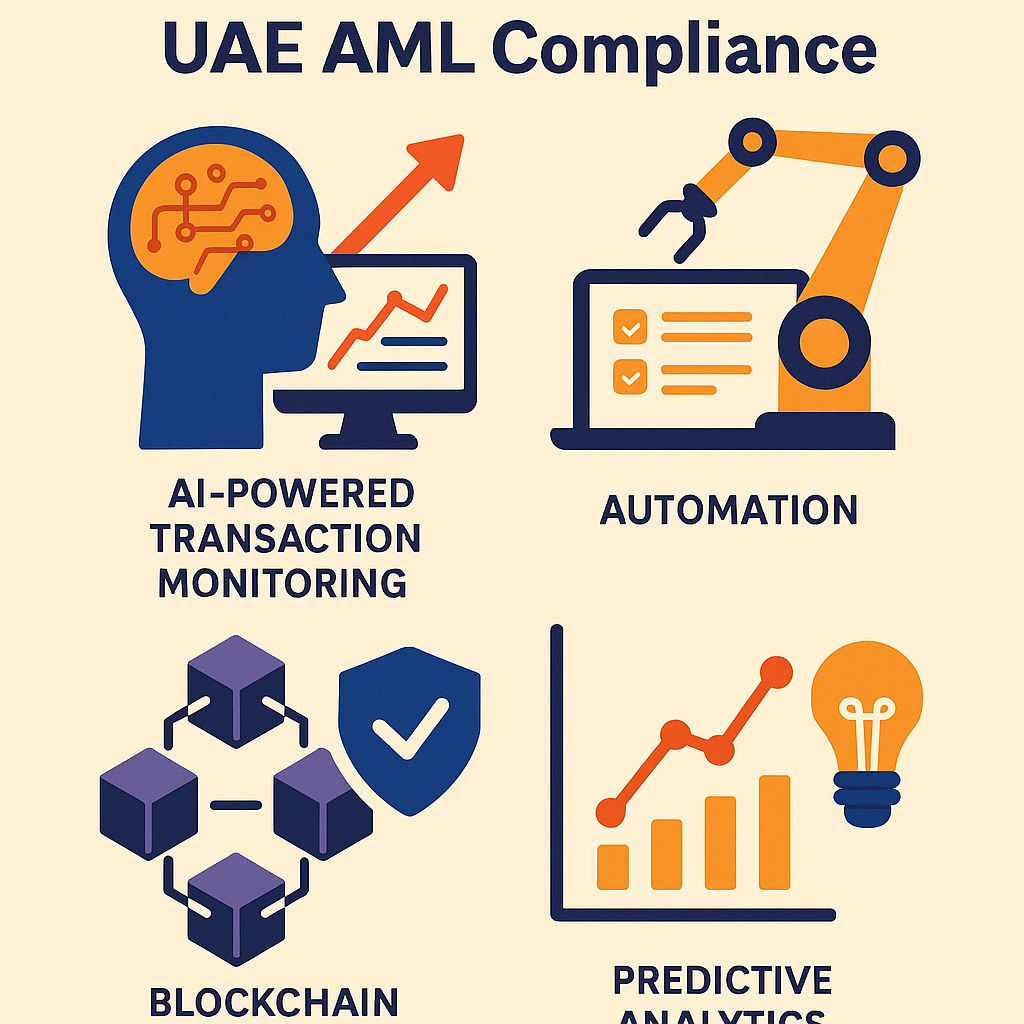
A. AI-Powered Transaction Monitoring
AI and machine learning models learn from past data to detect hidden patterns of suspicious activity.
They identify anomalies, cross-border layering, and unusual behaviour across customer segments — reducing false positives and enhancing early risk detection.
________________________________________
B. Advanced KYC and Identity Verification
Digital onboarding solutions leverage:
• Facial recognition and biometric authentication
• Document verification with OCR and forgery detection
• Sanctions and PEP screening across global lists
• Continuous monitoring for CDD refresh cycles
This ensures end-to-end compliance with both FATF standards and UAE’s customer due diligence requirements.
________________________________________
C. Blockchain and Virtual Asset Analytics
With the rapid rise of crypto transactions, RegTech tools now incorporate on-chain analytics to trace:
• Source and destination of virtual asset funds
• Wallet linkages to illicit entities
• DeFi and NFT-based laundering patterns
Solutions like Chainalysis, TRM Labs, and MyAML.io Analytics enable exchanges and VASPs to meet VARA and FSRA expectations for AML transparency.
________________________________________
D. Robotic Process Automation (RPA)
RPA automates repetitive compliance tasks such as data collection, screening, and report generation.
This frees compliance officers to focus on strategic analysis and high-risk investigations.
________________________________________
E. Regulatory Reporting & goAML Integration
RegTech platforms now integrate directly with goAML portals, allowing seamless Suspicious Transaction Report (STR) submissions with structured XML exports, document attachments, and digital audit trails.
________________________________________
F. Predictive Analytics & Risk Scoring
Predictive models assign real-time dynamic risk scores to customers, adapting automatically to behavioral changes, transactions, and geopolitical developments — a game-changer for risk-based AML compliance.
________________________________________
5. Key Benefits of RegTech Adoption
Benefit Impact
Automation & Efficiency Speeds up onboarding, screening, and reporting.
Accuracy & Consistency Reduces manual errors and human bias.
Cost Reduction Cuts compliance costs through workflow optimization.
Regulatory Confidence Demonstrates proactive AML controls to authorities.
Scalability Supports growth without proportionally increasing compliance staff.
________________________________________
6. The Role of RegTech in Strengthening DNFBPs and VASPs
In the UAE, Designated Non-Financial Businesses and Professions (DNFBPs) — such as real estate brokers, dealers in precious metals, and law firms — face heightened AML obligations.
Many rely on RegTech to manage:
• Periodic risk assessments
• Beneficial ownership verification
• Ongoing CDD reviews
• Sanctions re-screening
Similarly, Virtual Asset Service Providers (VASPs) regulated under VARA and FSRA use blockchain-enabled RegTech tools to ensure:
• Source-of-funds analysis
• Cross-chain tracing
• Travel Rule compliance
• Automated STR generation
________________________________________
7. Future RegTech Trends in UAE AML Compliance
1. Artificial Intelligence and Explainable Models (XAI)
AI models will become standard for AML monitoring — but regulators will demand explainability.
XAI will ensure every system decision is traceable, interpretable, and auditable.
________________________________________
2. Integrated Compliance Ecosystems
Future RegTech will offer end-to-end compliance orchestration — linking KYC, monitoring, risk scoring, and reporting on a single unified platform.
________________________________________
3. Cross-Border Data Collaboration
Regional data-sharing frameworks will emerge between the GCC, EU, and Asia, powered by privacy-preserving RegTech and blockchain-based audit layers.
________________________________________
4. Regulatory Sandboxes and AI Testing Hubs
The UAE’s regulators (FSRA, DFSA, VARA) are already establishing AI and FinTech sandboxes, allowing firms to safely test innovative AML solutions before market-wide deployment.
________________________________________
5. Integration of ESG and AML Data
RegTech will evolve to correlate environmental, social, and governance (ESG) data with AML risks — aligning ethical compliance with sustainable finance goals.
________________________________________
8. Challenges Ahead
Despite its potential, RegTech adoption faces barriers:
• Legacy infrastructure in older financial systems.
• High initial integration costs for smaller DNFBPs.
• Data privacy concerns under UAE Federal Decree-Law No. 45 of 2021.
• Shortage of AI-skilled compliance professionals.
Overcoming these challenges will require collaboration between regulators, technology providers, and financial institutions to standardize frameworks and promote interoperability.
________________________________________
9. The Road Ahead — UAE’s Vision for Smart Compliance
The UAE’s commitment to innovation, combined with its AI-driven national vision, places it at the forefront of RegTech evolution.
Over the next five years, AML compliance will move toward:
• Autonomous compliance systems that learn and adapt continuously.
• Blockchain-integrated audit trails for full transaction transparency.
• Real-time regulatory reporting powered by data analytics.
Ultimately, RegTech will redefine compliance as a strategic advantage — not a regulatory burden.
________________________________________
10. Conclusion
The future of AML compliance in the UAE lies in intelligent automation, predictive analytics, and regulatory innovation.
RegTech is no longer an option — it’s an essential investment in resilience, reputation, and regulatory alignment.
As regulators demand effectiveness over formality, UAE businesses must embrace RegTech now to ensure they remain compliant, competitive, and future-ready in the digital economy.
________________________________________
About Sheikh Anwar Accounting & Auditing LLC
Sheikh Anwar Accounting & Auditing LLC (SA Auditors) — MOE Entry No. 5817 — is a professional firm in Dubai specializing in AML compliance, outsourced MLRO services, audit, and corporate tax advisory.
Through MyAML.io, we deliver AI-driven RegTech and AML automation solutions tailored for financial institutions, DNFBPs, and Virtual Asset Service Providers across the UAE and GCC.
📍 Office Address: M-35, Dubai Creek Tower, Dubai, U.A.E.
📞 Phone: +971 4 250 1084
✉️ Email: info@sa-auditors.com
🌐 Websites: www.sa-auditors.com | www.myaml.io