Functional Analysis in TP Reports
The introduction of UAE Corporate Tax (Federal Decree-Law No. 47 of 2022) has placed significant emphasis on Transfer Pricing (TP) compliance. For businesses engaged in related-party transactions, one of the most critical elements of TP documentation is the Functional Analysis (FAR).
A well-prepared FAR analysis not only ensures compliance with the Arm’s Length Principle but also provides clarity on how value is created and shared within a multinational group.
________________________________________
1. What is a Functional Analysis (FAR)?
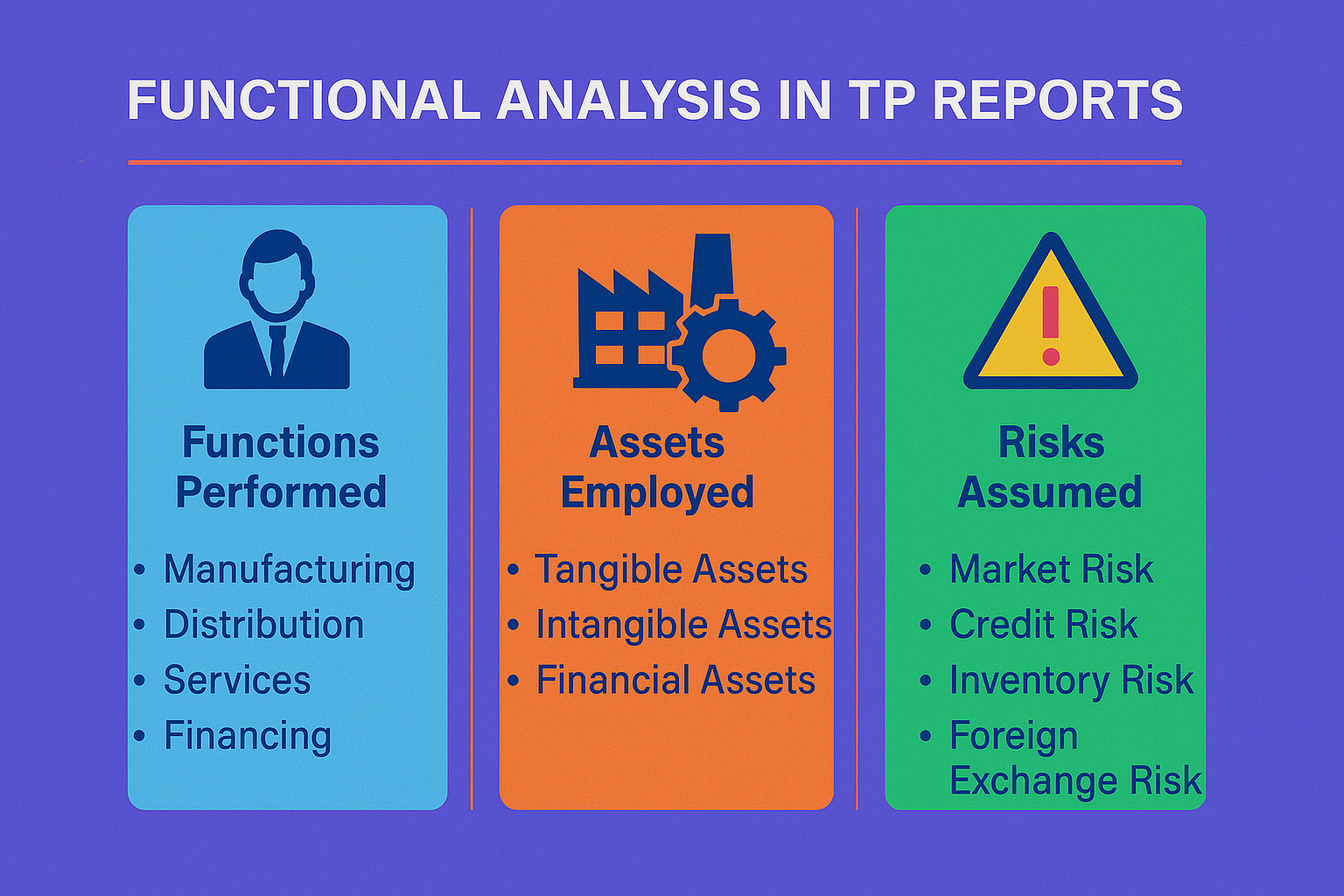
Functional Analysis is the process of identifying and evaluating:
• Functions performed – what each entity does,
• Assets employed – resources (tangible and intangible) used in transactions, and
• Risks assumed – commercial, operational, and financial risks borne by each party.
This three-dimensional approach ensures that profits are aligned with economic substance, not just legal ownership.
________________________________________
2. Why is FAR Essential in TP Reports?
• Demonstrates that intra-group transactions comply with the Arm’s Length Principle.
• Determines the tested party for benchmarking analysis.
• Guides the selection of the most appropriate TP method.
• Provides strong evidence in case of FTA audit or inspection.
• Protects businesses from penalties, adjustments, and double taxation.
________________________________________
3. The FAR Framework Explained
A) Functions Performed
Functions vary depending on the business model. Common examples include:
• Manufacturing: procurement, production, R&D, quality control.
• Distribution: warehousing, marketing, logistics, after-sales service.
• Services: IT, HR, management, consultancy.
• Financing: cash pooling, loans, treasury functions.
👉 Entities performing high-value functions (e.g., R&D, marketing intangibles) are expected to earn greater returns.
________________________________________
B) Assets Employed
Assets directly influence the value created in a transaction.
• Tangible assets: property, plant, equipment, warehouses.
• Intangible assets: patents, brands, know-how, customer lists.
• Financial assets: working capital, intercompany loans, guarantees.
👉 Ownership of unique intangibles (like trademarks or technology) typically commands premium profits.
________________________________________
C) Risks Assumed
Risk allocation is central to determining profitability. Examples include:
• Market Risk – demand fluctuations, competition.
• Credit Risk – customer defaults.
• Inventory Risk – obsolescence, storage losses.
• Operational Risk – production delays, supply chain disruptions.
• Foreign Exchange Risk – volatility in cross-border transactions.
👉 Higher risks should correspond to higher expected returns.
________________________________________
4. Role of FAR in TP Method Selection
The findings of FAR directly impact:
• Which TP method applies (CUP, Resale Price, Cost Plus, TNMM, Profit Split).
• Whether the entity is a limited-risk service provider/distributor or a full-risk entrepreneur.
• What profit margin or pricing policy is justified under benchmarking studies.
________________________________________
5. FAR in UAE Context
• Free Zone Companies: FAR is crucial for proving substance and retaining Qualifying Income status.
• Gold & Jewellery Sector: FAR distinguishes between a trader assuming inventory risk and a limited-risk reseller.
• Family Businesses: FAR clarifies roles and ensures tax-efficient allocation across group entities.
• Cross-Border Transactions: FAR supports double tax treaty positions and dispute prevention.
________________________________________
6. Example of FAR in Practice
Scenario: A UAE subsidiary imports branded apparel from its parent and sells locally.
• Functions: Sales, limited marketing, distribution.
• Assets: Warehousing facilities, no unique IP.
• Risks: Bears inventory and credit risk; brand risk stays with parent.
Conclusion: The UAE entity is a limited-risk distributor. Under TNMM, its return should be benchmarked against independent distributors, typically earning a modest margin (e.g., 3–6%).
________________________________________
7. Best Practices for FAR Analysis
• Conduct management interviews and process walkthroughs.
• Validate functions/risks using contracts and actual conduct.
• Ensure consistency across FAR, benchmarking, and financials.
• Refresh FAR annually to reflect business changes.
• Integrate FAR into Local File and Master File for UAE compliance.
________________________________________
✅ How Sheikh Anwar Accounting & Auditing LLC Can Help
At Sheikh Anwar Accounting & Auditing LLC, we prepare comprehensive Transfer Pricing documentation, with FAR analysis tailored to UAE business models and FTA expectations.
Our Expertise Includes:
• FAR interviews & documentation.
• Preparation of Local File & Master File.
• Benchmarking studies and arm’s length range analysis.
• Advisory on TP method and tested party selection.
• Support during FTA Transfer Pricing audits.
📌 Contact Us Today
🌐 www.sa-auditors.com
✉️ info@sa-auditors.com | 📱 +971-XX-XXXXXXX