FATF’s Role in Countering Terrorism Financing
Introduction
Terrorism financing is one of the most serious threats to global peace, economic stability, and financial system integrity. Terrorist organizations rely on financial resources to recruit members, acquire weapons, organize attacks, and sustain their networks. To address this threat globally, the Financial Action Task Force (FATF) plays a critical role in establishing international standards and ensuring countries implement effective measures to combat terrorism financing.
What is Terrorism Financing?
Terrorism financing refers to the collection, movement, or provision of funds intended to support terrorist activities or organizations. Unlike traditional money laundering, terrorism financing may involve funds that originate from both legal and illegal sources, including:
• Donations and charitable contributions
• Business profits
• Criminal activities such as smuggling or fraud
• Informal money transfer systems such as hawala
• Cross-border financial transactions
Because terrorist groups often use complex networks and financial channels, global cooperation and regulatory oversight are essential to identify and disrupt these activities.
FATF and the Global Counter-Terrorism Financing Framework
The Financial Action Task Force (FATF) is an intergovernmental organization established in 1989 to combat money laundering. Following the September 11 attacks in 2001, FATF expanded its mandate to include Countering the Financing of Terrorism (CFT).
FATF developed the internationally recognized 40 Recommendations, which serve as the global framework for Anti-Money Laundering (AML) and Counter-Terrorism Financing (CTF) measures. These recommendations require countries to implement legal, regulatory, and operational frameworks to detect, prevent, and prosecute terrorism financing activities.
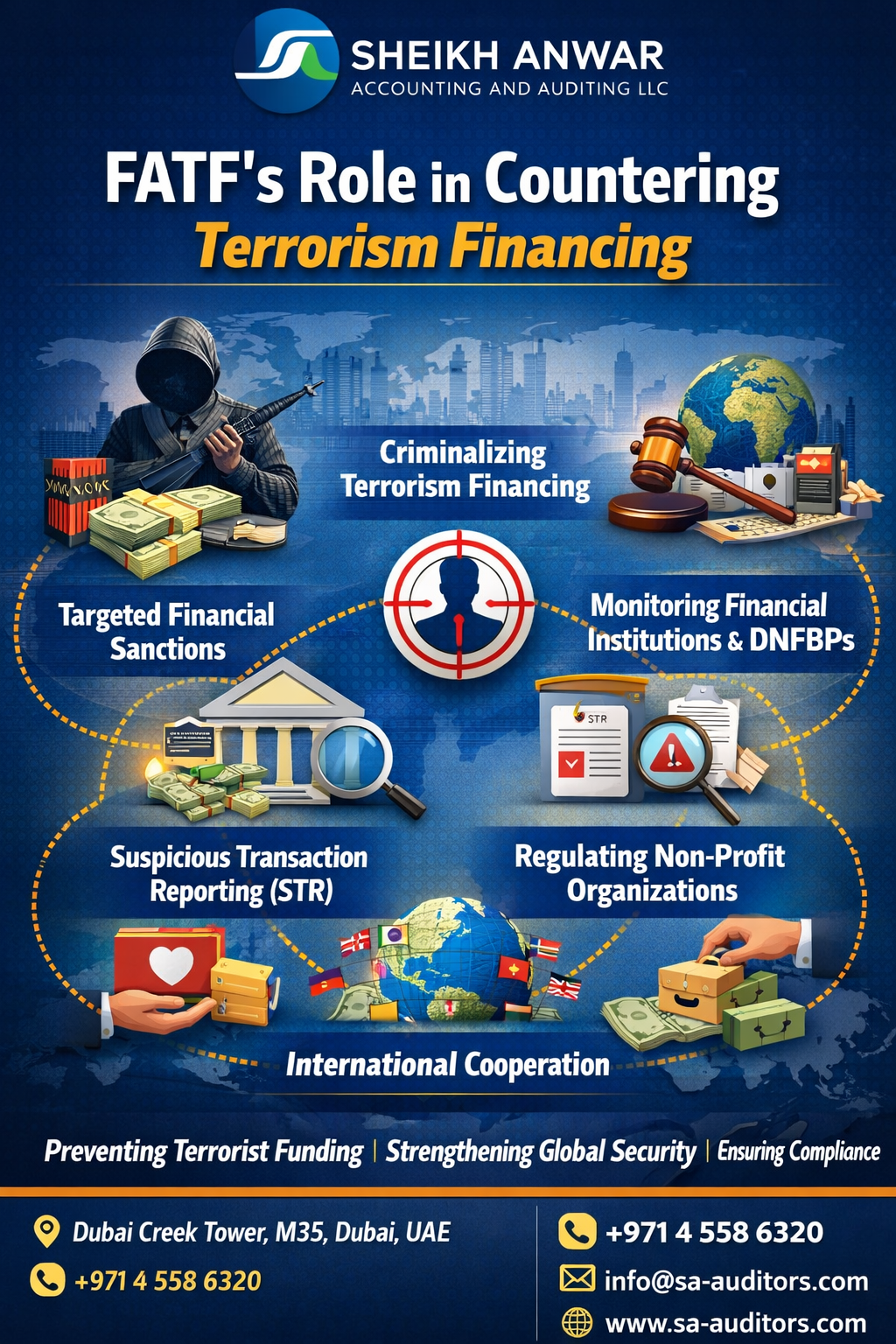
Key FATF Measures to Combat Terrorism Financing
1. Criminalization of Terrorism Financing
FATF requires countries to establish laws that criminalize terrorism financing as a separate offence. This means that individuals or entities providing funds to terrorist organizations can be prosecuted even if the terrorist act has not yet occurred.
2. Targeted Financial Sanctions
Countries must implement targeted financial sanctions in accordance with United Nations Security Council (UNSC) resolutions. Financial institutions must immediately freeze assets and prohibit transactions involving individuals or entities designated as terrorists.
3. Monitoring Financial Institutions and DNFBPs
FATF requires both financial institutions and Designated Non-Financial Businesses and Professions (DNFBPs) to implement strong compliance measures. DNFBPs include sectors such as:
• Auditors and accountants
• Lawyers and company service providers
• Real estate agents
• Dealers in precious metals and stones (DPMS)
• Trust and corporate service providers
These sectors must apply Customer Due Diligence (CDD), beneficial ownership verification, and ongoing transaction monitoring to identify potential terrorism financing risks.
4. Suspicious Transaction Reporting (STR)
Financial institutions and DNFBPs are required to report suspicious activities to their national Financial Intelligence Units (FIUs). FIUs analyze financial intelligence and coordinate with law enforcement agencies to investigate and disrupt terrorism financing networks.
5. Oversight of Non-Profit Organizations (NPOs)
FATF acknowledges that certain non-profit organizations may be vulnerable to misuse for terrorism financing. Countries must implement risk-based supervision to ensure transparency while protecting legitimate charitable activities.
6. International Cooperation
Terrorism financing networks often operate across multiple jurisdictions. FATF encourages strong international cooperation, intelligence sharing, and joint investigations between countries to effectively combat these networks.
FATF Mutual Evaluations and Global Compliance
To ensure countries comply with global AML/CFT standards, FATF conducts Mutual Evaluations, assessing both technical compliance and the effectiveness of national systems.
Countries that fail to meet FATF standards may be placed on the Grey List or Black List, which can impact their international financial reputation, foreign investment, and banking relationships. This mechanism encourages countries to continuously improve their regulatory frameworks and enforcement mechanisms.
UAE’s Commitment to Combating Terrorism Financing
The United Arab Emirates (UAE) has significantly strengthened its AML and CFT framework in recent years. The country has introduced strict regulations, enhanced regulatory supervision, and improved coordination between authorities such as:
• UAE Financial Intelligence Unit (FIU)
• Ministry of Economy (MoE)
• Central Bank of the UAE
• Various regulatory authorities overseeing DNFBPs
The UAE continues to align its national regulations with FATF standards to maintain transparency, strengthen financial integrity, and protect the global financial system.
Importance for Businesses and Compliance Professionals
Businesses operating in regulated sectors must ensure they maintain strong AML and CFT compliance frameworks. Key compliance measures include:
• Risk-based Customer Due Diligence (CDD) procedures
• Screening against international sanctions lists
• Monitoring high-risk transactions
• Identifying Ultimate Beneficial Owners (UBOs)
• Training employees on AML and terrorism financing risks
• Reporting suspicious activities to authorities
Failure to implement effective compliance controls may lead to regulatory penalties, reputational damage, and legal consequences.
Conclusion
The FATF plays a crucial role in safeguarding the global financial system from misuse by terrorist organizations. Through its international standards, mutual evaluations, and coordination among countries, FATF strengthens global efforts to detect and prevent terrorism financing.
For businesses, financial institutions, and DNFBPs, adherence to FATF standards is not only a regulatory requirement but also a critical responsibility in maintaining financial transparency and contributing to global security.
________________________________________
About Our Company
Sheikh Anwar Accounting & Auditing LLC is a professional consulting and advisory firm based in Dubai, United Arab Emirates. The firm specializes in:
• AML/CFT Compliance Advisory
• FATF Compliance Guidance
• UAE Corporate Tax Advisory
• VAT Consultancy and Compliance
• External Audit and Assurance Services
• Risk Assessment and Regulatory Compliance
Our team assists businesses, financial institutions, and DNFBPs in implementing robust compliance frameworks aligned with UAE regulations and international FATF standards.
Company Details
Sheikh Anwar Accounting & Auditing LLC
📍 Dubai Creek Tower, M35, Dubai, UAE
📞 +971 4 558 6320
📧 info@sa-auditors.com
🌐 www.sa-auditors.com