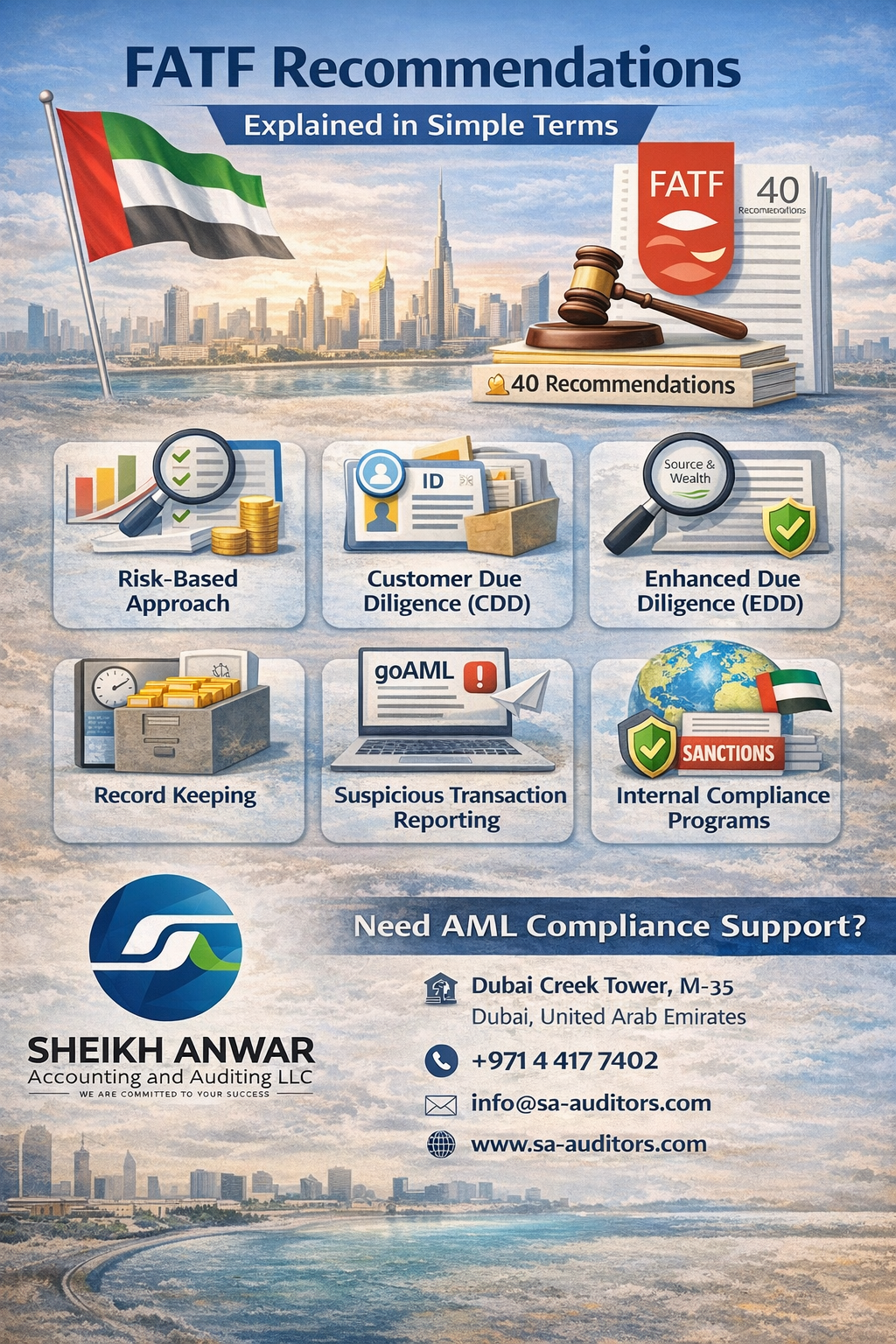
FATF Recommendations Explained in Simple Terms
Introduction
Financial crime such as money laundering and terrorist financing poses a serious threat to the global financial system. To combat these risks, international standards have been developed to help countries and businesses implement strong compliance frameworks.
One of the most important global bodies in this area is the Financial Action Task Force (FATF). The FATF has issued 40 recommendations that serve as the international benchmark for Anti-Money Laundering (AML) and Counter-Terrorism Financing (CFT) systems worldwide.
For businesses operating in the United Arab Emirates—especially in sectors such as gold trading, financial services, real estate, accounting, and corporate services—understanding these recommendations is essential to maintain compliance and avoid regulatory risks.
________________________________________
What Are FATF Recommendations?
The Financial Action Task Force developed the 40 FATF Recommendations to guide countries in creating effective systems to prevent:
• Money laundering
• Terrorism financing
• Proliferation financing
These recommendations provide a framework that governments adopt into their national laws and regulations.
In the UAE, these international standards are implemented through laws such as Federal Decree Law No. 20 of 2018 on Anti-Money Laundering and Combating the Financing of Terrorism.
________________________________________
Why FATF Recommendations Are Important
The FATF recommendations play a critical role in protecting the global financial system.
They aim to:
• Prevent criminals from hiding illegal funds
• Protect financial institutions and businesses
• Improve transparency in financial transactions
• Strengthen cooperation between countries
Countries that fail to implement these standards risk increased monitoring by the Financial Action Task Force, which can impact international banking and investment.
________________________________________
Key FATF Recommendations Explained in Simple Terms
Although there are 40 recommendations, they can be understood through several key principles.
________________________________________
1. Risk-Based Approach
Countries and businesses must identify and assess the risks of money laundering and terrorist financing.
Organizations should:
• Conduct risk assessments
• Identify high-risk customers and transactions
• apply stronger controls where risks are higher
For example, sectors such as precious metals trading and cross-border financial transactions often require enhanced monitoring.
________________________________________
2. Customer Due Diligence (CDD)
Businesses must verify the identity of their customers before establishing business relationships.
Customer due diligence includes:
• verifying customer identity
• understanding the nature of the business relationship
• identifying the beneficial owner of a company
CDD helps prevent criminals from using businesses to disguise illegal funds.
________________________________________
3. Enhanced Due Diligence (EDD)
For high-risk customers or transactions, companies must conduct additional checks.
EDD may involve:
• verifying the source of funds
• verifying the source of wealth
• conducting deeper background checks
This is especially required when dealing with Politically Exposed Persons (PEPs) or high-risk jurisdictions.
________________________________________
4. Record Keeping
Businesses must maintain records of transactions and customer information.
Typically, these records must be kept for at least five years, allowing authorities to investigate suspicious activities if necessary.
________________________________________
5. Suspicious Transaction Reporting
Businesses must report suspicious transactions to the national Financial Intelligence Unit.
In the UAE, suspicious transactions are reported through the UAE Financial Intelligence Unit goAML platform.
This helps authorities detect and investigate financial crimes.
________________________________________
6. Internal Compliance Programs
Companies are required to establish internal AML compliance systems.
This usually includes:
• appointing a Money Laundering Reporting Officer (MLRO)
• implementing AML policies and procedures
• conducting staff training
• performing ongoing monitoring of transactions
________________________________________
7. Sanctions Compliance
Businesses must comply with international sanctions issued by organizations such as the United Nations.
In the UAE, sanctions compliance is coordinated by the Executive Office for Control and Non-Proliferation.
Companies must screen customers against sanction lists and freeze assets where required.
________________________________________
FATF Recommendations and UAE Businesses
Businesses in the UAE must comply with AML regulations aligned with FATF standards.
Key regulators include:
• Central Bank of the UAE – supervising banks and financial institutions
• UAE Ministry of Economy – supervising DNFBPs such as auditors and precious metals dealers
• Securities and Commodities Authority – supervising capital markets
Companies must maintain proper AML controls to avoid penalties and regulatory action.
________________________________________
Importance for DNFBPs and Precious Metals Traders
Designated Non-Financial Businesses and Professions (DNFBPs) are considered high-risk sectors under AML regulations.
These sectors include:
• Gold and jewellery traders
• Real estate brokers
• auditors and accountants
• company service providers
Due to the UAE’s position as a global hub for precious metals trading, regulators continue to strengthen monitoring in these industries.
________________________________________
Conclusion
The 40 Recommendations of the Financial Action Task Force form the backbone of global efforts to combat money laundering and terrorist financing.
For businesses operating in the UAE, understanding and implementing these standards is essential for maintaining regulatory compliance and protecting the integrity of the financial system.
Organizations should proactively implement strong AML frameworks, conduct regular risk assessments, and ensure proper reporting mechanisms.
________________________________________
About Us
Sheikh Anwar Accounting and Auditing LLC is a Dubai-based professional firm specializing in:
• AML Compliance & Audits
• AML Risk Assessments
• AML Policy Development
• goAML Registration & Reporting
• UAE Corporate Tax Advisory
• VAT Compliance & Filing
• Financial Audits & Accounting Services
📍 Office Address:
Dubai Creek Tower, M-35, Dubai, United Arab Emirates
📞 Phone: +971 4 417 7402
📧 Email: info@sa-auditors.com
🌐 Website: www.sa-auditors.com