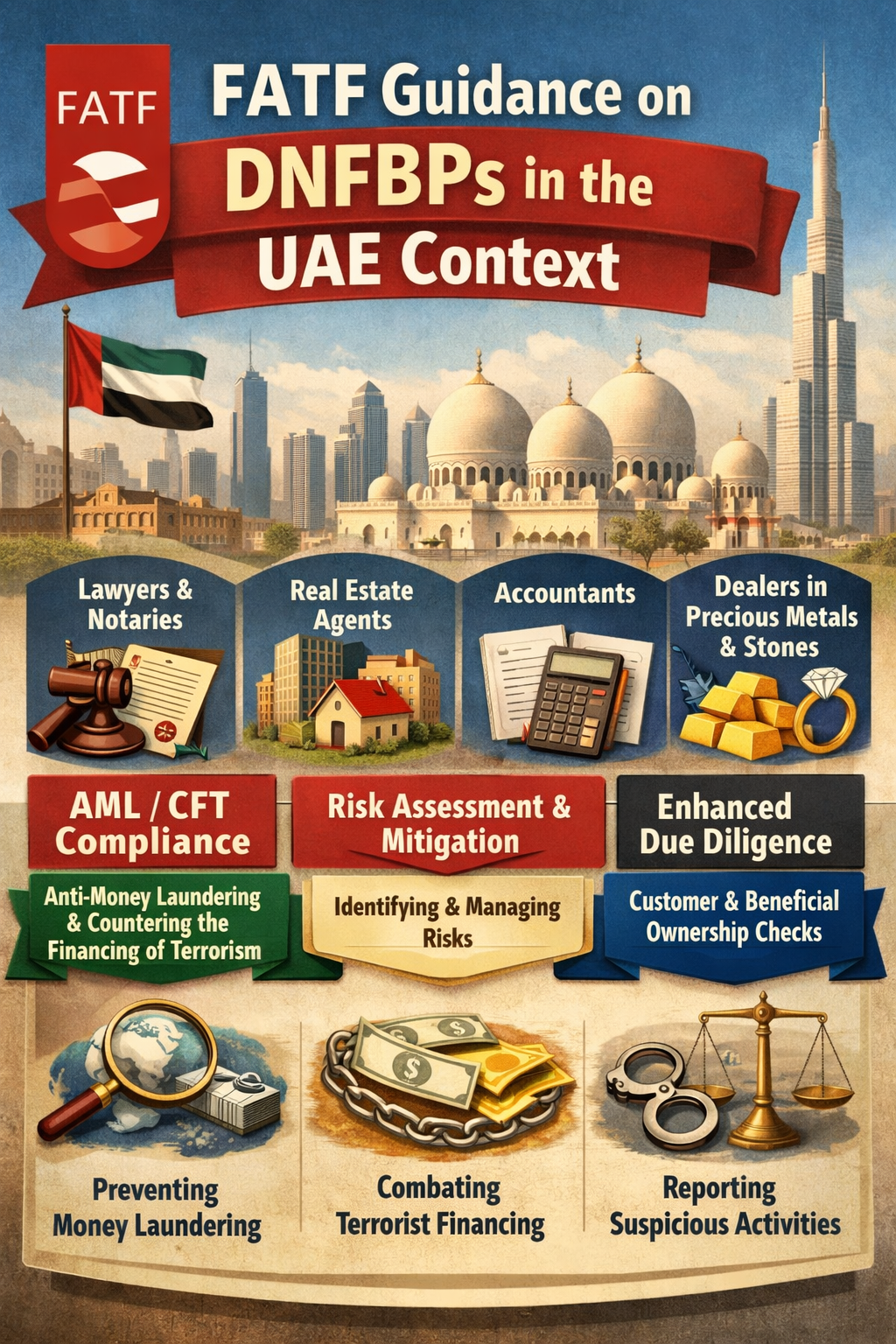
FATF Guidance on DNFBPs in UAE Context
Introduction
The fight against money laundering and terrorist financing is a global priority. While financial institutions are often the primary focus of Anti-Money Laundering (AML) regulations, several non-financial sectors also play a critical role in preventing financial crime.
To address this, the Financial Action Task Force (FATF) introduced guidelines for Designated Non-Financial Businesses and Professions (DNFBPs). These sectors are considered vulnerable to misuse for money laundering activities due to their involvement in high-value transactions and asset transfers.
In the United Arab Emirates (UAE), DNFBPs are subject to strict AML compliance requirements aligned with FATF recommendations.
________________________________________
What Are DNFBPs?
DNFBPs refer to certain non-financial businesses and professions that may be exposed to financial crime risks.
According to the Financial Action Task Force, DNFBPs include:
• Dealers in Precious Metals and Stones (DPMS)
• Real Estate Brokers and Developers
• Auditors and Accounting Firms
• Company Service Providers
• Lawyers and Legal Consultants
• Trust and Corporate Service Providers
These sectors often deal with large transactions, asset transfers, and company structures, making them potential targets for money laundering activities.
________________________________________
FATF Expectations for DNFBPs
The FATF requires DNFBPs to implement strong compliance measures similar to those required for financial institutions.
Key obligations include:
Customer Due Diligence (CDD)
DNFBPs must verify the identity of their customers before establishing a business relationship. This includes identifying the beneficial owner of companies and understanding the nature of the business transaction.
Enhanced Due Diligence (EDD)
For high-risk customers or transactions, additional verification measures must be applied. This may include verifying the source of funds and source of wealth.
Suspicious Transaction Reporting
DNFBPs must report suspicious activities to the national Financial Intelligence Unit.
In the UAE, suspicious transactions are reported through the goAML platform managed by the UAE Financial Intelligence Unit.
Record Keeping
Businesses must maintain records of customer information and transactions for at least five years.
Internal AML Controls
DNFBPs must establish internal compliance systems, including:
• AML policies and procedures
• staff training programs
• appointment of a Money Laundering Reporting Officer (MLRO)
________________________________________
DNFBP Supervision in the UAE
The UAE has established several supervisory authorities to regulate DNFBPs and ensure compliance with AML laws.
Key regulators include:
Ministry of Economy
The UAE Ministry of Economy supervises several DNFBP sectors, including:
• Dealers in Precious Metals and Stones
• auditors and accounting firms
• corporate service providers
Dubai Land Department
The Dubai Land Department supervises AML compliance for real estate brokers and developers.
Free Zone Authorities
Various free zone authorities, such as DMCC and DAFZA, also monitor DNFBP compliance within their jurisdictions.
These regulators conduct inspections, enforce compliance requirements, and impose administrative penalties for violations.
________________________________________
Importance for Precious Metals and Jewellery Businesses
The UAE is one of the world's leading hubs for gold and precious metals trading, making the sector particularly sensitive from an AML perspective.
Businesses dealing in precious metals must implement strict AML measures, including:
• Customer identification and verification
• monitoring large cash transactions
• verifying the source of funds
• reporting suspicious activities
These measures help prevent illicit financial flows and maintain the integrity of the UAE’s financial system.
________________________________________
Key Challenges for DNFBPs
Despite increasing regulatory oversight, DNFBPs often face several compliance challenges.
Limited Compliance Awareness
Many smaller businesses may lack sufficient knowledge of AML obligations.
Complex Customer Structures
Corporate ownership structures can make it difficult to identify beneficial owners.
Cross-Border Transactions
International transactions increase exposure to high-risk jurisdictions.
To address these challenges, DNFBPs must implement structured AML compliance programs and regularly update their risk assessments.
________________________________________
UAE’s Commitment to FATF Standards
The UAE has taken significant steps to strengthen AML compliance across DNFBP sectors. This includes:
• strengthening regulatory supervision
• increasing compliance inspections
• enhancing reporting mechanisms
• improving international cooperation
These efforts demonstrate the UAE’s commitment to aligning with the standards established by the Financial Action Task Force.
________________________________________
Conclusion
DNFBPs play a vital role in the global fight against money laundering and terrorist financing. The guidance provided by the Financial Action Task Force ensures that these sectors adopt robust compliance measures.
In the UAE, regulators have implemented strong frameworks to monitor DNFBPs and ensure adherence to AML regulations. Businesses operating in these sectors must maintain effective compliance programs to mitigate risks and support the country’s efforts to protect the integrity of its financial system.
________________________________________
About Us
Sheikh Anwar Accounting and Auditing LLC is a Dubai-based professional firm specializing in:
• AML Compliance & Audits
• AML Risk Assessments
• AML Policy Development
• goAML Registration & Reporting
• UAE Corporate Tax Advisory
• VAT Compliance & Filing
• Financial Audit & Accounting Services
📍 Office Address
Dubai Creek Tower, M-35
Dubai, United Arab Emirates
📞 Phone: +971 4 417 7402
📧 Email: info@sa-auditors.com
🌐 Website: www.sa-auditors.com