FATF Grey List and UAE’s Response
Introduction
The Financial Action Task Force (FATF) is the global watchdog for money laundering (ML) and terrorism financing (TF). It monitors jurisdictions worldwide to ensure they have effective systems to combat financial crime. Countries that show strategic deficiencies in their AML/CTF frameworks may be placed on the “Grey List”, subjecting them to increased monitoring.
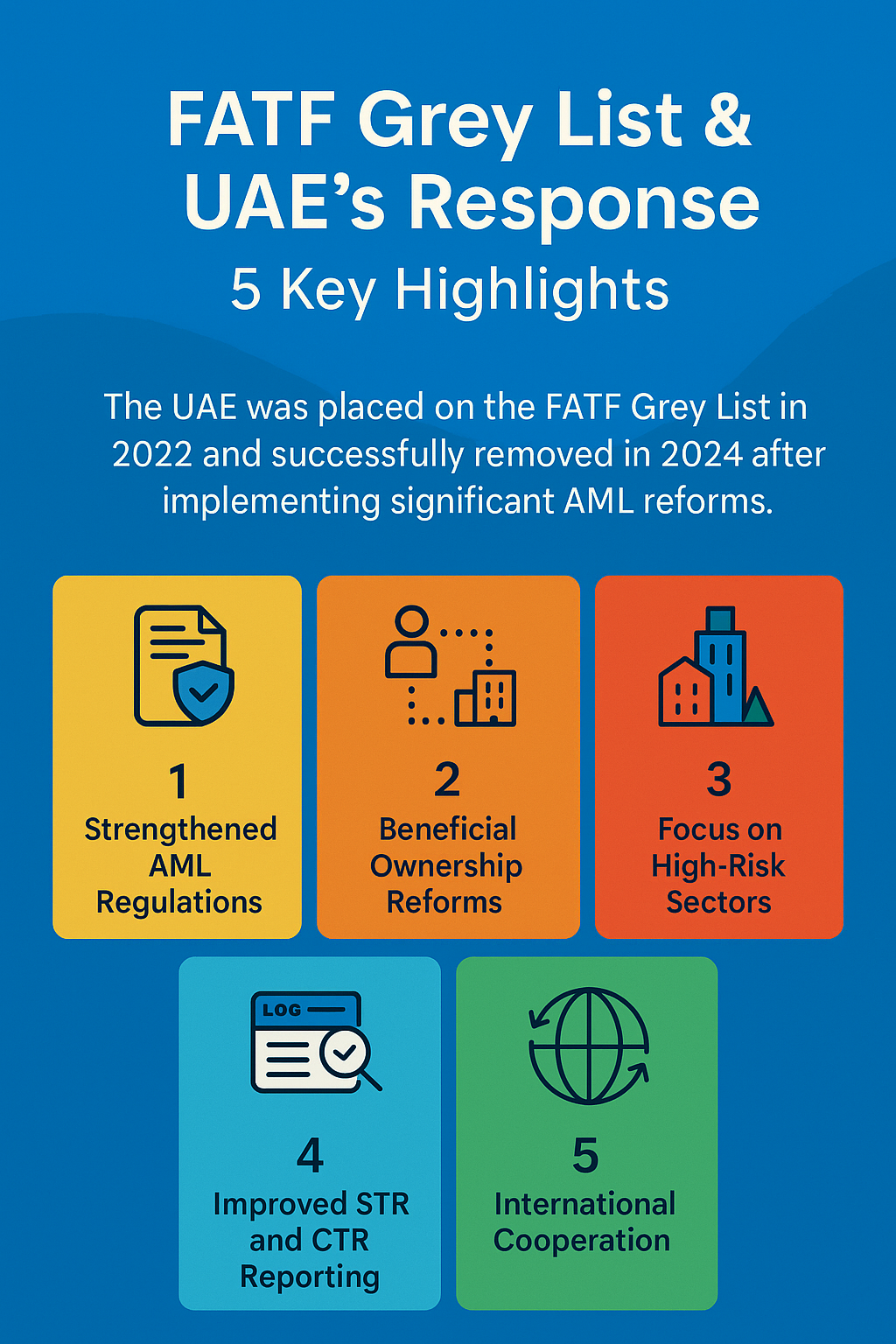
In March 2022, the UAE was placed on the FATF Grey List due to identified gaps in AML enforcement. However, through significant reforms and rapid improvements, the UAE was removed from the Grey List in February 2024. This journey reflects the UAE’s strong commitment to global compliance standards and its determination to protect its position as a trusted financial hub.
________________________________________
What Is the FATF Grey List?
• A list of countries that have deficiencies in AML/CTF systems but are working with FATF to address them.
• Grey-listed countries face enhanced due diligence (EDD) from global financial institutions.
• It increases transaction costs, compliance burdens, and reputational risks for businesses operating in those countries.
________________________________________
Why Was the UAE Placed on the Grey List?
FATF highlighted several areas where the UAE needed improvement:
1. Effective Supervision of DNFBPs – Sectors like real estate, gold trading, auditors, and corporate service providers were deemed under-monitored.
2. Transparency of Beneficial Ownership – Complex company structures required stronger UBO disclosure.
3. Risk-Based AML Implementation – Businesses needed to adopt more consistent risk-based approaches (RBA).
4. Timely STR Filing – Delays in reporting suspicious transactions to the Financial Intelligence Unit (FIU).
5. Cross-Border Cooperation – Gaps in international information-sharing and investigations.
________________________________________
UAE’s Response to FATF Grey Listing
1. Strengthening AML Regulations
• Issuance of Federal Decree-Law No. 26 of 2021 (amending AML laws).
• Cabinet Decisions No. 111 of 2022 and No. 109 of 2023 tightening obligations for DNFBPs.
• Expansion of penalties and fines (AED 50,000 to AED 5 million).
2. Beneficial Ownership Reforms
• Implementation of Cabinet Decision No. 58 of 2020 on UBO disclosure.
• Stricter requirements for company registers and transparency in ownership structures.
3. Focus on High-Risk Sectors
• Enhanced supervision of real estate, gold & jewellery, corporate services, and auditors.
• Cash transaction thresholds fixed at AED 55,000 with mandatory reporting.
4. Improved STR and CTR Reporting
• Mandatory use of the goAML portal for Suspicious Transaction Reports (STRs) and Cash Transaction Reports (CTRs).
• Increased awareness campaigns and training for DNFBPs.
5. Capacity Building & Enforcement
• Appointment of compliance officers/MLROs across regulated sectors.
• More on-site inspections by the Ministry of Economy (MoE) and Central Bank of UAE (CBUAE).
• Several high-profile AML enforcement actions and penalties.
6. International Cooperation
• Strengthened collaboration with international FIUs through the Egmont Group.
• Enhanced cross-border investigations and intelligence sharing.
________________________________________
Removal from FATF Grey List
• In February 2024, FATF recognized the UAE’s significant progress and announced its removal from the Grey List.
• This move was a milestone for the UAE, restoring global confidence and strengthening its reputation as a transparent and secure financial hub.
________________________________________
Impact on UAE Businesses
Positive Effects:
• Increased investor confidence and foreign direct investment (FDI).
• Easier cross-border transactions with reduced due diligence requirements.
• Enhanced international partnerships with banks and regulators.
Ongoing Responsibilities:
• Businesses must still maintain strict AML compliance to avoid future risks.
• Continued focus on CDD, STR/CTR filing, and UBO disclosures is necessary.
________________________________________
Conclusion
The UAE’s journey from being placed on the FATF Grey List to its removal in 2024 is a clear demonstration of its commitment to global AML/CTF standards. Through regulatory reforms, stronger supervision, and international cooperation, the UAE not only addressed FATF’s concerns but also strengthened its role as a global financial leader.
For businesses, the key takeaway is clear: AML compliance is not optional—it is central to sustainable growth, global trust, and long-term success in the UAE.
________________________________________
About Sheikh Anwar Accounting and Auditing LLC
At Sheikh Anwar Accounting and Auditing LLC, we guide businesses through complex AML compliance requirements. Our services include:
• AML risk assessments and policy drafting.
• goAML registration and STR/CTR reporting support.
• UBO compliance and register management.
• MLRO advisory and outsourced compliance officer services.
• Staff training on FATF standards and UAE AML laws.
• 📍 Head Office: Dubai, UAE
• 🌐 Website: www.sa-auditors.com
• 📧 Email: info@sa-auditors.com