FATF Focus on DNFBPs in UAE
Introduction
The Financial Action Task Force (FATF), the global standard-setter for combating money laundering and terrorist financing, has consistently emphasized the importance of monitoring Designated Non-Financial Businesses and Professions (DNFBPs). In the UAE, DNFBPs include jewellers, real estate brokers, lawyers, accountants, auditors, and trust or company service providers (TCSPs).
These sectors are particularly vulnerable to misuse because they handle high-value transactions, complex ownership structures, and cross-border dealings. FATF’s focus on DNFBPs has placed these businesses under close scrutiny, both internationally and within the UAE, making AML compliance not just a regulatory requirement but a business survival necessity.
________________________________________
1. FATF’s Global Perspective on DNFBPs
FATF Recommendations 22 and 23 specifically address DNFBPs, requiring them to implement:
• Customer Due Diligence (CDD) and Know Your Customer (KYC) procedures.
• Ongoing monitoring of transactions and reporting of suspicious activity.
• Enhanced Due Diligence (EDD) for high-risk customers, such as Politically Exposed Persons (PEPs).
• Effective record-keeping of transactions and client details.
Globally, FATF has highlighted that DNFBPs are often exploited for trade-based money laundering, tax evasion, and terrorist financing due to their less stringent oversight compared to financial institutions.
________________________________________
2. UAE’s Commitment to FATF Standards
The UAE has made significant progress in strengthening AML/CTF controls, especially after being placed under FATF’s “grey list” in 2022. With its removal from the grey list in 2024, the country has demonstrated a strong commitment to aligning DNFBPs with international best practices.
Key measures include:
• Mandatory registration of DNFBPs on the goAML portal for suspicious transaction reporting.
• Implementation of Cabinet Decision No. 10 of 2019, which sets out AML obligations for DNFBPs.
• Supervisory oversight by the Ministry of Economy (MOE) and free zone regulators (e.g., DFSA in DIFC, FSRA in ADGM).
• Sector-specific AML guidance for DNFBPs issued by the MOE and UAE FIU.
________________________________________
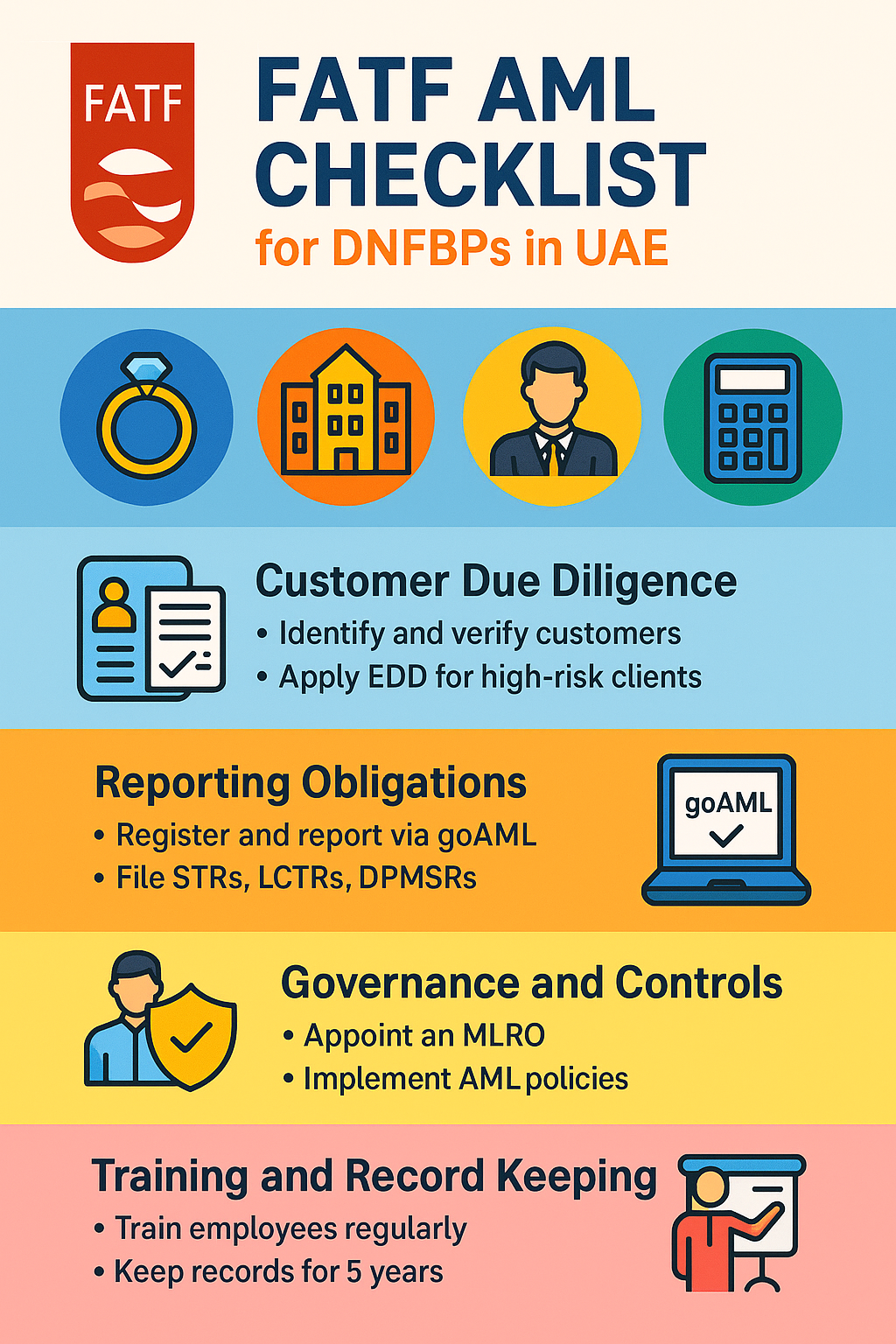
3. AML Obligations for DNFBPs under FATF Lens
DNFBPs in the UAE are required to adopt risk-based compliance measures, including:
a) Customer Due Diligence (CDD)
• Identify and verify customers and Ultimate Beneficial Owners (UBOs).
• Apply EDD for high-risk transactions or customers from FATF-listed jurisdictions.
b) Reporting Obligations
• File Suspicious Transaction Reports (STRs), Large Cash Transaction Reports (LCTRs), and sector-specific reports (e.g., DPMSR for jewellers).
c) Governance and Internal Controls
• Appoint a dedicated Money Laundering Reporting Officer (MLRO) or AML Compliance Officer.
• Develop and maintain AML policies and procedures.
d) Training and Awareness
• Conduct regular training for staff to identify AML red flags.
• Ensure employees understand FATF-related requirements and reporting processes.
e) Record Keeping
• Maintain client and transaction records for at least five years, enabling audit trails and regulator inspections.
________________________________________
4. FATF Concerns Specific to UAE DNFBPs
FATF has flagged the following areas as higher risk for DNFBPs in the UAE:
• Jewellery & Precious Metals (DPMS): Large cash transactions, bulk purchases, and cross-border trade.
• Real Estate: Use of property transactions to launder illicit funds.
• Lawyers & Accountants: Structuring of trusts and companies to obscure ownership.
• Corporate Service Providers: Establishment of shell entities in free zones without clear economic purpose.
________________________________________
5. Consequences of Non-Compliance
Failure to meet FATF-aligned obligations exposes DNFBPs to:
• Financial penalties: ranging from AED 50,000 to AED 10 million.
• Regulatory actions: suspension or revocation of trade licenses.
• Reputational damage: loss of credibility with banks, regulators, and international partners.
• Criminal liability: imprisonment for serious money laundering offences.
In 2024 alone, UAE authorities imposed hundreds of fines totaling over AED 339 million on DNFBPs for AML breaches, underscoring the seriousness of enforcement.
________________________________________
6. Best Practices for DNFBPs to Stay Compliant
• Register and remain active on the goAML portal.
• Establish a robust risk-based AML framework.
• Screen customers against sanctions and PEP lists.
• Appoint an experienced MLRO/Compliance Officer.
• Conduct periodic AML audits and refresh compliance policies.
• Stay updated with FATF recommendations and UAE regulatory changes.
________________________________________
Conclusion
FATF’s focus on DNFBPs in the UAE reflects the global recognition that non-financial sectors are just as exposed to financial crime risks as banks. For DNFBPs, AML compliance is not only about avoiding fines but also about building sustainable, trustworthy businesses. By adopting technology-driven, risk-based approaches, DNFBPs can protect their operations, satisfy regulators, and contribute to the UAE’s global reputation as a transparent and secure business environment.
________________________________________
About Us
Sheikh Anwar Accounting and Auditing LLC is a leading compliance and advisory firm in Dubai, specializing in AML frameworks, corporate tax, VAT, and transfer pricing. We provide tailored AML solutions for DNFBPs—including jewellers, real estate firms, legal practices, accountants, and trust service providers—ensuring compliance with both FATF recommendations and UAE regulations.
📍 Address: Dubai Creek Tower, M 35, Dubai, UAE
📞 Contact: info@sa-auditors.com | +971-XXX-XXXX
🌐 Website: www.sa-auditors.com