Dual Licensing and Corporate Tax
Introduction
With the UAE’s growing emphasis on regulatory compliance and tax transparency, Free Zone businesses operating under dual licenses need to carefully evaluate how UAE Corporate Tax Law applies to them.
Here, we explore the implications of dual licensing for Corporate Tax, how it affects Qualifying Free Zone Person (QFZP) status, and what businesses must do to ensure compliance.
________________________________________
📘 What is Dual Licensing?
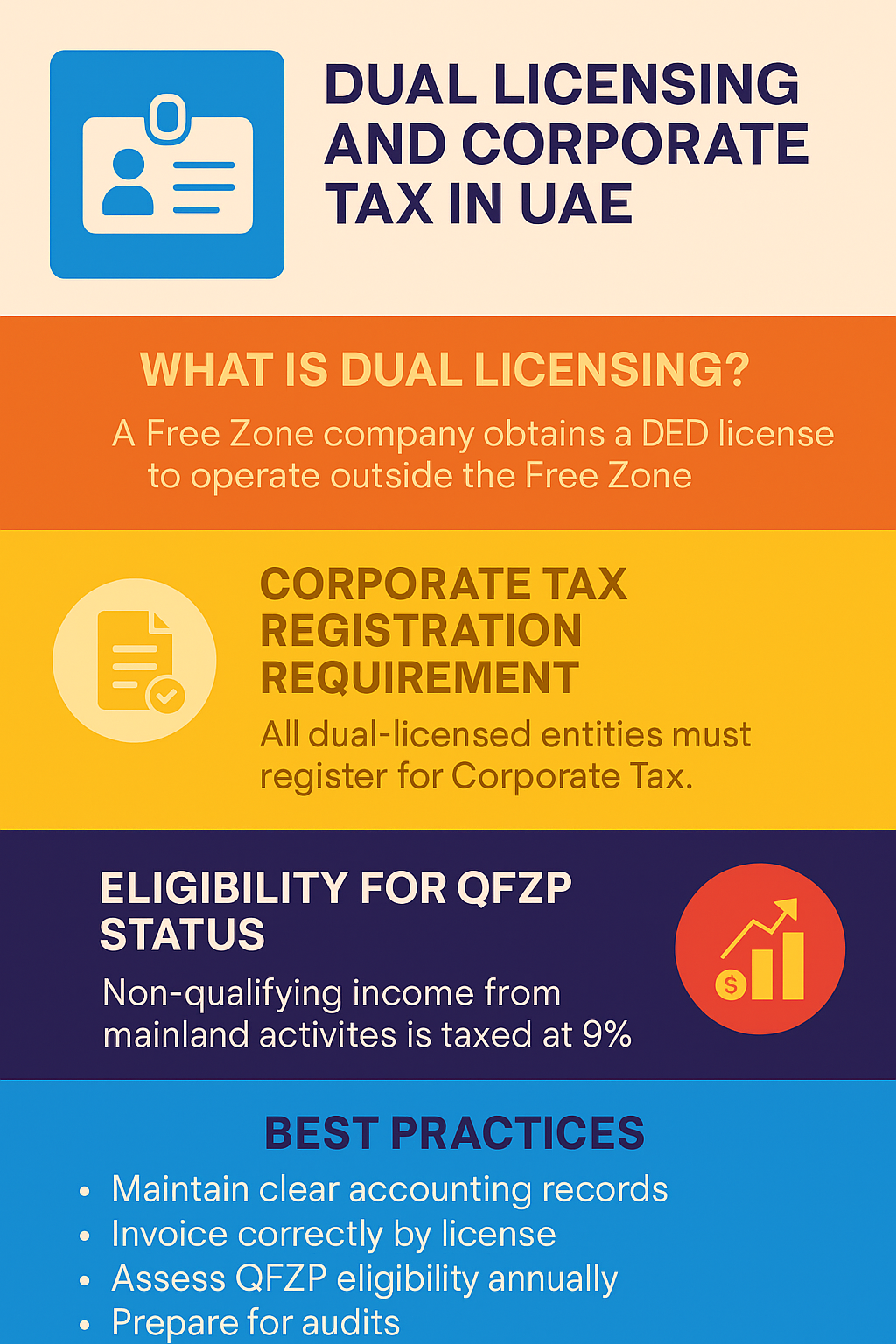
Dual licensing allows a Free Zone company to obtain an additional license from the Department of Economic Development (DED) of the respective Emirate, enabling them to operate outside the Free Zone, especially in the UAE mainland.
This is often permitted:
• Without a physical office on the mainland
• To facilitate mainland business activities
• For cost-saving and market access
However, this arrangement has serious tax implications under the UAE Corporate Tax regime.
________________________________________
⚖️ Legal Framework
Key references include:
• Federal Decree-Law No. 47 of 2022 – Corporate Tax Law
• Cabinet Decision No. 55 of 2023 – Conditions for QFZP
• Ministerial Decision No. 139 of 2023 – Qualifying & Excluded Income
• FTA Public Clarifications on QFZPs and Free Zones
• General Anti-Abuse Rule (GAAR) – Article 50
________________________________________
🧾 How Dual Licensing Affects Corporate Tax
1️⃣ Corporate Tax Registration Requirement
✅ All dual-licensed entities must register for Corporate Tax — regardless of whether they pay 0% or 9%.
• A Free Zone company holding a DED license must obtain a Tax Registration Number (TRN).
• The FTA may ask for clarification on the dual-licensed entity’s business model and customer base.
________________________________________
2️⃣ Eligibility for QFZP Status
To retain 0% tax on qualifying income, a dual-licensed Free Zone company must meet all conditions under Article 18, including:
• Substance in the Free Zone
• Income from qualifying activities
• Proper account segregation
• Transfer pricing compliance
However, income generated through the DED license from UAE mainland customers is generally considered:
🚫 Non-Qualifying Income → Taxed at 9%
Unless:
• It relates to passive income (e.g., interest, royalties), or
• Activities involve trading of goods in designated zones under customs control
________________________________________
3️⃣ Mainland Activities = Loss of 0% Tax on That Income
If your Free Zone company:
• Delivers services to mainland clients under the DED license
• Raises invoices using the DED license
• Or conducts business outside Free Zone using that license
Then:
➡️ The related income is not qualifying income
➡️ Subject to 9% corporate tax
➡️ You must ensure segregated accounting
________________________________________
🧠 Common Misconceptions
❌ Misconception ✅ Reality
Dual license = still 0% tax on all income Only qualifying income remains tax-free; DED-licensed activity usually taxable
No physical office = no mainland tax exposure DED license use creates mainland nexus
FTA won't notice split billing or informal invoicing FTA audits and data sharing can detect tax avoidance
Dual licensing protects QFZP status Misuse may trigger GAAR and revoke benefits
________________________________________
🧾 Transfer Pricing Considerations
If your Free Zone company transacts with its DED-licensed operations or related entities, you must apply:
• Arm’s length pricing
• Transfer Pricing Disclosure Form
• Master and Local Files if thresholds are met
FTA treats related party transactions seriously — especially in dual-licensed setups.
________________________________________
🚨 GAAR Risk: Anti-Abuse Rule (Article 50)
FTA may invoke GAAR if the dual licensing structure is:
• Primarily used to route income through Free Zone
• Lacks real substance in the Free Zone
• Designed to obtain tax advantage without commercial justification
➡️ Result: FTA may disregard the Free Zone structure, apply 9% tax, and levy penalties.
________________________________________
✅ Best Practices for Dual-Licensed Entities
Area Best Practice
📄 Income Segregation Maintain clear accounting records by license
🧾 Separate Invoicing Use correct license for issuing invoices
📊 Substance Maintain staff, systems, and activity in the Free Zone
🧠 Annual Review Assess QFZP eligibility every year
📑 TP Compliance Benchmark inter-entity transactions
🧑💼 FTA Audit Preparedness Keep documentation ready for both licenses
________________________________________
🧑💼 How We Can Help
At Sheikh Anwar Accounting and Auditing LLC, we help dual-licensed Free Zone businesses:
• Understand their corporate tax obligations
• Maintain QFZP compliance
• Establish proper income segregation systems
• Prepare for FTA audits and TP documentation
• File returns with accurate license-based disclosures
📧 Email: info@sa-auditors.com
🌐 Website: https://www.sa-auditors.com

