Documents to Maintain for a VAT Audit in the UAE
Introduction
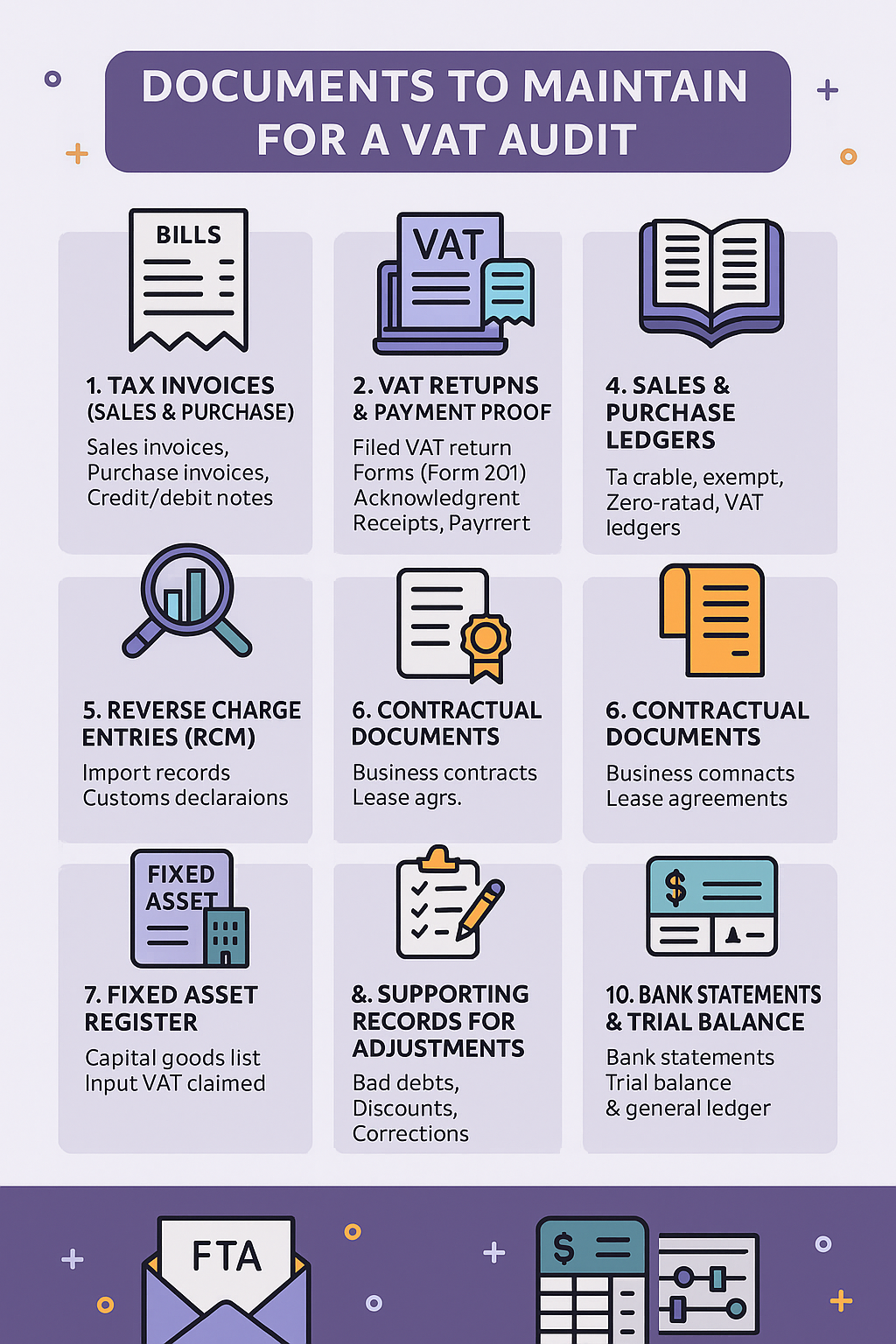
The Federal Tax Authority (FTA) in the UAE has the right to conduct a VAT audit to ensure that businesses are complying with tax laws. During an audit, the FTA may request a wide range of documents to verify the accuracy of your VAT returns, input tax claims, and overall compliance.
Failing to maintain or produce the required documents can result in penalties or disallowed input VAT claims.
Here, we’ll outline the key documents every VAT-registered business must retain and present for a smooth and successful VAT audit.
________________________________________
✅ 1. Tax Invoices (Sales & Purchases)
• Sales invoices issued to customers
• Purchase invoices from suppliers
• Credit and debit notes
• Must include TRN, invoice number, date, VAT breakdown
📌 Ensure invoices are FTA-compliant and stored in order.
________________________________________
✅ 2. VAT Returns & Payment Proof
• Filed VAT return Forms (Form 201)
• Acknowledgment receipts from EmaraTax
• Bank transfer confirmations or payment receipts
📁 Retain for at least 5 years (15 years for real estate).
________________________________________
✅ 3. VAT Reconciliation Reports
• Monthly/quarterly reconciliations of sales, purchases, and VAT payable
• Reports linking general ledger to VAT returns
🧾 Use spreadsheets or ERP-generated reports with cross-references.
________________________________________
✅ 4. Sales & Purchase Ledgers
• Detailed listing of all taxable, exempt, and zero-rated supplies
• Separate ledgers for input VAT and output VAT
📊 Helps FTA verify the accuracy of declared amounts.
________________________________________
✅ 5. Reverse Charge Entries (RCM)
• Import records of goods and services
• Supporting documents: Customs declarations, import VAT proof, invoices from foreign suppliers
🔁 Ensure reverse charge VAT is recorded in both input and output VAT.
________________________________________
✅ 6. Contractual Documents
• Business contracts related to long-term projects
• Lease agreements, service-level agreements
• Agreements that affect VAT rates or exemptions
📑 Supports classification and VAT treatment.
________________________________________
✅ 7. Fixed Asset Register
• List of capital goods acquired
• Date of acquisition, supplier, value, and claimed input VAT
• Adjustments, if any, under the Capital Assets Scheme (CAS)
🏢 Useful for FTA to verify long-term asset usage.
________________________________________
✅ 8. Supporting Records for Adjustments
• Bad debt adjustments
• Returned goods
• Discounts or rebates
• Manual corrections made in VAT return
✏️ Keep proper explanations and approval records.
________________________________________
✅ 9. Correspondence with FTA
• Tax audit notices, clarifications, refund queries
• Voluntary disclosure (Form 211), reconsideration requests
📬 Track communication for audit transparency.
________________________________________
✅ 10. Bank Statements & Trial Balance
• Bank statements for the audit period
• Trial balance and general ledger to reconcile with VAT figures
💼 Used to match VAT-related entries with financials.
________________________________________
🧠 Final Thoughts
Proper recordkeeping is your first line of defense in a VAT audit. If your documents are complete, well-organized, and easy to access, an audit can be smooth and penalty-free. Remember, FTA can go back 5 years—so build a system that supports long-term retention and compliance.
Need help preparing for an upcoming audit or organizing your VAT documents? Contact Sheikh Anwar Accounting & Auditing LLC for VAT audit support and compliance services.
📧 info@sa-auditors.com
🌐 www.sa-auditors.com