Documentation for Maintaining QFZP Status
Introduction
Maintaining your status as a Qualifying Free Zone Person (QFZP) is crucial for continuing to benefit from the 0% corporate tax rate on qualifying income. This outlines the practical documentation and compliance requirements companies must follow under the UAE Corporate Tax regime.
________________________________________
⚖️ Legal Basis
To retain QFZP status, a Free Zone entity must comply with:
• Article 18 of Federal Decree-Law No. 47 of 2022
• Cabinet Decision No. 55 of 2023 (QFZP conditions)
• Ministerial Decision No. 139 of 2023 (Qualifying activities and excluded income)
• Ministerial Decision No. 265 of 2023 (TP documentation)
• FTA's guidance on registration, filing, and annual declaration
Failure to comply with any condition may result in the loss of QFZP status and the application of 9% tax on full income.
________________________________________
🗂️ Key Documentation for QFZP Compliance
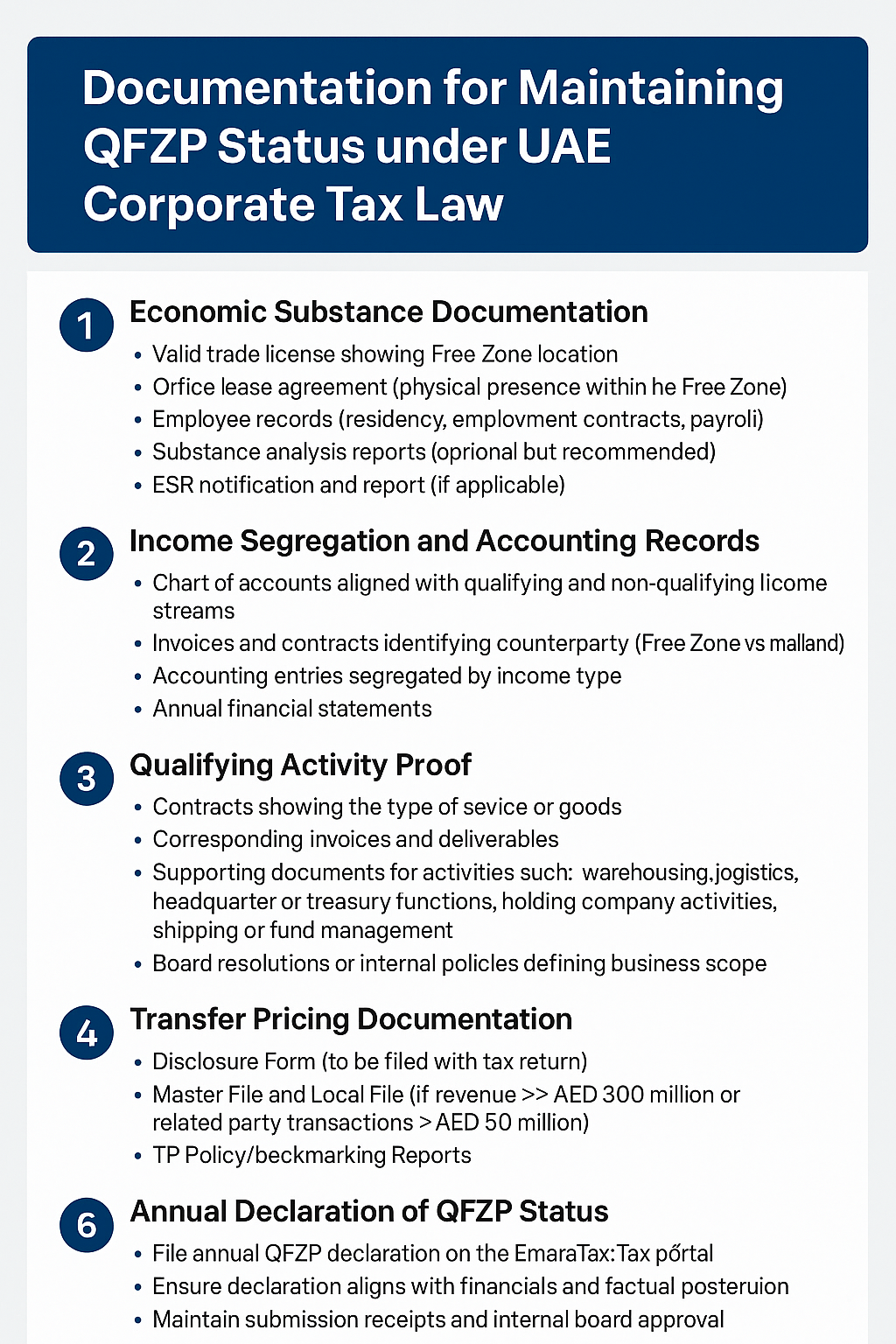
1. Economic Substance Documentation
✅ Purpose: To demonstrate that the entity has adequate presence in the Free Zone.
Documents to maintain:
• Valid trade license showing Free Zone location
• Office lease agreement (physical presence within the Free Zone)
• Employee records (residency, employment contracts, payroll)
• Substance analysis reports (optional but recommended)
• ESR notification and report (if applicable)
________________________________________
2. Income Segregation and Accounting Records
✅ Purpose: To clearly separate qualifying and non-qualifying income.
Required records:
• Chart of accounts aligned with qualifying and non-qualifying income streams
• Invoices and contracts identifying counterparty (Free Zone vs mainland)
• Accounting entries segregated by income type
• Annual financial statements
o Audit report if revenue > AED 50 million
o Internal classification of income as per Article 18(3)
Maintain for 7 years in accordance with UAE tax recordkeeping laws.
________________________________________
3. Qualifying Activity Proof
✅ Purpose: To demonstrate that income is derived from approved qualifying activities.
Documents required:
• Contracts showing the type of service or goods
• Corresponding invoices and deliverables
• Supporting documents for activities such as:
o Warehousing, logistics
o Headquarter or treasury functions
o Holding company activities
o Shipping or fund management
• Board resolutions or internal policies defining business scope
________________________________________
4. Transfer Pricing Documentation
✅ Purpose: To prove that related party and connected person transactions are at arm’s length.
Mandatory if thresholds are met:
• Disclosure Form (to be filed with tax return)
• Master File and Local File (if revenue > AED 200 million or related party transactions > AED 50 million)
• TP Policy/Benchmarking Reports
Maintain supporting agreements (e.g., service agreements, intercompany loans).
________________________________________
5. Annual Declaration of QFZP Status
✅ Purpose: To confirm to FTA that all conditions for QFZP status are met.
Required actions:
• File annual QFZP declaration on the EmaraTax portal
• Ensure the declaration aligns with financials and factual position
• Maintain submission receipts and internal board approval
This is a critical compliance step — failing to submit on time may result in automatic loss of QFZP status.
________________________________________
6. Corporate Tax Return & Related Filings
✅ Purpose: Fulfilling core tax obligations.
• Corporate Tax Registration Certificate
• Timely return filing (within 9 months of end of tax period)
• Backup documentation:
o Return summary
o Payment receipts
o FTA communication logs
________________________________________
📌 Additional Best Practices
• Conduct an annual QFZP eligibility assessment
• Retain meeting minutes approving qualifying transactions
• Establish a TP policy even if not legally required (for transparency)
• Regularly review FTA guidance and update documentation
• Keep a QFZP compliance file with all key records in one place
________________________________________
🚨 Consequences of Non-Compliance
Risk Area Consequence
Failure to meet substance Loss of QFZP status & 9% tax on full income
Misclassified income Tax on non-qualifying income + penalties
Missing declaration Disqualification + administrative penalties
TP non-compliance TP adjustments + penalties
________________________________________
🧾 Conclusion
Maintaining QFZP status is not just a one-time setup—it requires ongoing documentation, procedural discipline, and annual filings. Failure to comply with any single requirement could jeopardize the 0% corporate tax benefit.
________________________________________
🧑💼 Need Professional Help?
If your business needs assistance with QFZP documentation, tax return filing, or Transfer Pricing compliance, reach out to:
📧 Email: info@sa-auditors.com
🌐 Website: https://www.sa-auditors.com