Digital Economy and VAT Compliance
Introduction
The digital economy is transforming the global business landscape, and the UAE is no exception. From e-commerce platforms to digital content providers, online marketplaces, and cross-border services — digital transactions are booming. However, this rapid growth brings new tax challenges, especially in the area of Value Added Tax (VAT) compliance.
Here, we help businesses navigate these complexities by aligning their digital operations with UAE VAT laws. In this article, we’ll break down what the digital economy means under VAT regulations and how to stay compliant.
________________________________________
🌐 What Is the Digital Economy?
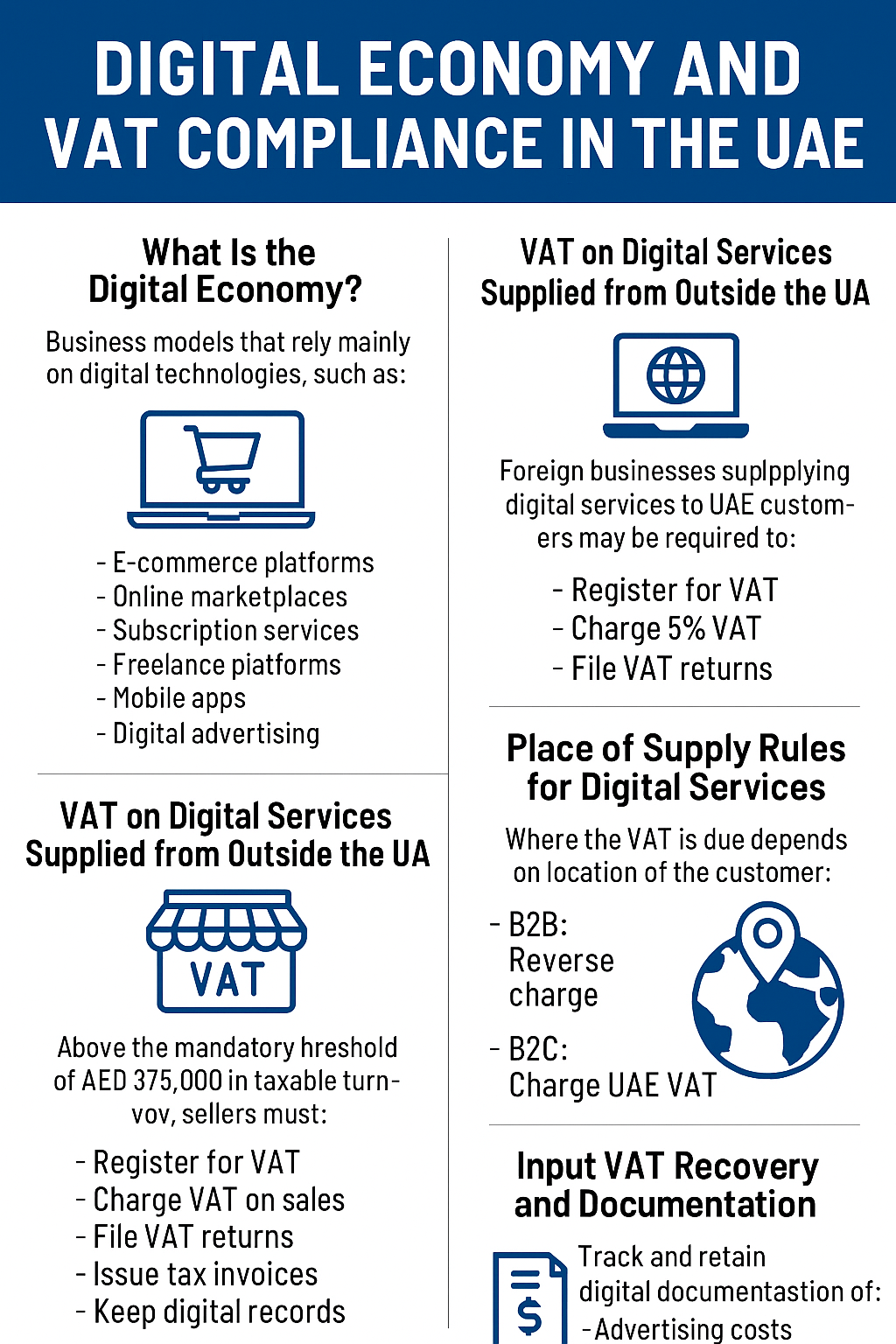
The digital economy includes business models that rely primarily on digital technologies, such as:
• E-commerce platforms (Amazon, Noon, Shopify stores)
• Online marketplaces (selling goods or services)
• Subscription services (Netflix, Spotify, e-learning)
• Freelance platforms (Fiverr, Upwork)
• Mobile apps and in-app purchases
• Digital advertising and cloud services
In VAT terms, these are considered electronic services, and they are subject to VAT rules—even when supplied cross-border.
________________________________________
🧾 How VAT Applies to the Digital Economy in the UAE
1. VAT on Digital Services Supplied from Outside the UAE
If a foreign business (not established in UAE) supplies digital services to UAE customers (especially B2C), it may be required to:
• Register for VAT in the UAE
• Charge 5% VAT on digital supplies
• File and remit VAT returns quarterly
Example: A software company based in the UK selling licenses to UAE residents must register for VAT if their revenue exceeds the mandatory threshold.
________________________________________
2. VAT Obligations for UAE-Based E-Commerce Sellers
If you’re selling goods or services online from within the UAE, and your taxable turnover exceeds AED 375,000, you must:
• Register for VAT
• Charge VAT on all eligible supplies
• File VAT returns on EmaraTax
• Issue VAT-compliant invoices
• Maintain digital records for 5 years
Example: A seller on Amazon UAE generating AED 500,000/year in sales must be VAT registered and file returns even if it’s a sole proprietorship.
________________________________________
3. Marketplace Facilitator Rules
FTA may treat certain online platforms as deemed suppliers. This means:
• The platform, not the seller, is responsible for collecting and remitting VAT.
• This applies if the platform controls pricing, invoicing, or delivery.
Implication: If you're selling through a marketplace, check whether the platform is remitting VAT on your behalf.
________________________________________
4. Place of Supply Rules for Digital Services
Understanding where VAT is due depends on the customer:
• B2B (Business-to-Business): Reverse charge mechanism applies (recipient accounts for VAT).
• B2C (Business-to-Consumer): Supplier must charge UAE VAT if the consumer is located in the UAE.
Key Criteria: IP address, billing address, payment method, and country of SIM card can all help determine the customer location.
________________________________________
5. Input VAT Recovery and Documentation
Businesses engaged in the digital economy must also:
• Track input VAT paid on advertising, hosting, software tools, etc.
• Maintain digital documentation, such as:
o Google Ads receipts
o Facebook Ads invoices
o Cloud service bills
Tip: These should be in your business’s name with valid TRN to claim input VAT.
________________________________________
🚨 Common VAT Mistakes in the Digital Economy
• Failing to register despite crossing the threshold
• Charging VAT before TRN is received
• Not verifying customer’s location for supply rules
• Using incorrect invoice formats
• Missing VAT on digital content subscriptions or app income
• Ignoring reverse charge mechanism for B2B imports
________________________________________
📊 What’s Coming: Future VAT Reforms for Digital Businesses
• Real-Time Reporting (RTIR) and e-invoicing may soon be mandated.
• Platform liability rules may become more stringent.
• FTA may introduce simplified registration for foreign suppliers.
• VAT compliance will shift toward more automated tracking and validations.
________________________________________
🛡️ How Sheikh Anwar Accounting and Auditing LLC Can Help
We offer:
• VAT registration for digital startups and foreign entities
• Customized advisory for e-commerce and SaaS businesses
• EmaraTax training and VAT return filing support
• Audit-ready VAT records for online sellers and service providers
________________________________________
📍Conclusion
The digital economy opens up global opportunities—but it also introduces local VAT responsibilities. Whether you're an app developer, marketplace seller, or overseas service provider, VAT compliance is critical to avoid penalties and ensure business sustainability in the UAE.
Need VAT help for your digital business?
Contact Sheikh Anwar Accounting and Auditing LLC today for expert, tailored VAT solutions.
📧 Email: info@sa-auditors.com
🌐 Website: www.sa-auditors.com
📞 Phone: +971-XXX-XXXX