Creating an AML Risk Assessment Document
Introduction
In today’s regulatory environment, Anti-Money Laundering (AML) compliance is not optional—it is a legal and ethical obligation. Businesses operating in sectors such as gold and diamond trading, real estate, accountancy, law, and other Designated Non-Financial Businesses and Professions (DNFBPs) in the UAE must develop a comprehensive AML Risk Assessment Document. This document is central to identifying, managing, and mitigating risks associated with money laundering and terrorist financing.
________________________________________
1. Purpose of the AML Risk Assessment
The primary objective of an AML Risk Assessment is to:
• Identify inherent risks in business operations.
• Assess the likelihood and potential impact of those risks.
• Implement controls to mitigate exposure.
• Document a structured, risk-based approach to compliance in line with Federal Decree-Law No. 20 of 2018 and Cabinet Decision No. 10 of 2019.
________________________________________
2. Key Components of the AML Risk Assessment Document
A. Business Risk Profile
• Overview of the company’s nature of business.
• Geographies of operations (local and international).
• Customer base and transaction patterns.
• Exposure to high-risk products or services (e.g., precious metals, high-value goods, cross-border transactions).
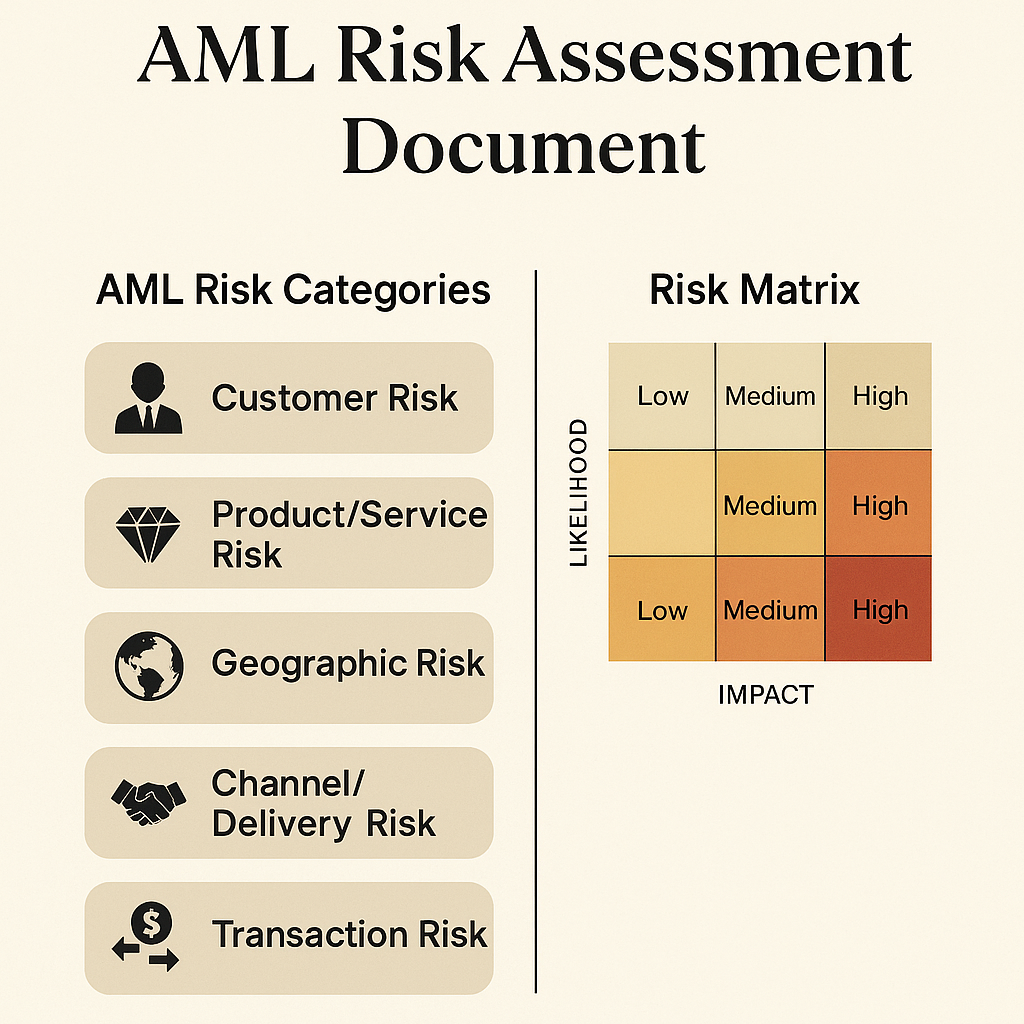
B. Risk Categories to be Assessed
1. Customer Risk – PEPs, non-resident clients, shell companies, trusts.
2. Product/Service Risk – High-value transactions, anonymous products, complex structures.
3. Geographic Risk – Countries under FATF monitoring or sanctioned jurisdictions.
4. Channel/Delivery Risk – Face-to-face vs. non-face-to-face onboarding, third-party intermediaries.
5. Transaction Risk – Unusual cash payments, frequent high-value transfers, inconsistent trade activities.
C. Methodology
• Use a risk matrix (Low, Medium, High).
• Assign weights to categories (e.g., Customer 30%, Product 25%, Geography 20%, Channel 15%, Transaction 10%).
• Define risk thresholds for escalation and enhanced due diligence (EDD).
D. Control Measures
• Customer Due Diligence (CDD) and Enhanced Due Diligence (EDD).
• Sanctions and PEP screening tools.
• Regular staff AML training programs.
• Monitoring and reporting through goAML platform.
• Independent audit and testing of AML framework.
E. Ongoing Monitoring & Review
• Risk assessments must be reviewed at least annually or when there are significant changes (e.g., new products, new markets, regulatory updates).
• Maintain records for regulatory inspections and demonstrate compliance.
________________________________________
3. Benefits of a Comprehensive AML Risk Assessment
• Protects the business from legal and reputational risks.
• Ensures compliance with UAE regulatory obligations.
• Demonstrates to the Ministry of Economy and other regulators that the business applies a risk-based approach (RBA).
• Provides management with clarity on resource allocation for AML compliance.
________________________________________
4. Practical Tips for Businesses
• Tailor the risk assessment to the specific business model. Avoid generic templates.
• Align the risk framework with FATF Recommendations and UAE-specific AML requirements.
• Ensure board and senior management approval of the risk assessment.
• Document every control measure—regulators require evidence, not just intent.
________________________________________
Conclusion
An AML Risk Assessment is not just a compliance exercise—it is a living document that protects businesses, enhances trust with regulators, and builds credibility with clients and stakeholders. Regularly updating and testing this framework is essential to stay ahead of evolving money laundering threats.
________________________________________
📌 About Us
Sheikh Anwar Accounting and Auditing LLC is a MOE-approved auditing firm in the UAE with expertise in AML compliance, corporate tax, VAT, and transfer pricing. We assist DNFBPs, financial institutions, and SMEs in designing and implementing robust AML frameworks, including Risk Assessments, Policies, MLRO Services, and Training.
🌐 www.sa-auditors.com
📧 info@sa-auditors.com
📍 Dubai Creek Tower, M 35, Dubai, UAE