Country-by-Country Reporting in UAE
Introduction
As part of its commitment to OECD’s Base Erosion and Profit Shifting (BEPS) Action Plan 13, the UAE has implemented Country-by-Country Reporting (CbCR) requirements for multinational enterprise (MNE) groups. CbCR enhances tax transparency by providing tax authorities with a clear picture of how global income, taxes, and economic activities are distributed across jurisdictions.
In the UAE, CbCR obligations apply to large multinational groups headquartered in the country. Non-compliance can result in penalties and reputational risks, making it critical for businesses to fully understand and comply with the framework.
1. What is Country-by-Country Reporting (CbCR)?
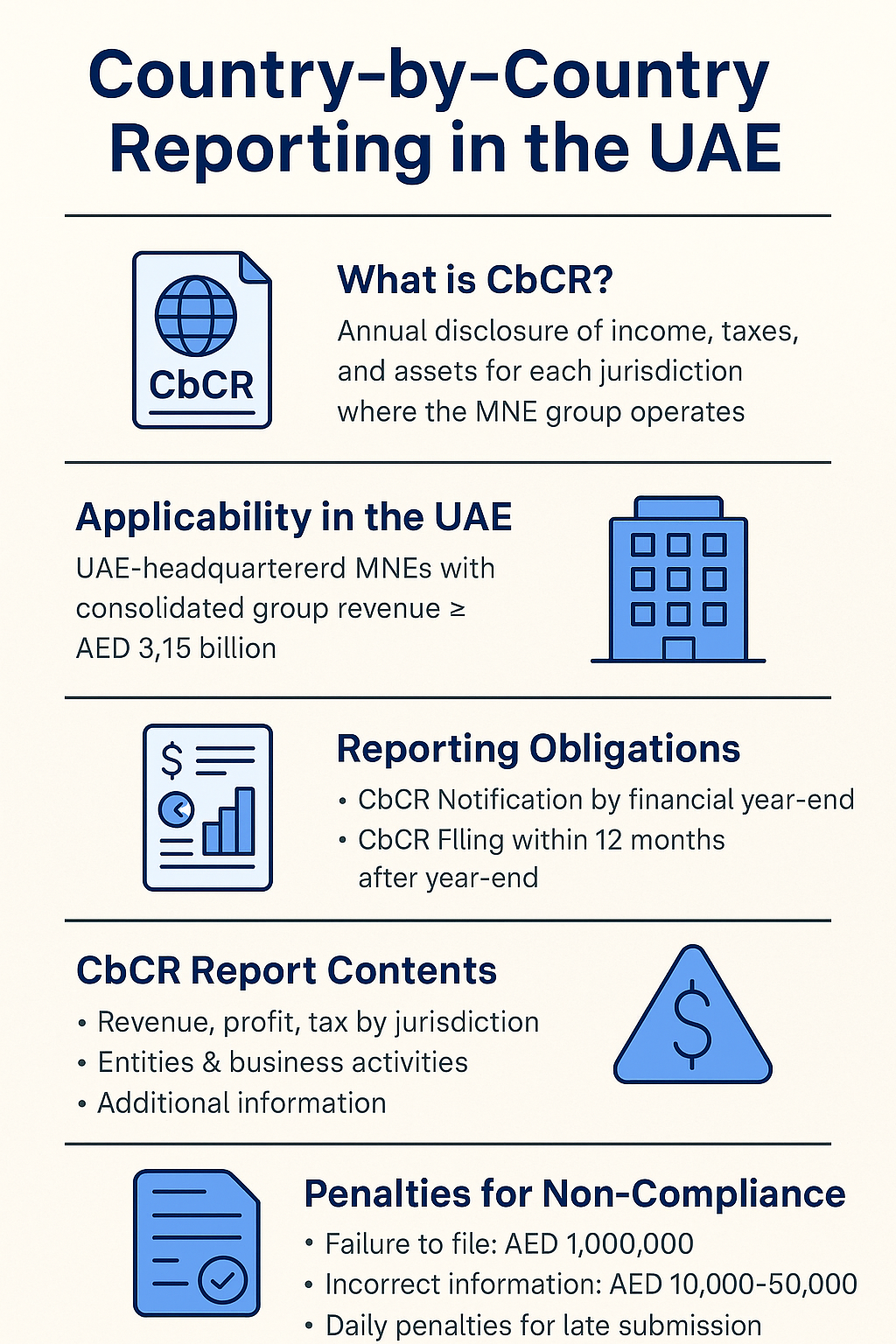
CbCR is a reporting standard requiring large MNE groups to submit an annual report that discloses:
Revenue (split into related-party and third-party).
Profits (or losses) before income tax.
Income tax paid and accrued.
Stated capital and accumulated earnings.
Number of employees.
Tangible assets other than cash.
This information must be provided for each tax jurisdiction where the group operates.
2. Applicability in the UAE
CbCR in the UAE applies to:
UAE-headquartered MNE Groups with consolidated group revenues ≥ AED 3.15 billion in the preceding financial year.
Subsidiaries in the UAE of foreign MNE groups may also have notification obligations if the parent is not filing CbCR in its home country.
3. Reporting Obligations
a) CbCR Notification
Must be submitted to the UAE Ministry of Finance (MoF) by the end of the group’s financial year.
Confirms whether the UAE entity is the reporting entity or a subsidiary.
b) CbCR Filing
Due within 12 months from the end of the reporting financial year.
Submitted electronically via the MoF portal.
Must include details for each jurisdiction where the group operates.
4. Contents of the CbCR Report
The CbCR must include:
Overview Table (per jurisdiction):
Revenues (related-party vs third-party).
Profit (loss) before tax.
Income tax paid and accrued.
Stated capital and accumulated earnings.
Number of employees.
Tangible assets (excluding cash).
Entity List Table:
Details of each group entity, jurisdiction of tax residence, and nature of business activities.
Additional Information Table:
Explanatory notes to clarify data or allocations.
5. Penalties for Non-Compliance
Failure to comply with CbCR rules in the UAE may result in:
AED 1,000,000 fixed penalty for failure to file.
AED 10,000 – 50,000 for incorrect/incomplete information.
Daily penalties for late submissions after deadlines.
Increased risk of tax authority audits in the UAE and abroad.
6. Best Practices for Compliance
Early Identification: Confirm whether your group meets the AED 3.15 billion threshold.
Appoint a Responsible Entity: Clarify reporting obligations within the group.
Align with OECD Standards: Ensure consistency in financial data across jurisdictions.
Use Technology: Adopt ERP systems for consolidated reporting.
Coordinate with Group HQ: Ensure UAE filing is aligned with global CbCR policies.
Maintain Documentation: Keep supporting evidence for numbers reported in CbCR.
7. Impact on Multinationals in the UAE
CbCR increases compliance burden but also enhances transparency. For businesses, this means:
More regulatory scrutiny from tax authorities.
Need for robust transfer pricing policies.
Greater importance of substance and alignment between reported profits and actual operations in the UAE.
Conclusion
CbCR is a powerful transparency tool under the UAE Corporate Tax regime. For large multinational groups, it means annual disclosure of financial and operational data across jurisdictions. While compliance can be demanding, it strengthens the UAE’s position as a responsible, OECD-aligned jurisdiction and reduces the risk of international tax disputes.
Businesses must adopt a proactive compliance strategy by meeting deadlines, preparing accurate reports, and aligning with OECD standards to avoid penalties and protect their Free Zone or tax planning benefits.
✍️ By Sheikh Anwar Accounting and Auditing LLC (SA-Auditors)
📍 Dubai, United Arab Emirates
🌐 www.sa-auditors.com
| ✉️ info@sa-auditors.com