Corporate Tax Simulation for Training
Introduction
With the implementation of Corporate Tax (CT) in the UAE, businesses of all sizes are now required to navigate new rules, filing procedures, and compliance frameworks. While guidance and advisory services are essential, the most effective way for finance teams and managers to prepare is through corporate tax simulation training.
Tax simulation allows companies to experience real-world compliance scenarios in a controlled environment. It transforms theory into practice, helping staff build confidence in applying tax laws, identifying risks, and making accurate filings.
________________________________________
What is Corporate Tax Simulation?
Corporate tax simulation is a training methodology where businesses and employees participate in a “mock” tax cycle. This involves:
• Preparing trial tax computations using sample data or actual financial records.
• Simulating tax return filing on platforms like EmaraTax.
• Running through audit and assessment scenarios to test responses to authority queries.
• Applying tax law provisions (deductions, exemptions, transfer pricing rules) in practice.
In short, it replicates the entire compliance journey—without the real-world risk of penalties.
________________________________________
Why Simulation is Important for Training
1. Bridging the Gap Between Theory and Practice
Tax workshops and seminars explain the law, but simulations show employees how to apply it. Staff get hands-on exposure to calculations, reporting, and decision-making.
2. Error Identification and Correction
By simulating filings, common mistakes—such as incorrect expense classification, overlooking exemptions, or misreporting VAT adjustments—are identified early.
3. Building Confidence Before the First Filing
The first corporate tax filing deadline is a source of stress for startups and SMEs. Practicing beforehand reduces uncertainty and ensures a smoother real submission.
4. Team Alignment
Simulations bring together finance, accounting, and compliance staff, ensuring everyone understands their roles and responsibilities in the tax process.
5. Audit Preparedness
Simulated tax audits prepare businesses for potential Federal Tax Authority (FTA) reviews, teaching teams how to respond professionally with documentation and justifications.
________________________________________
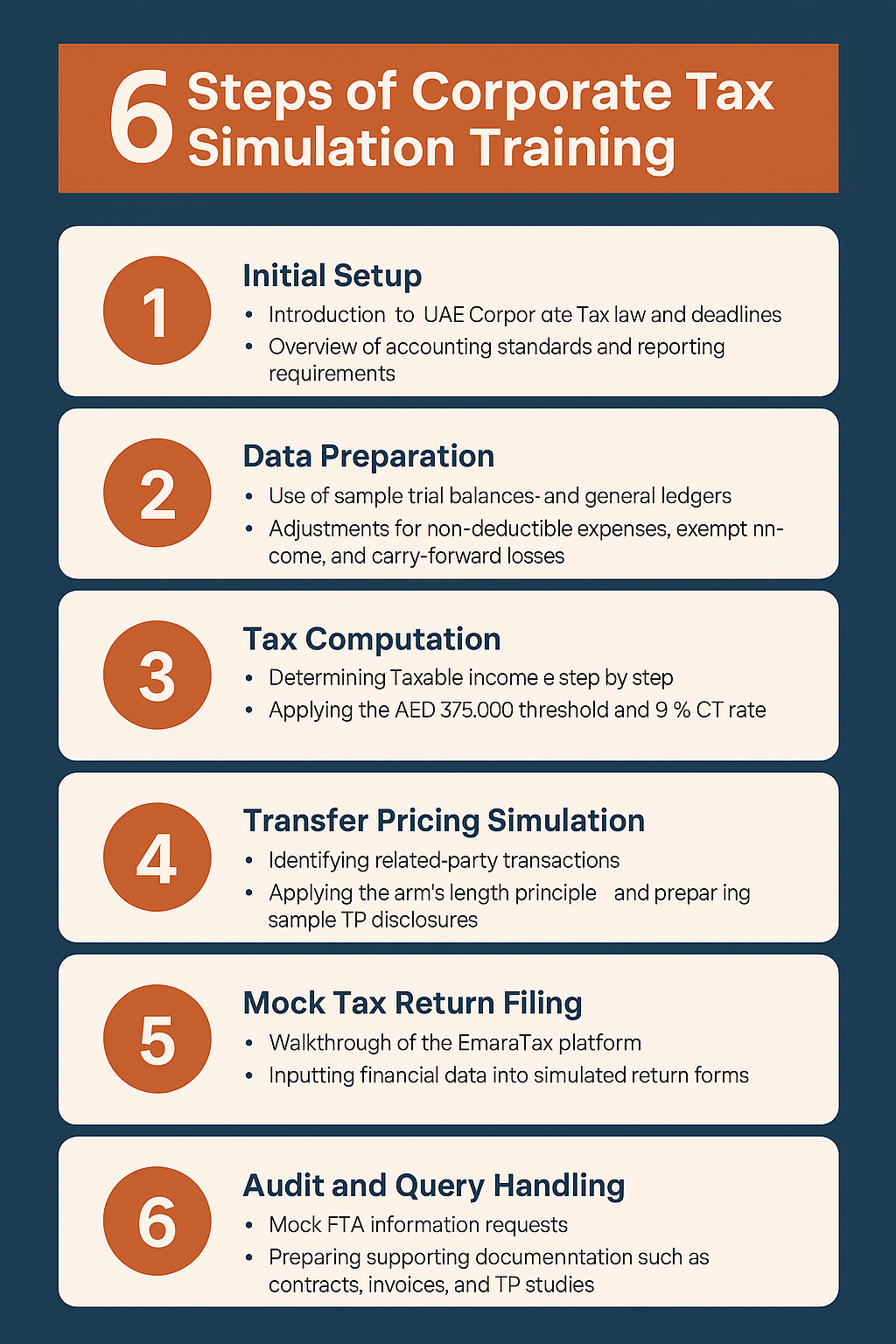
Key Elements of a Corporate Tax Simulation Training
1. Initial Setup
o Introduction to UAE Corporate Tax law and deadlines.
o Overview of accounting standards (IFRS-based) and reporting requirements.
2. Data Preparation
o Use of sample trial balances and general ledgers.
o Adjustments for non-deductible expenses, exempt income, and carry-forward losses.
3. Tax Computation
o Determining taxable income step by step.
o Applying the AED 375,000 threshold and 9% CT rate.
o Incorporating free zone provisions where applicable.
4. Transfer Pricing Simulation
o Identifying related-party transactions.
o Applying the arm’s length principle and preparing sample TP disclosures.
5. Mock Tax Return Filing
o Walkthrough of the EmaraTax platform.
o Inputting financial data into simulated return forms.
6. Audit and Query Handling
o Mock FTA information requests.
o Preparing supporting documentation such as contracts, invoices, and TP studies.
________________________________________
Benefits for Businesses
✅ Compliance Readiness – Ensures accurate filings and avoids penalties.
✅ Efficiency Gains – Teams learn to complete filings faster and with fewer errors.
✅ Risk Management – Identifies compliance gaps before they become costly.
✅ Capacity Building – Develops in-house expertise, reducing dependence on external advisors for every step.
✅ Strategic Awareness – Helps management understand tax impacts on pricing, financing, and investment decisions.
________________________________________
Case Example
A mid-sized trading company in Dubai participated in a corporate tax simulation training ahead of its first filing. The exercise revealed that:
• AED 250,000 in marketing costs were non-deductible as they exceeded the allowable threshold.
• The company had incorrectly classified certain related-party loans, which triggered Transfer Pricing concerns.
• After corrections, the taxable income was reduced by AED 1.2 million, saving AED 108,000 in Corporate Tax liability.
By conducting the simulation, the business avoided real-world penalties and improved its compliance framework.
________________________________________
Conclusion
Corporate tax simulation is more than a training exercise—it is a strategic compliance tool. By practicing filings, calculations, and audits in advance, businesses equip their teams with the skills needed to handle the UAE’s tax regime confidently and efficiently.
Startups, SMEs, and large corporates alike can benefit from embedding simulation into their tax training programs.
________________________________________
How We Can Help
At Sheikh Anwar Academy, we offer specialised Corporate Tax Simulation Training Programs for finance teams, auditors, and business owners. These programs combine lectures, case studies, and mock filing exercises to ensure participants are fully prepared for the UAE’s tax landscape.
📩 Enrol now by contacting us at info@sa-auditors.com | 🌐 www.sa-auditors.com