Corporate Tax Planning for SMEs
Introduction
Small and Medium Enterprises (SMEs) form the backbone of the UAE economy, contributing significantly to GDP, employment, and innovation. With the implementation of the UAE Corporate Tax regime under Federal Decree-Law No. 47 of 2022, tax compliance has become an essential part of business management for SMEs.
While SMEs may have smaller operational budgets compared to large corporations, strategic corporate tax planning can help reduce tax liabilities, improve cash flow, and ensure compliance without overburdening resources.
At Sheikh Anwar Accounting and Auditing LLC, we specialise in helping SMEs navigate the corporate tax landscape while focusing on business growth.
________________________________________
1. Why Corporate Tax Planning is Essential for SMEs
a) Minimising Tax Liability
• Identifies allowable deductions, exemptions, and incentives.
• Helps SMEs remain competitive by reducing unnecessary tax costs.
b) Cash Flow Management
• Proper planning ensures taxes are paid without disrupting day-to-day operations.
• Prevents last-minute tax burdens.
c) Compliance and Risk Management
• Avoids penalties, fines, and reputational damage from non-compliance.
• Prepares SMEs for possible audits by the Federal Tax Authority (FTA).
d) Business Growth Support
• Savings from efficient tax planning can be reinvested into marketing, technology, and workforce development.
________________________________________
2. Understanding UAE Corporate Tax for SMEs
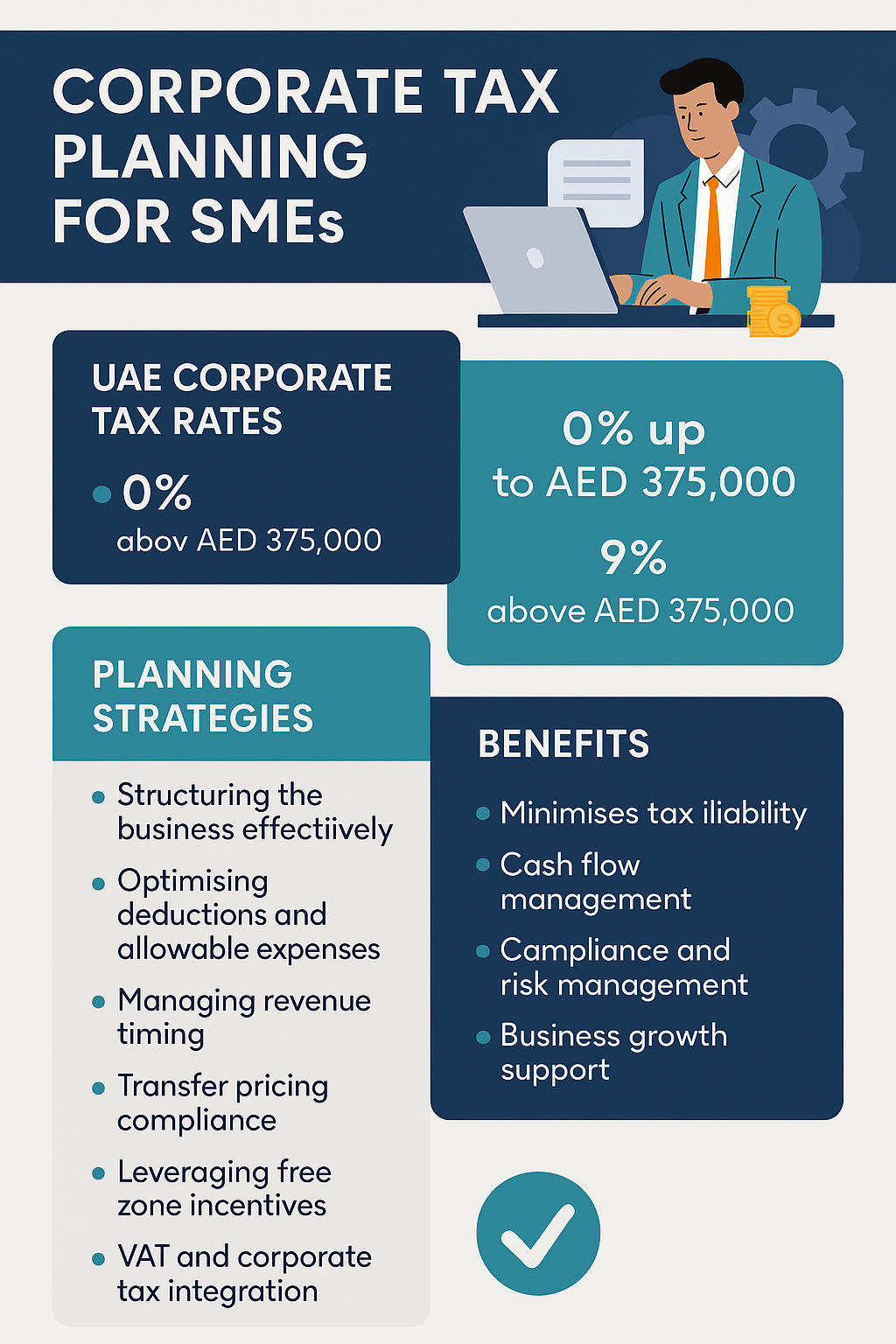
The UAE Corporate Tax rates applicable to SMEs are:
• 0% on taxable income up to AED 375,000.
• 9% on taxable income above AED 375,000.
Free zone SMEs that qualify as Qualifying Free Zone Persons (QFZPs) may enjoy 0% corporate tax on qualifying income, subject to strict conditions.
________________________________________
3. Key Corporate Tax Planning Strategies for SMEs
1. Structuring the Business Effectively
• Decide whether to operate as a mainland company, free zone entity, or branch based on tax benefits and operational needs.
• For free zone SMEs, ensure compliance with QFZP conditions to enjoy 0% tax on qualifying income.
2. Optimising Deductions and Allowable Expenses
• Deductible expenses include salaries, rent, utilities, marketing costs, and certain interest expenses.
• Maintain proper documentation for all claims.
3. Managing Revenue Timing
• If income is close to the AED 375,000 threshold, SMEs can manage invoicing and expense recognition to remain within the lower tax bracket.
4. Transfer Pricing Compliance
• SMEs with related-party transactions must follow Transfer Pricing (TP) rules and maintain arm’s length pricing to avoid disputes with the FTA.
5. Leveraging Free Zone Incentives
• SMEs operating in designated free zones should focus on qualifying activities to maintain the 0% rate.
• Separate qualifying and non-qualifying income in the accounts.
6. VAT and Corporate Tax Integration
• Plan VAT and corporate tax strategies together to ensure consistent financial records and avoid double counting.
________________________________________
4. Common Mistakes SMEs Make in Tax Planning
1. Mixing personal and business expenses – leads to disallowed deductions.
2. Ignoring free zone requirements – losing 0% corporate tax benefits.
3. Poor record keeping – weak documentation can cause disputes and penalties.
4. Focusing only on year-end planning – tax planning should be ongoing.
________________________________________
5. Compliance Requirements for SMEs
Regardless of tax rate or exemption, SMEs must:
• Register for corporate tax with the FTA.
• Maintain IFRS-compliant financial statements.
• Keep records for at least 7 years.
• File annual corporate tax returns within 9 months of the tax period end.
• Submit Transfer Pricing disclosure forms where applicable.
________________________________________
6. The Role of Professional Advice
Corporate tax laws in the UAE are relatively new and still evolving. A professional tax advisor can:
• Assess the SME’s eligibility for exemptions.
• Design a tax-efficient structure.
• Ensure ongoing compliance with legal requirements.
• Provide insights into future tax law changes.
________________________________________
Conclusion
For SMEs in the UAE, corporate tax planning is not optional — it is essential. With the right approach, SMEs can reduce tax costs, stay compliant, and free up resources for growth. The key is to treat tax planning as an ongoing business process, not a one-time task.
At Sheikh Anwar Accounting and Auditing LLC, we work with SMEs across industries to create tailored corporate tax strategies that ensure compliance and maximise savings.
📍 Dubai, UAE
🌐 Website: www.sa-auditors.com