Corporate Tax in the Real Estate Sector
Introduction
The UAE real estate sector is a cornerstone of the economy, attracting global investors, developers, and institutional funds. With the introduction of UAE Corporate Tax (Federal Decree-Law No. 47 of 2022), stakeholders in the real estate industry must carefully assess how this new regime impacts their business models, income streams, and investment structures.
While real estate remains a highly attractive asset class, Corporate Tax brings new compliance requirements that affect developers, property management companies, real estate investment funds, and landlords.
________________________________________
1. Applicability of Corporate Tax in Real Estate
Corporate Tax applies broadly to companies incorporated in the UAE, including those engaged in real estate activities. However, the treatment varies depending on the entity and income source:
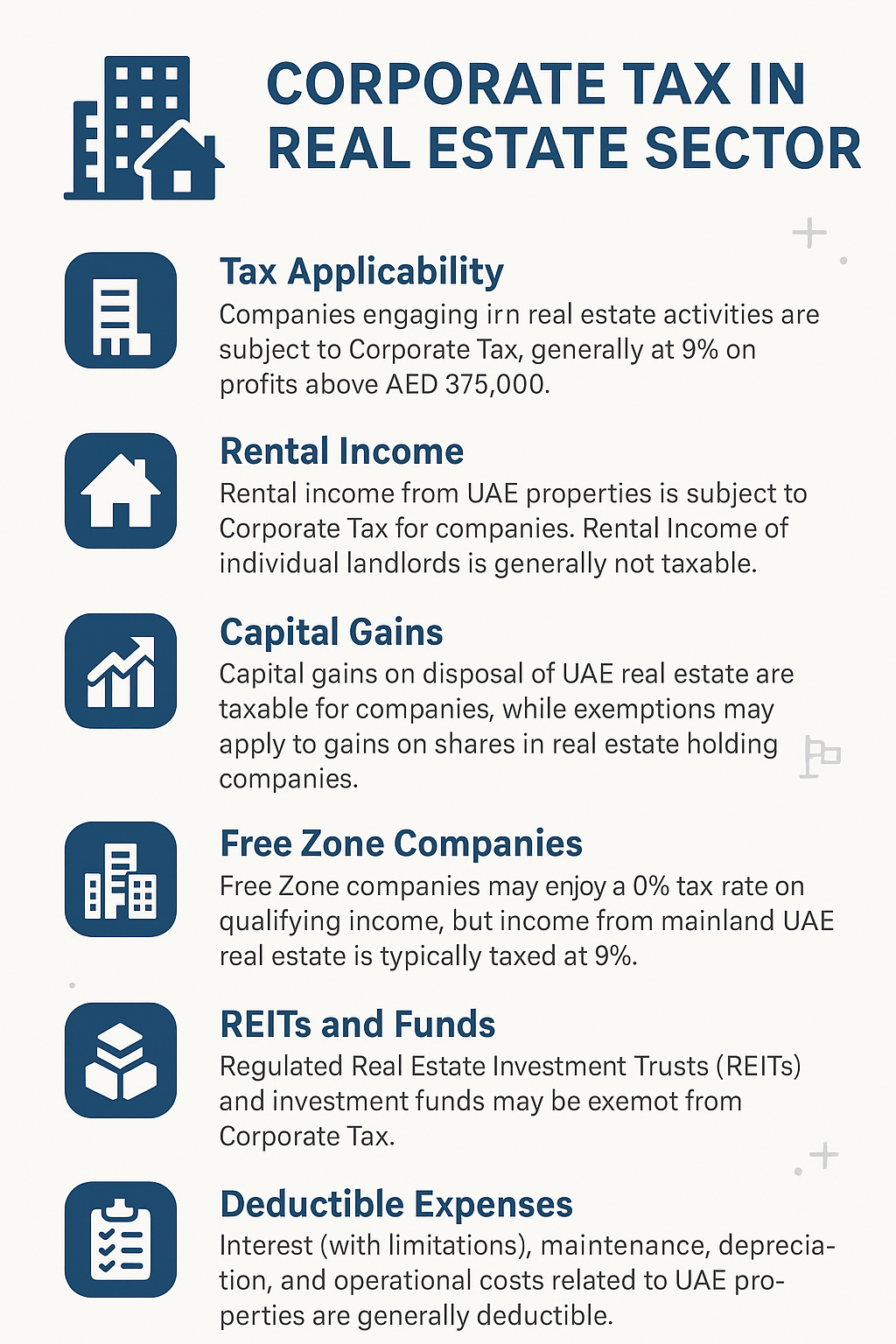
• Real Estate Developers & Construction Companies – fully taxable at 9% on profits above AED 375,000.
• Property Management & Brokerage Firms – taxable on service income.
• Property Investment Companies – rental income, capital gains, and management fees fall under Corporate Tax.
• Free Zone Real Estate Entities – may qualify for 0% Corporate Tax on qualifying income if substance requirements are met.
________________________________________
2. Key Income Streams and Tax Treatment
1. Rental Income
o Rental income derived from UAE properties by companies is subject to Corporate Tax.
o Rental income earned by individual landlords (not through a company) is generally not subject to Corporate Tax.
2. Capital Gains
o Gains on disposal of real estate assets are taxable for companies.
o Exemptions may apply under participation exemption if shares in a real estate holding company are disposed of (subject to conditions).
3. Service Income
o Brokerage, facility management, and property consultancy fees are fully taxable.
4. Free Zone Income
o Income from transactions with other Free Zone entities or from outside UAE may qualify for 0% tax.
o Income from mainland UAE real estate activities is generally subject to 9% tax.
________________________________________
3. Real Estate Investment Trusts (REITs) and Funds
• REITs and certain regulated investment funds may be exempt from Corporate Tax if approved by the FTA and meeting regulatory requirements.
• Conditions often include being widely held, diversified, and subject to oversight by a recognized authority.
• This exemption encourages institutional investment in the UAE property sector.
________________________________________
4. Deductible vs. Non-Deductible Expenses in Real Estate
• Deductible:
o Interest on loans (subject to 30% EBITDA cap).
o Maintenance, depreciation, property management costs.
o Marketing and administrative expenses.
• Non-Deductible:
o Fines, penalties, certain entertainment expenses.
o Unrealized revaluation gains not recognized for tax purposes.
Accurate financial reporting is crucial to maximize deductions while remaining compliant.
________________________________________
5. Free Zone Considerations for Real Estate Companies
• Many developers and holding companies are incorporated in Free Zones such as DIFC, ADGM, DMCC, and RAKEZ.
• To maintain Qualifying Free Zone Person (QFZP) status and enjoy 0% tax:
o Substance requirements must be met.
o Only qualifying income is exempt (e.g., rental from Free Zone property, cross-border transactions).
o Non-qualifying income (mainland property income) is taxed at 9%.
________________________________________
6. Transfer Pricing and Related-Party Transactions
Real estate businesses often operate through group structures with multiple entities.
• Transfer Pricing (TP) rules apply to related-party leases, financing, and service arrangements.
• Businesses must maintain Local File, Master File, and Benchmarking to comply with UAE CT Law and OECD TP Guidelines.
________________________________________
7. Structuring and Planning Opportunities
• Real Estate Holding Companies: Centralize property ownership for tax and compliance efficiency.
• Leverage REITs and Funds: Consider structuring investments via REITs for tax-exempt treatment.
• Group Relief: Utilize tax loss transfers or tax grouping provisions where ownership thresholds are met.
• Free Zone Planning: Use Free Zones strategically to minimize Corporate Tax exposure.
________________________________________
8. Compliance and Documentation Requirements
• Prepare audited financial statements under IFRS or IFRS for SMEs.
• Maintain proper records of property valuations, lease agreements, and service contracts.
• File tax returns within 9 months of the financial year-end.
• Retain records for at least 7 years for audit purposes.
________________________________________
Conclusion
The introduction of Corporate Tax in the UAE real estate sector changes the way developers, landlords, and investors must approach financial and tax planning. While exemptions exist for REITs and Free Zone entities, most companies involved in real estate activities will fall under the 9% Corporate Tax regime.
Early preparation, accurate accounting, and strategic structuring are essential to ensure compliance and optimize tax efficiency in this evolving regulatory environment.
________________________________________
✍️ By Sheikh Anwar Accounting and Auditing LLC (SA-Auditors)
📍 Dubai, United Arab Emirates
🌐 www.sa-auditors.com | ✉️ info@sa-auditors.com

