Corporate Tax for Travel Agencies
Introduction
The UAE is one of the world’s most dynamic travel and tourism hubs, hosting millions of tourists annually and supporting thousands of travel agencies. With the implementation of the UAE Corporate Tax (Federal Decree-Law No. 47 of 2022), travel agencies — from ticketing offices to tour operators and online platforms — must now align their operations with the new taxation framework.
Corporate Tax affects how agencies manage commissions, service income, and cross-border arrangements, making proper planning essential for compliance and profitability.
________________________________________
1. Applicability of Corporate Tax to Travel Agencies
• Mainland Travel Agencies: Fully subject to Corporate Tax on their net profits.
• Free Zone Travel Agencies: May enjoy 0% Corporate Tax on qualifying income (e.g., cross-border services), but income from mainland clients generally attracts 9% Corporate Tax.
• Foreign Travel Agencies: Liable if they have a permanent establishment (PE) in the UAE, such as an office, branch, or dependent agent.
________________________________________
2. Corporate Tax Rates for Travel Agencies
• 0% on taxable income up to AED 375,000.
• 9% on taxable income above AED 375,000.
• Free Zone Firms: 0% tax on qualifying income (cross-border transactions), but 9% on mainland services.
________________________________________
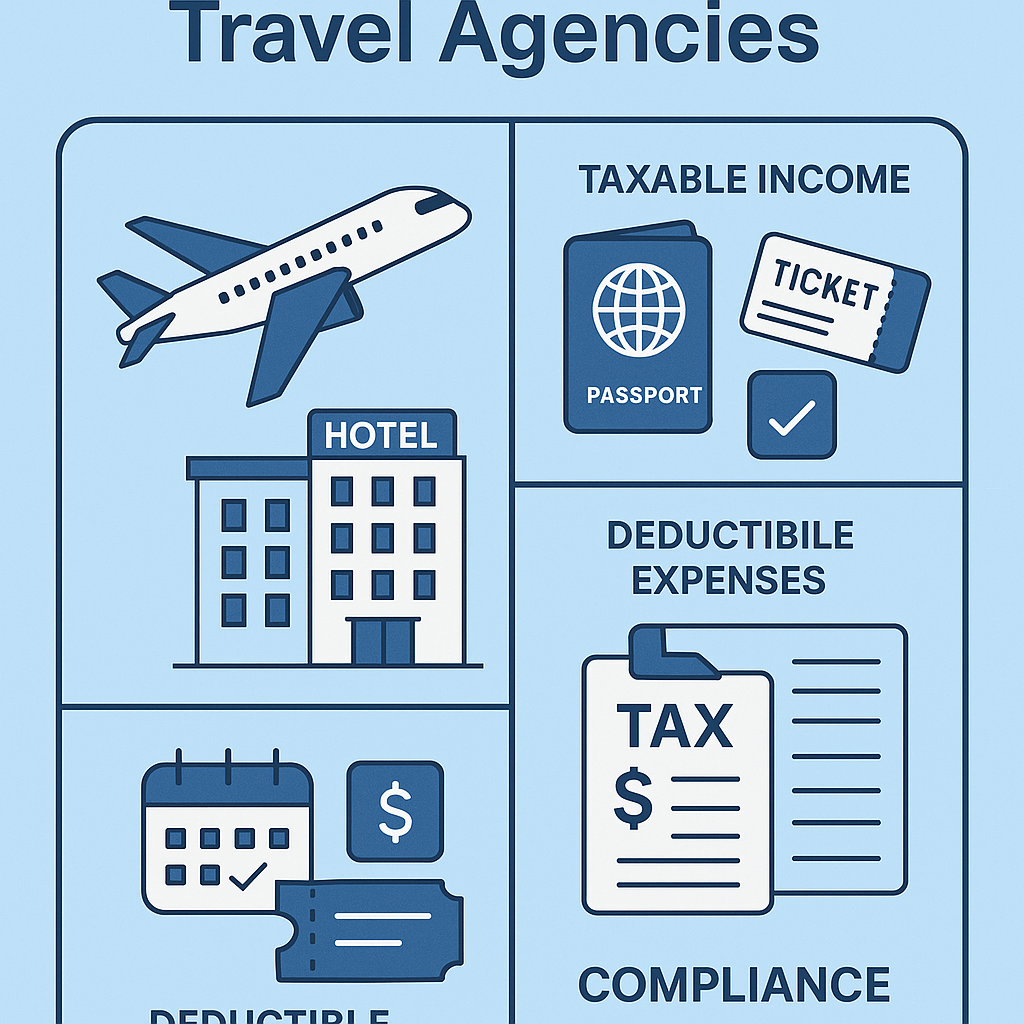
3. Taxable Income for Travel Agencies
Travel agencies have diverse income sources, all of which may be taxable:
• Commissions from airlines, hotels, and tour operators.
• Service Fees charged to clients for bookings and packages.
• Tourism Packages (domestic and international).
• Visa & Travel Documentation Fees.
• Corporate Travel Management Services.
• Online Booking Revenues for flights, hotels, and activities.
________________________________________
4. Deductible vs. Non-Deductible Expenses
Travel agencies must track operational expenses to optimize tax deductions.
• Deductible Expenses:
o Staff salaries and commissions.
o Office rent, utilities, and travel technology subscriptions.
o Marketing, promotions, and advertising.
o GDS (Global Distribution System) and online booking platform fees.
o Travel insurance and related professional expenses.
o Depreciation of office equipment and IT systems.
• Non-Deductible Expenses:
o Personal expenses.
o Regulatory fines or penalties.
o Certain entertainment costs unrelated to business.
________________________________________
5. VAT Compliance for Travel Agencies
Travel agencies must comply with UAE VAT in addition to Corporate Tax:
• Standard 5% VAT applies on most travel services sold in the UAE.
• Zero-Rated: International passenger transport and certain cross-border services.
• Exempt: Life insurance and certain financial services sold through travel agencies.
VAT reconciliation with Corporate Tax filings is critical to avoid mismatches during FTA audits.
________________________________________
6. Free Zone Opportunities for Travel Agencies
Some agencies operate within Free Zones like Dubai Tourism Cluster, DIFC, or DMCC:
• 0% Corporate Tax on qualifying income (cross-border or Free Zone-to-Free Zone services).
• Strategic access to global travel partners and networks.
• Substance Requirements: Firms must maintain a physical office, staff, and management in the UAE to qualify.
________________________________________
7. Transfer Pricing in Travel Groups
Large travel groups and franchises often operate multiple branches.
• Transfer Pricing (TP) rules apply to:
o Commissions and royalties for brand/franchise rights.
o Intercompany shared services (marketing, ticketing, customer support).
o Group financing arrangements.
• Firms must comply with the arm’s length principle and maintain TP documentation if thresholds apply.
________________________________________
8. Compliance Requirements for Travel Agencies
• Corporate Tax Registration with the Federal Tax Authority (FTA).
• Annual Tax Return submission within 9 months of the end of the financial year.
• VAT Filings (quarterly/monthly depending on turnover).
• Audited Financial Statements (mandatory for medium and large agencies).
• Record-Keeping: Invoices, contracts, ticketing reports, and GDS data must be maintained for 7 years.
________________________________________
9. Strategic Tax Planning for Travel Agencies
• Optimize Expense Deductions: Record staff commissions, office costs, and system fees accurately.
• Leverage Free Zone Benefits: Structure international booking operations through Free Zones for 0% Corporate Tax on qualifying income.
• Loss Relief: Carry forward tax losses to offset future taxable profits.
• Digital Transformation: Use ERP and booking platforms integrated with VAT and Corporate Tax compliance.
• Corporate Structuring: Group agencies under one entity to benefit from tax grouping or loss transfer provisions.
________________________________________
Conclusion
The introduction of Corporate Tax significantly impacts travel agencies in the UAE. With multiple income streams, international operations, and VAT implications, agencies must adopt robust tax planning and compliance frameworks.
By optimizing expense management, leveraging Free Zone opportunities, and maintaining accurate financial reporting, travel agencies can remain compliant while continuing to thrive in the UAE’s fast-growing tourism market.
________________________________________
✍️ By Sheikh Anwar Accounting and Auditing LLC (SA-Auditors)
📍 Dubai, United Arab Emirates
🌐 www.sa-auditors.com | ✉️ info@sa-auditors.com