Corporate Tax for Sole Establishments
Introduction
With the enforcement of Federal Decree-Law No. 47 of 2022 on the Taxation of Corporations and Businesses, sole establishments (also known as sole proprietorships) in the UAE are now subject to Corporate Tax—but with specific thresholds, exemptions, and treatment based on the nature and scale of their activities.
It explain the Corporate Tax implications for sole establishments, including tax rates, registration rules, exemptions, and compliance requirements.
________________________________________
🧾 What Is a Sole Establishment?
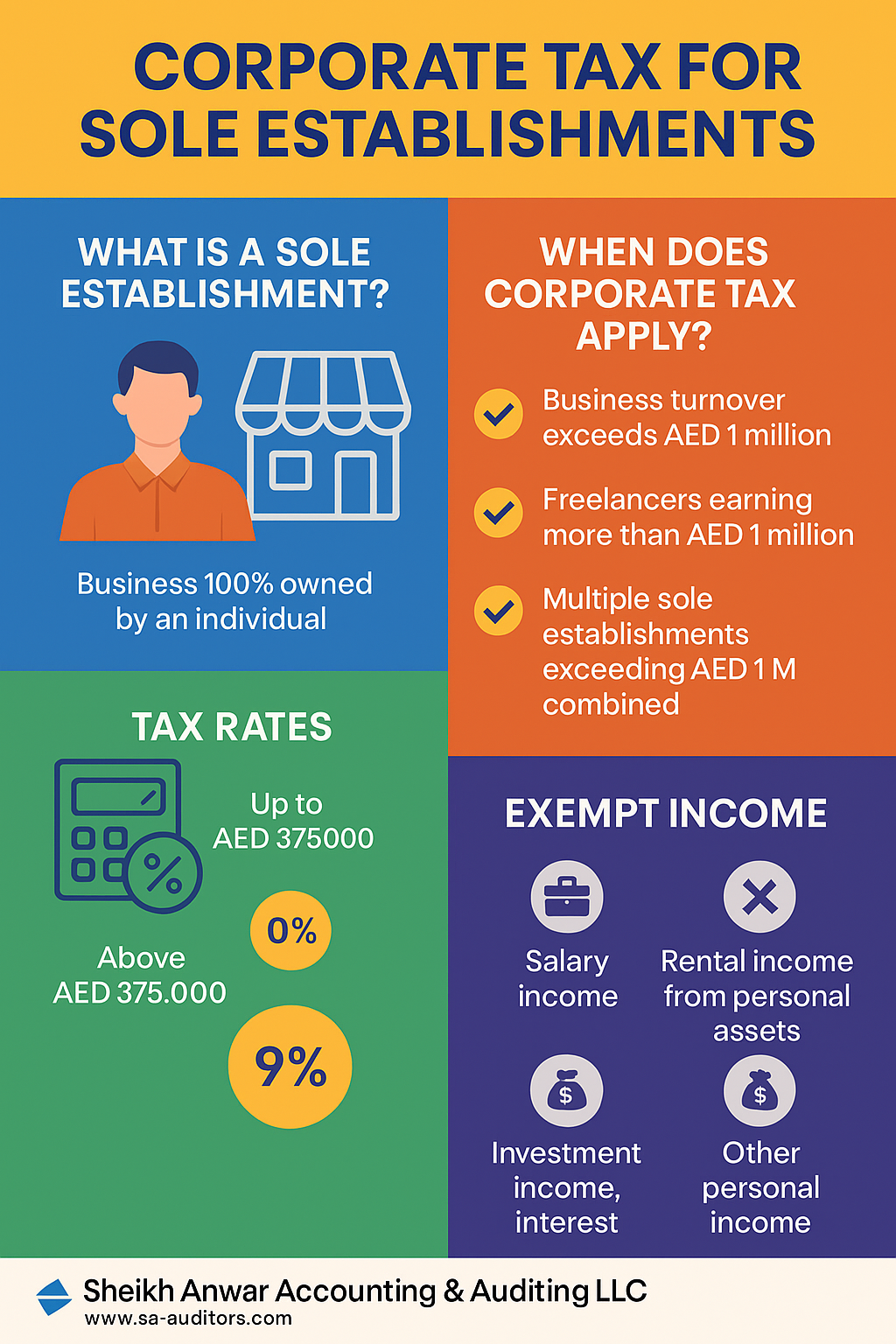
A sole establishment is a legal structure in which a single individual (natural person) owns 100% of the business. It is not a separate legal person from the owner.
Common examples include:
• Freelancers
• Small business owners
• Consultants
• Shops, salons, small traders, or service providers
In this model, the individual and the business are one and the same in legal and tax terms.
________________________________________
⚖️ Corporate Tax Treatment of Sole Establishments
According to Article 11 of the Corporate Tax Law:
• Natural persons conducting business in the UAE are subject to Corporate Tax only if their annual turnover exceeds AED 1 million.
• If multiple sole establishments are owned by the same individual, their combined turnover is assessed to determine taxability.
Important: Salary income, rental income from personal assets, investment income, and interest income are not subject to Corporate Tax for natural persons.
________________________________________
✅ When Does Corporate Tax Apply to Sole Establishments?
Situation Corporate Tax Applies?
Business turnover below AED 1 million ❌ No
Business turnover exceeds AED 1 million ✅ Yes
Freelancers earning more than AED 1 million ✅ Yes
Multiple sole establishments exceeding AED 1M combined ✅ Yes
________________________________________
💼 Tax Rates Applicable
Annual Net Income Corporate Tax Rate
Up to AED 375,000 0%
Above AED 375,000 9%
The AED 375,000 threshold applies to the net income (profits) of the sole establishment after deducting allowable business expenses.
________________________________________
📋 Corporate Tax Registration Requirements
If a sole establishment crosses the AED 1 million revenue threshold, the owner must:
1. Register for Corporate Tax through the FTA's EmaraTax platform
2. Obtain a Corporate Tax Registration Number (TRN)
3. File an annual Corporate Tax return
4. Pay Corporate Tax due (if net profits exceed AED 375,000)
________________________________________
🧾 Allowable Deductions
Sole establishments can deduct ordinary and necessary business expenses, such as:
• Office rent and utilities
• Marketing and professional services
• Salaries of employees (not the owner)
• Software and equipment
• Bank charges related to business
• Depreciation of business assets
Note: Personal expenses or owner’s salary are not deductible.
________________________________________
🛡️ Small Business Relief
Sole establishments may qualify for Small Business Relief under Article 21, if:
• Revenue is below AED 3 million in the current and previous tax periods
• They are resident persons (UAE nationals or residents)
• They are not part of a multinational group or Qualifying Free Zone Person
Benefit: Deemed as having no taxable income and can file a simplified return.
________________________________________
📆 Tax Period and Filing Deadlines
• The tax period is usually the calendar year (1 Jan to 31 Dec), unless otherwise approved.
• The Corporate Tax return must be filed within 9 months after the end of the tax period.
For example: If the tax period ends on 31 Dec 2024, the return is due by 30 Sep 2025.
________________________________________
❌ When Corporate Tax Does Not Apply
Corporate Tax does not apply to:
• Salaries and employment income
• Investment income from personal portfolios (shares, bonds)
• Bank deposit interest or savings account interest
• Rental income from personally owned real estate (if not conducted via license)
________________________________________
🧠 Example Scenarios
📌 Scenario 1: Freelance Designer
• Total revenue from freelance contracts: AED 800,000
• Not subject to Corporate Tax
📌 Scenario 2: Consultant with Sole Establishment
• Revenue: AED 1.5 million
• Net income: AED 600,000
• Corporate Tax due on AED 225,000 at 9% = AED 20,250
📌 Scenario 3: UAE national with 3 small shops
• Combined turnover: AED 3.2 million
• Eligible for Corporate Tax, but may opt for Small Business Relief (if 2024 revenue < AED 3 million)
________________________________________
📌 Summary Table
Criteria CT Liability
Turnover < AED 1M ❌ No
Turnover ≥ AED 1M ✅ Yes
Net Profit ≤ AED 375K 0% Rate
Net Profit > AED 375K 9% Rate
Revenue ≤ AED 3M (with conditions) May claim Small Business Relief
Non-business income (e.g., salary) ❌ Not taxable
________________________________________
🧠 How Sheikh Anwar Accounting & Auditing LLC Can Help
We assist sole establishment owners in:
✅ Evaluating Corporate Tax applicability
✅ Registration and TRN application
✅ Income segregation and deduction planning
✅ Filing CT returns
✅ Small Business Relief application
Let us help you stay compliant, efficient, and stress-free under the UAE Corporate Tax regime.
________________________________________
📞 Contact Us
📍 Sheikh Anwar Accounting & Auditing LLC
🌐 www.sa-auditors.com
📧 info@sa-auditors.com
📞 +971-XX-XXX-XXXX