Corporate Tax for Shipping & Logistics Firms
Introduction
The UAE is a global logistics hub, home to world-class ports, airports, and free zones such as JAFZA, KIZAD, and Dubai South, making it one of the busiest centers for shipping, freight forwarding, and logistics. With the introduction of the UAE Corporate Tax (Federal Decree-Law No. 47 of 2022), shipping and logistics firms must evaluate how taxation impacts their freight operations, warehousing services, and cross-border contracts.
As the sector involves high-value transactions, cross-border services, and multinational networks, effective tax planning and compliance are vital to maintain competitiveness and profitability.
________________________________________
1. Applicability of Corporate Tax in Shipping & Logistics
• Mainland Companies: Fully subject to Corporate Tax on worldwide income (except exempt income).
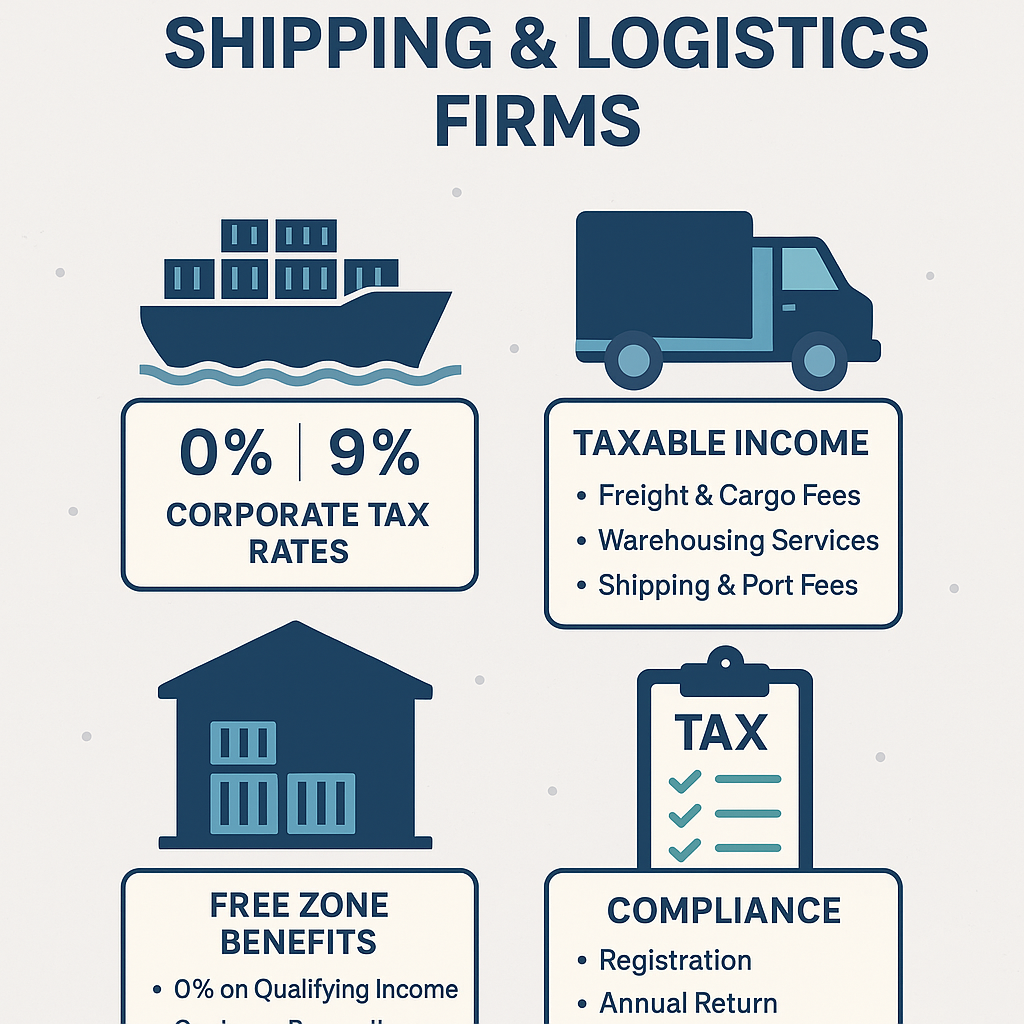
• Free Zone Companies: May benefit from 0% Corporate Tax on qualifying income (e.g., cross-border services, Free Zone-to-Free Zone transactions). Income from mainland clients is generally subject to 9% Corporate Tax.
• Foreign Shipping Companies: Taxable if they have a permanent establishment (PE) in the UAE, such as an office, depot, warehouse, or dependent agent.
________________________________________
2. Corporate Tax Rates for Shipping & Logistics Firms
• 0% on taxable income up to AED 375,000.
• 9% on taxable income above AED 375,000.
• Free Zone Operators: 0% Corporate Tax on qualifying income (cross-border logistics, Free Zone services), 9% on mainland UAE services.
________________________________________
3. Taxable Income in Shipping & Logistics
Revenue streams for logistics and shipping firms include:
• Freight & Cargo Handling Fees.
• Warehousing & Storage Services.
• Customs Brokerage & Documentation Charges.
• Shipping & Port Service Fees.
• Third-Party Logistics (3PL) & Distribution Contracts.
• Value-Added Services such as packaging, consolidation, and cold storage.
All such income is taxable unless specifically exempt.
________________________________________
4. Deductible vs. Non-Deductible Expenses
Shipping and logistics companies have significant operational costs.
• Deductible Expenses:
o Salaries of staff and port workers.
o Fuel, transport, and fleet maintenance.
o Warehousing costs (rent, utilities, depreciation).
o Insurance for cargo and assets.
o Port charges, customs, and clearance expenses.
o Technology systems (ERP, tracking software).
• Non-Deductible Expenses:
o Regulatory fines and penalties.
o Personal or unrelated expenses.
o Certain excessive entertainment costs.
________________________________________
5. VAT Implications in Shipping & Logistics
• Standard 5% VAT applies on most domestic logistics services.
• Zero-Rated: International transport of goods and exports of services.
• Exempt: Certain passenger transport services.
• Reverse Charge Mechanism (RCM): Applies to imported freight and logistics services.
VAT compliance must align with Corporate Tax records for consistency.
________________________________________
6. Free Zone Benefits for Shipping & Logistics Firms
Many logistics firms are based in Free Zones such as JAFZA, KIZAD, and Dubai South, offering:
• 0% Corporate Tax on qualifying cross-border income.
• Customs duty exemptions for re-exports.
• Strategic access to ports, airports, and bonded warehouses.
• Substance Requirements: Must maintain offices, warehouses, and management presence in the UAE.
________________________________________
7. Transfer Pricing in Global Logistics Groups
Shipping and logistics are often managed by multinational groups with multiple subsidiaries.
• Transfer Pricing (TP) rules apply to:
o Intercompany shipping contracts.
o Shared logistics hubs and warehouses.
o Cost-sharing for fleet and technology.
• Firms must comply with the arm’s length principle and prepare TP documentation (Local File, Master File, Benchmarking) if thresholds are met.
________________________________________
8. Compliance Requirements for Shipping & Logistics Firms
• Corporate Tax Registration with the Federal Tax Authority (FTA).
• Annual Corporate Tax Return within 9 months of financial year-end.
• VAT Returns (quarterly or monthly).
• Audited Financial Statements required for most medium and large companies.
• Record-Keeping: Invoices, contracts, freight documents, and customs declarations for at least 7 years.
________________________________________
9. Strategic Tax Planning for Shipping & Logistics
• Leverage Free Zone Benefits for global cargo operations.
• Optimize Expense Deductions for fuel, warehousing, and fleet depreciation.
• Use Loss Relief to carry forward operational losses.
• ERP & Technology Adoption to integrate cargo management with tax compliance.
• Cross-Border Structuring to minimize PE risks for international partners.
________________________________________
Conclusion
The UAE’s Corporate Tax framework brings new obligations for shipping and logistics firms, but also opportunities for structuring efficiency. With complex supply chains and global operations, businesses must carefully align freight revenue, VAT compliance, and Free Zone benefits with Corporate Tax rules.
By adopting proactive tax planning, technology integration, and robust compliance systems, shipping and logistics companies can maintain competitiveness in the UAE’s world-class trade ecosystem.
________________________________________
✍️ By Sheikh Anwar Accounting and Auditing LLC (SA-Auditors)
📍 Dubai, United Arab Emirates
🌐 www.sa-auditors.com | ✉️ info@sa-auditors.com