Corporate Tax for Professional Freelancers
Introduction
The UAE has become a global hub for freelancers and independent professionals, offering flexible business licenses in Free Zones and mainland structures. From consultants, IT specialists, and designers to legal, tax, and training professionals, freelancing has grown rapidly in recent years.
With the introduction of the UAE Corporate Tax (Federal Decree-Law No. 47 of 2022), freelancers must now assess how this regime affects their earnings, expenses, and compliance requirements. While Corporate Tax primarily applies to companies, freelancers operating under licenses are also considered taxable persons if they earn income from business activities.
________________________________________
1. Applicability of Corporate Tax to Freelancers
• Freelancers with Trade/Professional Licenses: Income earned under a Free Zone or mainland license is subject to Corporate Tax.
• Self-Employed Individuals Without a License: Informal freelancing income may still be treated as business income if carried out in a continuous manner.
• Foreign Freelancers: Those working remotely for UAE clients may be taxable if they have a permanent establishment (PE) or fixed base in the UAE.
________________________________________
2. Corporate Tax Rates for Freelancers
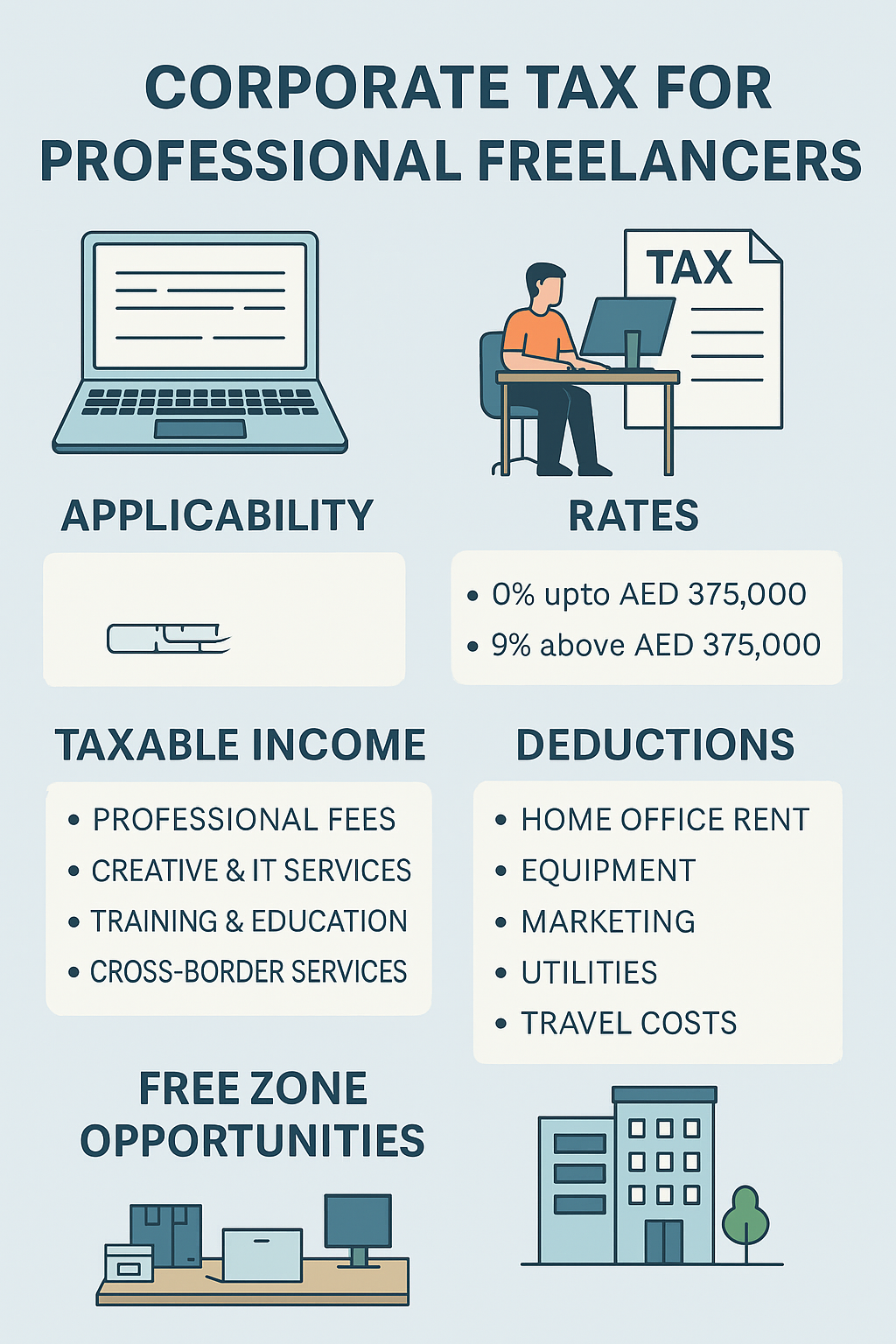
• 0% on taxable income up to AED 375,000.
• 9% on taxable income above AED 375,000.
• Free Zone Freelancers: May qualify for 0% Corporate Tax on qualifying income if registered as a Qualifying Free Zone Person (QFZP), provided they meet economic substance requirements.
________________________________________
3. Taxable Income for Freelancers
Freelancers generate diverse income streams, which may include:
• Professional Fees – consulting, advisory, or technical services.
• Creative & IT Services – web development, graphic design, social media, software solutions.
• Training & Education – online courses, coaching, and certifications.
• Cross-Border Services – providing services to foreign clients (depending on nexus rules).
All such income must be aggregated to determine taxable profits.
________________________________________
4. Deductible and Non-Deductible Expenses
Freelancers can deduct business-related expenses to reduce taxable income.
• Deductible Expenses:
o Home office rent or co-working space charges.
o Laptop, software, and internet costs.
o Professional subscriptions and certifications.
o Marketing, website hosting, and advertising.
o Travel costs linked to client work.
• Non-Deductible Expenses:
o Personal living costs (rent, groceries, school fees).
o Fines or penalties.
o Non-business related travel and leisure.
________________________________________
5. Free Zone Opportunities for Freelancers
Many freelancers operate in Free Zones such as DIFC, ADGM, Dubai Media City, or Sharjah Research Park, which issue freelance permits.
• 0% Corporate Tax on qualifying cross-border income.
• Income from mainland UAE clients is usually taxed at 9% Corporate Tax.
• Freelancers must maintain economic substance by having a registered office or workspace, proper contracts, and local management.
________________________________________
6. Transfer Pricing and Cross-Border Freelancers
Freelancers who are part of international groups (e.g., providing services to related companies abroad) may fall under Transfer Pricing (TP) rules.
• Transactions with related parties must follow the arm’s length principle.
• In most cases, freelancers working independently will not have large TP obligations, but international consultants linked to corporate structures must comply.
________________________________________
7. Compliance Requirements for Freelancers
• Registration: All freelancers earning taxable income must register for Corporate Tax with the FTA.
• Annual Tax Returns: Must be filed within 9 months of the end of the tax year.
• Record-Keeping: Maintain contracts, invoices, receipts, and expense records for 7 years.
• Audited Financial Statements: Generally not mandatory for small freelancers, but highly recommended for transparency and loan/visa applications.
________________________________________
8. Strategic Tax Planning for Freelancers
• Expense Management: Maximize deductions by properly recording professional costs.
• Free Zone Choice: Choose a Free Zone license strategically to benefit from 0% Corporate Tax on qualifying income.
• Revenue Threshold Planning: Monitor income around the AED 375,000 threshold for effective tax planning.
• Technology Integration: Use cloud accounting tools to manage invoices, expenses, and compliance seamlessly.
• Professional Structuring: Consider setting up a small company to separate personal and business income for clarity.
________________________________________
Conclusion
The UAE’s Corporate Tax regime now extends to freelancers, requiring them to adopt a more structured approach to income reporting, expense management, and compliance. While the 9% rate remains globally competitive, freelancers must ensure they register, file returns, and maintain proper records to avoid penalties.
With the right planning — especially through Free Zone opportunities and professional expense management — freelancers can remain compliant while protecting their profits.
________________________________________
✍️ By Sheikh Anwar Accounting and Auditing LLC (SA-Auditors)
📍 Dubai, United Arab Emirates
🌐 www.sa-auditors.com | ✉️ info@sa-auditors.com