Corporate Tax for Non-Profit Institutions
Introduction
Non-profit institutions, such as charities, foundations, and professional associations, play a crucial role in supporting communities and advancing social causes in the UAE. With the implementation of UAE Corporate Tax (Federal Decree-Law No. 47 of 2022), questions have arisen regarding whether and how non-profit organizations fall under the scope of taxation.
While non-profits are generally not established for profit-making purposes, their income sources, organizational structure, and licensing status determine their Corporate Tax obligations.
________________________________________
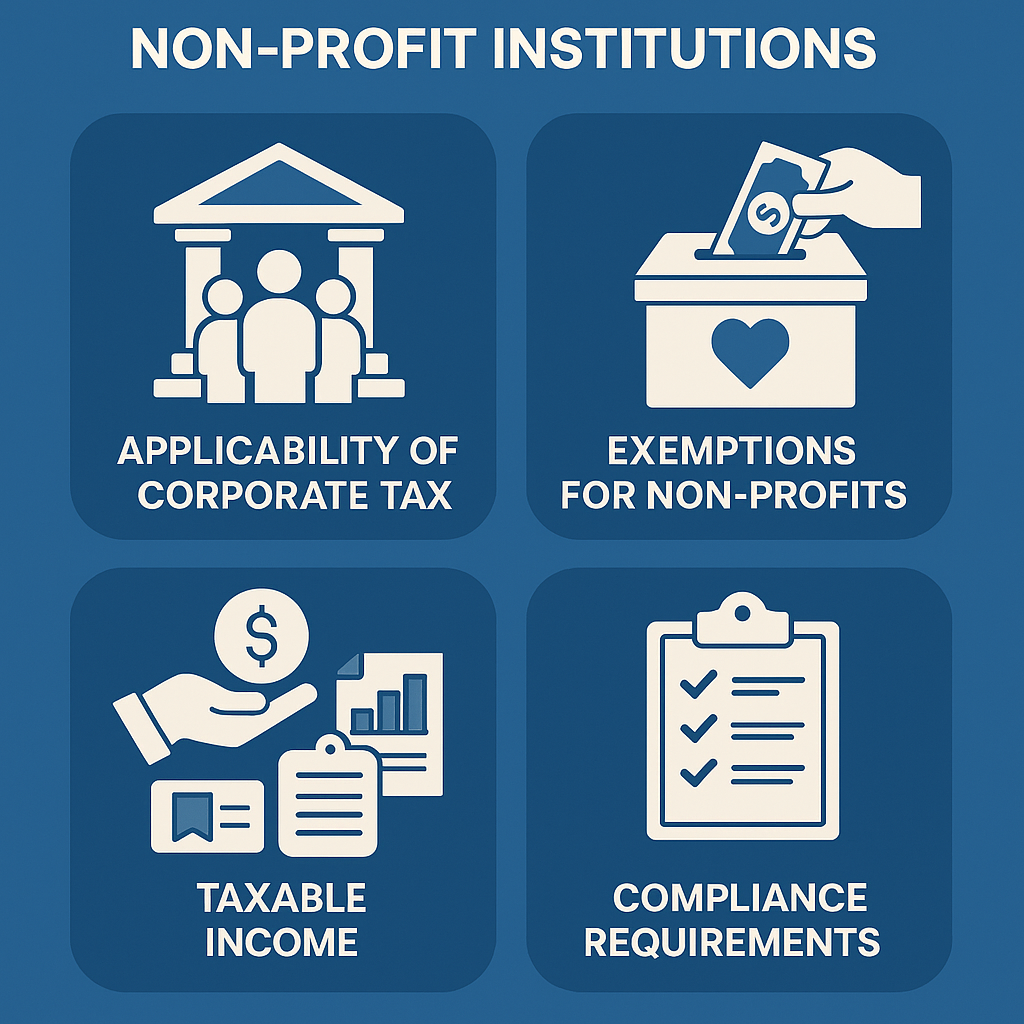
1. Applicability of Corporate Tax to Non-Profits
• Non-Profit Organizations Recognized by Law: Charities, societies, and public benefit organizations approved by the UAE Cabinet or Ministry of Community Development may be exempt from Corporate Tax.
• Foundations & Endowments: May also be exempt if established under specific legal frameworks.
• Professional Associations & Clubs: If engaged in business-like activities (training, events, services for fees), their income may be taxable.
• Unregistered or Informal Non-Profits: If not recognized by the government, they may be treated as regular taxable entities.
________________________________________
2. Corporate Tax Rates
For non-profit institutions that are subject to tax:
• 0% on taxable income up to AED 375,000.
• 9% on taxable income above AED 375,000.
• Exempt entities, once listed by the UAE Cabinet, are not required to pay Corporate Tax but must comply with reporting requirements.
________________________________________
3. Taxable Income for Non-Profits
Even non-profits may generate taxable income if they engage in certain activities:
• Membership Fees & Subscriptions (if linked to services provided).
• Training & Certification Programs.
• Commercial Activities (such as operating a café, bookstore, or event services).
• Rental Income from property owned by the organization.
• Sponsorships or Advertising Revenue.
Pure donations and grants used for charitable purposes are typically not taxable if the entity is registered as exempt.
________________________________________
4. Deductible vs. Non-Deductible Expenses
For non-profits subject to Corporate Tax, expense deductions can reduce taxable income.
• Deductible Expenses:
o Salaries and administrative costs.
o Rent and utilities.
o Program-related expenses (training, education, charity initiatives).
o Depreciation of equipment and office facilities.
o Marketing and outreach campaigns.
• Non-Deductible Expenses:
o Fines and penalties.
o Personal or unrelated expenses.
o Political contributions not permitted by law.
________________________________________
5. Exemptions for Non-Profits
The Corporate Tax Law provides exemptions for:
• Public Benefit Entities approved by the Cabinet.
• Charitable Institutions registered under UAE law.
• Foundations & Endowments recognized under applicable laws.
• Government-Owned Social Enterprises operating for community benefit.
To qualify, non-profits must apply for approval and maintain compliance with reporting and transparency requirements.
________________________________________
6. VAT Implications for Non-Profits
• Standard 5% VAT: Applies to commercial services provided by non-profits (training, ticketed events).
• Zero-Rated or Exempt: Certain charitable activities may be VAT exempt, particularly where donations are made without consideration.
• VAT registration may still be required if taxable turnover exceeds the threshold (AED 375,000 annually).
________________________________________
7. Compliance Requirements
Non-profits, whether exempt or taxable, must comply with regulatory obligations:
• Corporate Tax Registration with the FTA (even exempt entities may need to register for monitoring purposes).
• Annual Returns: Filing may be required, even for exempt organizations, to demonstrate compliance.
• Audited Financial Statements: Often mandatory for transparency.
• Record-Keeping: Maintain accounts, receipts, and donation records for 7 years.
________________________________________
8. Strategic Tax Planning for Non-Profits
• Apply for Exempt Status: Ensure recognition as a public benefit entity to avoid Corporate Tax liability.
• Separate Commercial & Non-Profit Activities: Maintain separate accounts for charitable and business-related activities.
• Optimize Expense Deductions: For taxable activities, maximize allowable deductions.
• Compliance Culture: Strengthen financial reporting and audit readiness.
• Leverage Free Zone Benefits: Some non-profits registered in Free Zones may enjoy operational and cost advantages.
________________________________________
Conclusion
Corporate Tax in the UAE brings a new compliance framework for non-profits, requiring clarity on their income sources and recognition status. While many charitable and public benefit organizations are exempt, professional associations, training providers, and non-profits engaged in commercial activities may fall under Corporate Tax obligations.
By applying for exemptions, maintaining transparency, and aligning operations with UAE regulations, non-profits can continue to focus on their mission while staying fully compliant with the law.
________________________________________
✍️ By Sheikh Anwar Accounting and Auditing LLC (SA-Auditors)
📍 Dubai, United Arab Emirates
🌐 www.sa-auditors.com | ✉️ info@sa-auditors.com