Corporate Tax for Law Firms
Introduction
Law firms in the UAE play a vital role in supporting businesses, individuals, and institutions with legal services. With the introduction of Corporate Tax (Federal Decree-Law No. 47 of 2022), law firms, like other professional service providers, are now within the scope of taxation.
Whether structured as partnerships, sole establishments, or incorporated legal entities, law firms must carefully assess their tax obligations, income sources, and compliance requirements under the new regime.
________________________________________
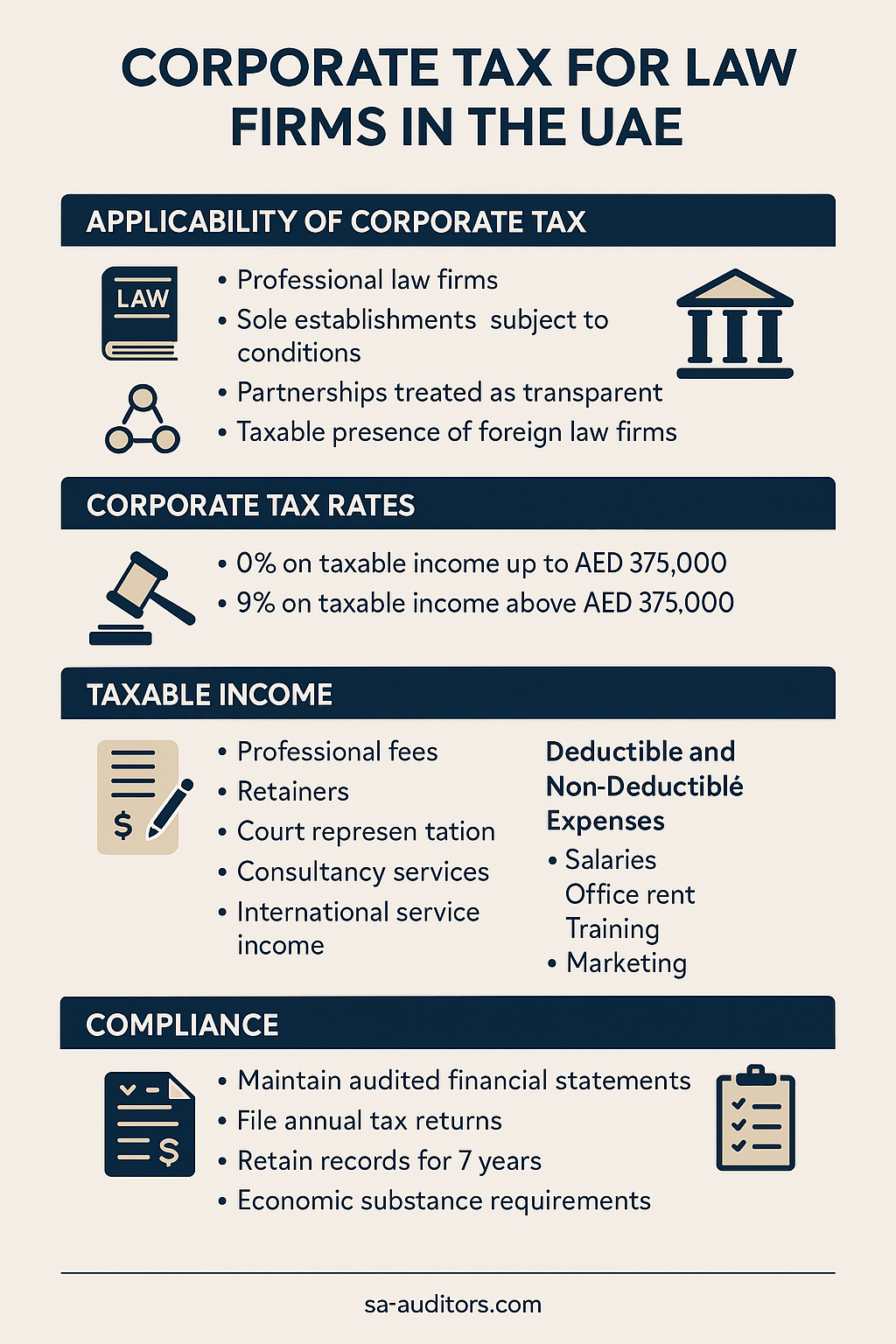
1. Applicability of Corporate Tax to Law Firms
• Professional Firms: Law firms registered as companies in the UAE are subject to Corporate Tax.
• Sole Establishments: The income of sole practitioners may be taxed at the individual level if considered business income.
• Partnerships: Treated as “transparent” for tax purposes unless incorporated as a separate legal entity.
• Foreign Law Firms: Branches of international firms with operations in the UAE are taxable on their UAE-sourced income.
________________________________________
2. Corporate Tax Rates for Law Firms
• 0% on taxable income up to AED 375,000.
• 9% on taxable income above AED 375,000.
• Free Zone Law Firms: May qualify for 0% tax on “qualifying income” if economic substance requirements are met. However, income earned from providing services to mainland clients is subject to 9% Corporate Tax.
________________________________________
3. Taxable Income in Law Firms
Taxable income for law firms generally includes:
• Professional Fees for legal advice, drafting, litigation, and arbitration.
• Retainers & Advisory Contracts with corporate clients.
• Court Representation Fees and related charges.
• Consultancy & Compliance Services, e.g., AML, corporate structuring, and regulatory advisory.
• International Service Income, subject to nexus and permanent establishment rules.
________________________________________
4. Deductible and Non-Deductible Expenses
Like other service-based businesses, law firms incur substantial operational costs.
• Deductible Expenses:
o Staff salaries and partner remuneration (if structured under firm policy).
o Office rent, utilities, and administrative costs.
o Professional development and training costs.
o Marketing and client acquisition expenses.
o Depreciation of IT equipment, furniture, and legal resources.
• Non-Deductible Expenses:
o Fines and penalties imposed by regulators or courts.
o Personal expenses disguised as business costs.
o Certain entertainment costs outside the allowed thresholds.
________________________________________
5. Free Zone Considerations for Law Firms
Law firms located in Free Zones such as DIFC, ADGM, or DMCC benefit from proximity to international clients and arbitration centers.
• If classified as a Qualifying Free Zone Person (QFZP), they may enjoy 0% Corporate Tax on cross-border or Free Zone-to-Free Zone services.
• Mainland client income, however, will likely attract 9% Corporate Tax.
• Maintaining substance (employees, premises, governance) in the Free Zone is mandatory.
________________________________________
6. Transfer Pricing and Related-Party Transactions
Larger law firms, particularly international networks, often share resources across jurisdictions.
• Transfer Pricing rules apply to related-party services, management fees, and cost-sharing arrangements.
• Firms must follow the arm’s length principle and prepare documentation such as:
o Local File & Master File (if revenue thresholds are met).
o Benchmarking studies for intercompany pricing.
________________________________________
7. Compliance Requirements for Law Firms
Law firms must meet the following compliance obligations under UAE Corporate Tax Law:
• Maintain audited financial statements (mandatory for most firms).
• File annual Corporate Tax returns within 9 months of the financial year-end.
• Keep records for at least 7 years, including client fee agreements, invoices, and expense records.
• Economic Substance: Demonstrate actual management and decision-making in the UAE.
________________________________________
8. Strategic Tax Planning for Law Firms
• Optimize Remuneration Structures: Align partner draws and staff salaries to ensure clarity in deductible expenses.
• Leverage Free Zone Status: Where possible, structure services to qualify for 0% tax on cross-border work.
• Cost Allocation: Segregate non-deductible costs to avoid disallowances.
• Loss Relief: Carry forward tax losses to offset against future taxable profits.
• ERP & Accounting Systems: Implement systems that integrate VAT and Corporate Tax compliance for streamlined reporting.
________________________________________
Conclusion
The introduction of Corporate Tax in the UAE marks a significant regulatory shift for law firms. Professional service firms must now adapt to profit-based taxation, enhanced record-keeping, and international compliance standards.
By preparing audited accounts, optimizing expense management, and leveraging Free Zone opportunities, law firms can ensure compliance while maintaining profitability.
________________________________________
✍️ By Sheikh Anwar Accounting and Auditing LLC (SA-Auditors)
📍 Dubai, United Arab Emirates
🌐 www.sa-auditors.com | ✉️ info@sa-auditors.com