Corporate Tax for Health Clinics & Hospitals
Introduction
The healthcare industry is a cornerstone of the UAE’s economy, serving residents and medical tourists alike. With the introduction of the UAE Corporate Tax (Federal Decree-Law No. 47 of 2022), health clinics, hospitals, and other medical service providers must now comply with new tax obligations while balancing patient care and financial sustainability.
As healthcare institutions often operate with high capital expenditure, specialized staff costs, and regulated service fees, tax planning is essential to safeguard profitability and ensure compliance.
________________________________________
1. Applicability of Corporate Tax in Healthcare
• Mainland Health Clinics & Hospitals: Fully subject to Corporate Tax at standard rates.
• Free Zone Medical Facilities: May qualify for 0% Corporate Tax on certain qualifying income, but services to mainland patients are taxed at 9%.
• Foreign Medical Groups: Taxable if they have a permanent establishment (PE) in the UAE (e.g., a branch or affiliated hospital).
• Government-Owned Hospitals: May be exempt depending on FTA classification.
________________________________________
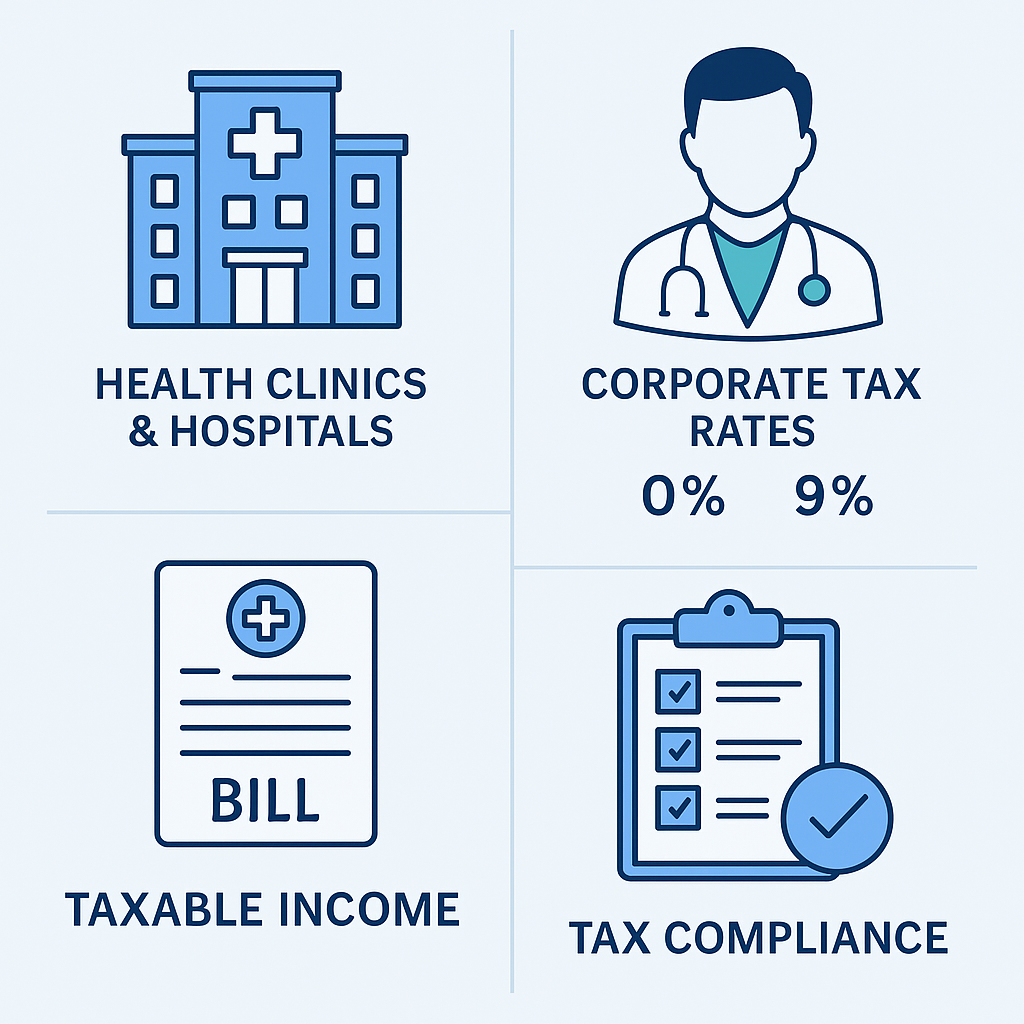
2. Corporate Tax Rates for Healthcare Providers
• 0% on taxable income up to AED 375,000.
• 9% on taxable income above AED 375,000.
• Free Zone Healthcare Providers: 0% Corporate Tax on qualifying cross-border or Free Zone-to-Free Zone activities, 9% on mainland patient revenue.
________________________________________
3. Taxable Income in Clinics & Hospitals
Healthcare businesses have diverse income sources, all of which are taxable unless exempt:
• Consultation Fees (GPs, specialists, surgeons).
• Diagnostic Services (labs, radiology, pathology).
• Inpatient & Outpatient Services.
• Pharmacy Income within hospital premises.
• Insurance Claim Settlements.
• Medical Tourism Packages.
________________________________________
4. Deductible vs. Non-Deductible Expenses
Healthcare providers incur significant operational costs.
• Deductible Expenses:
o Salaries and staff benefits for doctors, nurses, and admin staff.
o Rent, utilities, and maintenance of clinics/hospitals.
o Medical equipment depreciation.
o Consumables (medicines, gloves, PPE).
o Insurance (malpractice, property, liability).
o Training and CME (Continuing Medical Education) costs.
• Non-Deductible Expenses:
o Regulatory fines or penalties.
o Personal or non-business expenses.
o Certain entertainment costs not related to business.
________________________________________
5. VAT Compliance in Healthcare
• Exempt Supplies: Basic healthcare services and medicines approved by UAE authorities.
• Zero-Rated: Exports of healthcare services (if conditions met).
• Standard-Rated (5%): Cosmetic procedures not medically required, certain non-essential services.
Hospitals and clinics must reconcile VAT with Corporate Tax filings for accuracy.
________________________________________
6. Free Zone Benefits for Healthcare Facilities
Some Free Zones such as Dubai Healthcare City (DHCC), ADGM, and DIFC attract medical businesses with favorable structures.
• 0% Corporate Tax on qualifying income (e.g., cross-border services, Free Zone collaborations).
• 9% on mainland services.
• Substance requirements must be met: offices, staff, and governance in UAE.
________________________________________
7. Transfer Pricing in Healthcare Groups
Healthcare groups with multiple branches or international affiliations often share resources.
• Transfer Pricing rules apply to:
o Intercompany service charges (e.g., shared doctors, lab facilities).
o Royalty fees for brand/franchise rights.
o Medical equipment leasing between group entities.
• Firms must comply with the arm’s length principle and maintain Local File, Master File, and Benchmarking studies if required.
________________________________________
8. Compliance Requirements for Clinics & Hospitals
• Corporate Tax Registration with FTA.
• Annual Corporate Tax Return filed within 9 months of financial year-end.
• Audited Financial Statements mandatory for medium and large providers.
• Record-Keeping: Patient billing records, insurance claims, contracts, and expenses must be retained for 7 years.
________________________________________
9. Strategic Tax Planning for Healthcare Providers
• Optimize Expense Deductions by recording all allowable operational costs.
• Use Free Zone Structures for cross-border medical services.
• Leverage Loss Relief to carry forward and offset future profits.
• Depreciation Planning for expensive medical equipment.
• ERP & Compliance Systems to integrate VAT + Corporate Tax with hospital billing.
________________________________________
Conclusion
The UAE Corporate Tax regime brings new compliance obligations for the healthcare industry, impacting clinics, hospitals, and medical groups. While the 9% tax rate is globally competitive, providers must ensure robust accounting, VAT reconciliation, and Transfer Pricing compliance.
By adopting strategic tax planning, leveraging Free Zone incentives, and managing expenses efficiently, healthcare providers can remain compliant while continuing to deliver world-class medical care in the UAE.
________________________________________
✍️ By Sheikh Anwar Accounting and Auditing LLC (SA-Auditors)
📍 Dubai, United Arab Emirates
🌐 www.sa-auditors.com | ✉️ info@sa-auditors.com